

Best Desk Organizers for a Productive Work Desk
A desk organizer gives frequently used tools a defined home and protects the clear working area needed for a keyboard, mouse, notebook, or creative task. The useful question is not how many compartments you can buy, but which few categories need faster access during a normal workweek.
Based on our conversations with regular Sesoris customers, organization problems are usually solved not by buying more, but by rearranging what's already there.

This article provides a comprehensive guide on how to choose the best desk organizer - from types and materials to effective desk arrangement tips. Whether you work from an office or home office, this guide will help you create a workspace that supports maximum productivity.
Key Takeaways: > - Audit the tools you use each week before choosing compartments > - Protect keyboard, mouse, writing, and device space before adding desktop storage > - Use trays for a small daily kit, drawers for small supplies, and vertical organizers for paper > - Compare capacity and relative cost in the Sesoris desk organizer buying guide
Why is Desk Organizer Important for Productivity?
A messy work desk creates extra search and reset steps whenever tools do not have a defined location. A simple organizer can reduce that friction, but only when its layout follows the work you actually perform. For additional setup ideas, see the Sesoris home office organization guide.
Impact of a Messy Desk
- Reduced focus - your brain is constantly distracted by items unrelated to your work
- Increased stress - visual clutter triggers cortisol, a hormone that raises stress levels
- Wasted movement - scattered tools add avoidable search and reset steps during the day
- Decreased creativity - a cluttered mind from a messy environment struggles to generate fresh ideas
- Unprofessional appearance - for online meetings, a messy desk background gives an impression of incompetence
Benefits of Investing in a Desk Organizer
Desk organizer helps provide a designated space for each item, reduce visual clutter on your desk surface, speed up access to needed tools, and create a more structured work routine.
Types of Desk Organizers Based on Function
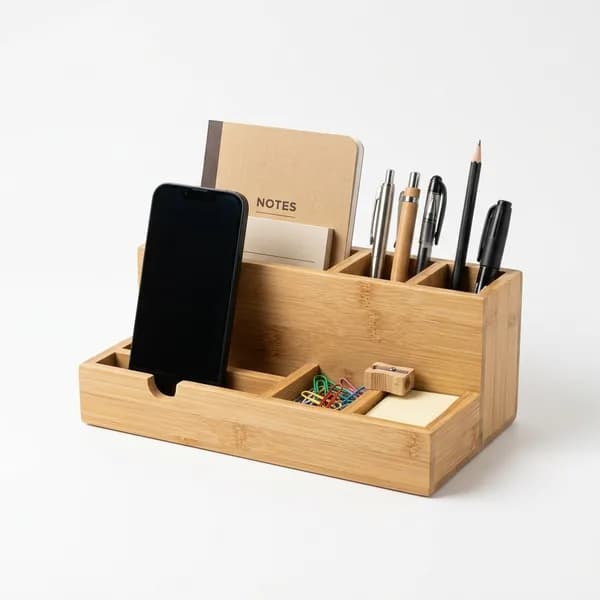
1. Multifunctional Desktop Organizer
This type combines several compartments in one unit - a pen holder, slots for paper, small drawers, and sometimes a phone holder. Perfect for standard-sized desks that need an all-in-one solution. Materials are typically wood, bamboo, or premium plastic. For additional information, also see the guide from Real Simple.
2. Monitor Stand with Storage
A monitor stand equipped with drawers or storage compartments underneath. Besides organizing your desk, it also raises the monitor to eye level for better ergonomics and neck and eye health. Very efficient as it uses the space below the monitor that's usually empty.
3. Drawer Organizer
Inserts or dividers installed inside desk drawers to divide space into smaller compartments. Prevents small items like clips, staplers, and USB drives from mixing into one messy pile.
4. Cable Management Box
A special box for organizing charger cables, adapters, and computer cables that usually clutter the space under or on top of your desk. Desk organizer of this type is often overlooked, yet tangled cables are the number one source of visual clutter on modern work desks.
5. Wall-Mounted Organizer
Installed on the wall above your desk to free up desk surface space. Includes pegboards, magnetic boards, and small floating shelves. Perfect for small work desks in dorms or apartments.
6. Portable Desk Caddy
An organizer that can be easily moved, ideal for those without a fixed work desk or who frequently change work locations. Usually shaped like a box or tote with handles and multiple compartments.
Comparison of Desk Organizer Materials
Desk organizer material affects the appearance, durability, and overall impression of your work desk:
| Material | Appearance | Durability | Relative Cost | Maintenance | Best For |
|---|---|---|---|---|---|
| Bamboo | Natural, warm | High | Medium | Wipe with damp cloth | Home office, Japandi style |
| Wood composite | Elegant, varied | Medium | Low to medium | Avoid moisture | Formal office, WFH |
| ABS plastic | Modern, varied colors | Medium | Low | Easy to clean | Kids' desks, tight budget |
| Metal mesh | Industrial, premium | High | Medium | Keep dry and wipe clean | Industrial style, office |
| Synthetic leather | Luxurious, professional | Medium | Medium | Dry wipe | Executive desk |
| Acrylic | Transparent, modern | Medium | Medium | Soft cloth | Minimalist desk |
For a home office with minimalist style, bamboo or acrylic materials are the most versatile choices. For a formal office, synthetic leather gives a strong professional impression.
How to Choose the Right Desk Organizer
Choosing the right desk organizer isn't just about appearance - follow these steps to find the perfect fit:
Step 1 - Audit Your Work Desk
Remove all items from your desk and drawers. Group them into three categories: items used daily, items used weekly, and items rarely used. The third category should be stored elsewhere - not on your work desk.
Step 2 - Measure Available Space
Measure the width, depth, and height of your work desk. Leave at least 60% of desk surface for active work area. Desk organizer should occupy a maximum of 40% of your desk area to keep a comfortable workspace.
Step 3 - Identify Main Problems
Is your main issue tangled cables, scattered supplies, stacked documents, or a combination? Identifying specific problems will help you choose the right type of organizer.
Step 4 - Match Your Interior Style
Your desk organizer will be a visual part of your work desk every day. Choose one that matches your work space's interior style. Bamboo or wood for warm vibes, metal for industrial, acrylic for modern minimalist.
Tips for Organizing Your Desk with Desk Organizer
Having a desk organizer alone isn't enough - how you arrange it determines its effectiveness. Here are desk organization principles proven to boost productivity:
Efficient Work Zones
Divide your desk into zones based on activities. The main zone in front of you for your laptop or monitor. The right or left zone (depending on your dominant hand) for supplies and frequently used items. The back or side zone for supporting items.
Clear Desk Rule
Practice cleaning your desk at the end of each work day. Return all items to their organizer, discard trash, and tidy up documents. With the right desk organizer, this process takes only 3-5 minutes and lets you start fresh the next day.
Cable Management
Cables are the biggest enemy of a tidy desk. Use a cable management tray under your desk to hide cables and power strips. Cable clips on desk edges keep charger cables in place. Velcro ties bundle multiple cables neatly.
- Dominant hand - place frequently used items on your dominant hand side
- Minimize movement - the more often an item is used, the closer it should be
- One in, one out - each time you add a new item to your desk, remove an old one
Desk Organizers for Different Professions
- Content creators and designers - choose organizers with compartments for tablet stylus, SD cards, hard drives, and headphones. A monitor stand with USB hub is very useful
- Accountants and admin staff - prioritize tiered document trays, stamp holders, and supply drawers
- Programmers and developers - focus on cable management and ergonomic monitor stands. Add a small tray for sticky notes
- Students - portable desk caddy that can be moved between study desk and library
- Freelance remote workers - compact multifunctional organizer since space is often shared with other activities
Organization Recommendations Based on Desk Size
| Desk Size | Suitable Organizer | Configuration | Tips |
|---|---|---|---|
| Small (24-32 in) | Wall-mounted + desk caddy | Minimal on desk, maximum on wall | Use wall shelves for books |
| Standard (40-48 in) | Desktop organizer + cable tray | Organizer on one side of desk | Leave ample work area |
| Large (55-70 in) | Complete set + monitor stand | Separate zones for each function | Use width with document tray |
| L-shape | Combination per side | Main side for work, other side for storage | Use lazy susan at L corner |
Desk Organizer Cost and Capacity
Current prices vary by material, size, and seller, so compare capacity and relative cost before comparing sticker prices. A low-cost tray is enough for a small daily kit; drawers cost more but separate many small supplies; modular systems make sense when projects change often. See the full capacity and cost comparison for a decision table.
Budget-saving tip: start with one organizer for your biggest problem, usually scattered supplies or tangled cables, then add components only after the first setup has been used for two weeks.
Common Mistakes When Using Desk Organizers
Avoid these mistakes so your desk organizer truly works optimally:
- Too many organizers - a desk filled with organizers is just as cluttered as one without. Choose only what you need
- Overstuffing - each compartment should be only 70-80% full for easy access and return
- Lack of consistency - buying a great organizer but not disciplining yourself to return items defeats the purpose
- Ignoring ergonomics - an organizer that's too high or too far away actually disrupts your posture
- Keeping unnecessary items - a desk organizer isn't a storage unit. Only keep what you truly use on your desk
Conclusion
The right desk organizer is a small investment with big impact on your work productivity and comfort. Choose based on real needs, not just appearance. Start with your biggest problem, build your system gradually, and maintain consistency in organizing.
Visit Sesoris to browse home and desk organization products, or use the desk organizer comparison guide to choose a format first.
Frequently Asked Questions (FAQ)
Here are answers to the most frequently asked reader questions on this topic.
Q: How large should a desk organizer be?
Choose the smallest organizer that holds the tools used during a normal week while preserving enough surface for the keyboard, mouse, writing, and device movement.
Q: Are drawer organizers better than open trays?
Drawers hide visual clutter and separate many small categories. Open trays are faster for a short list of frequently used tools. The better choice follows your workflow.
Q: What should not stay on a desk?
Bulk refills, archives, rarely used cables, and unrelated household items should move to nearby storage so the desktop supports current work.
Q: How do I compare desk organizer prices?
Compare usable compartments, footprint, material, stability, and return policy at the time of purchase. Avoid relying on a static price range because listings change.
Q: Where should I place frequently used tools?
Keep them within comfortable reach on the dominant-hand side or in the closest shallow drawer. Less-used items should move farther away or off the desk.
Related Articles
Explore other guides from Sesoris to complement your knowledge:
- DIY Bedroom Drawer Organizer Tutorial
- Travel Organizer Bag Ultimate Guide Smart Packing Solutions 2026
About Tim Sesoris
The Sesoris editorial team consists of experienced writers in home organization, minimalist lifestyle, and Indonesian e-commerce. We test products, review market trends, and craft guides based on in-depth research and field experience. All recommendations are curated to give you accurate, practical, and relevant information for Indonesian households.
For questions or suggestions, contact us through the Sesoris contact page.
Weekly Home Tips
Get home organization ideas, product picks, and exclusive deals delivered weekly.
No spam. Unsubscribe anytime.
Explore More Articles
- Packing Cubes: Efficient Packing Method That Transforms Your Travel Style (2026)
- DIY Shelf Brackets: Complete 2026 Guide to Building Strong, Stylish Shelves on Any Budget
- Kitchen Organization Dish Rack Alternatives: 10 Smart Solutions for a Tidier Kitchen in 2026
- 30+ Best Bedroom Shelving Ideas to Maximize Every Inch of Your Space in 2026
- Decluttering Home Decor: The Complete 2026 Guide to a Beautiful, Clutter-Free Home
- Modular Shelving System: The Complete 2026 Guide to Flexible, Stylish Home Organization
- 25+ Best Makeup Vanity Organization Ideas to Transform Your Beauty Space in 2026
- 30+ Best Kids Bedroom Storage Ideas to Create a Fun, Tidy Space in 2026