
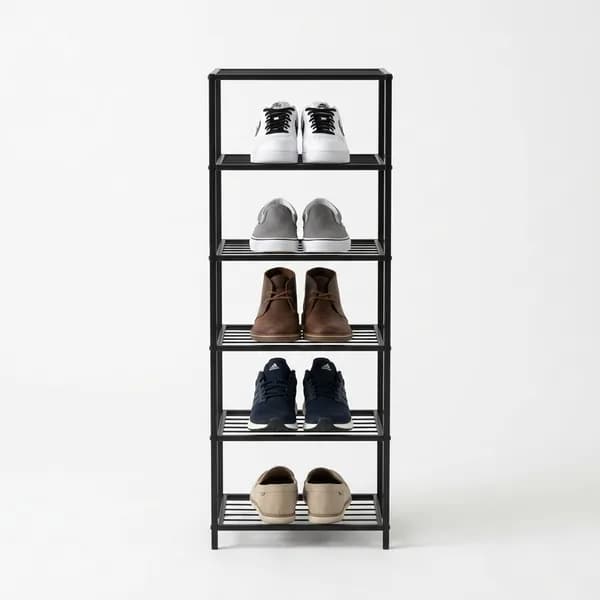
Minimalist Shoe Rack for Your Home's Foyer
A minimalist shoe rack for the foyer seems like a trivial purchase, right up until you buy the wrong one. A rack that is too shallow leaves larger shoes dangling off the edge, one that is too wide gets clipped by the door every time it swings open, and an MDF rack will swell and blister within a couple of rainy seasons, since entryways almost always catch tracked-in water and splash from the door. This article covers the concrete numbers: capacity, depth, materials that survive a semi-wet zone, and how to keep odors in check.
The foyer is the highest-traffic spot in the entire house. Get the system even slightly wrong and shoes end up scattered across the floor while your expensive rack becomes pure decoration.
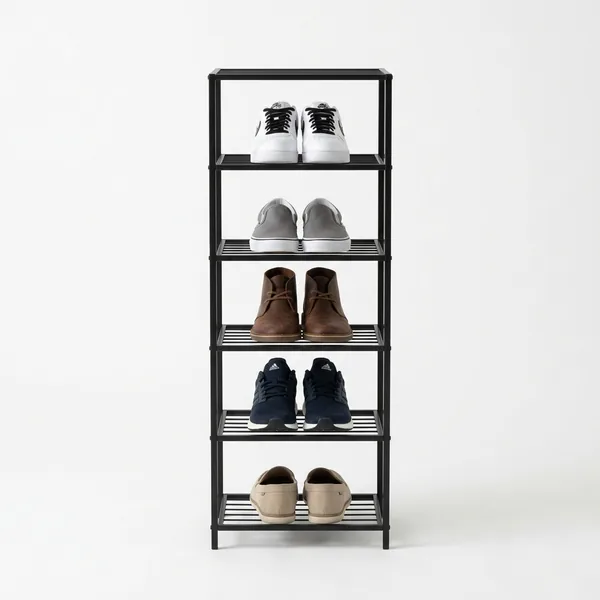
Table of Contents
- Size the Rack for Your Household and Guests - Materials That Survive Moisture and Rain Splash - Open or Closed Racks: Odor and Airflow - Height and Width That Keep the Door Clear - Add Seating for Putting On Shoes - Maintenance to Prevent Rust and Mold - Frequently Asked Questions - Conclusion
Size the Rack for Your Household and Guests
Do not size the rack around every pair of shoes you own. A foyer rack is not deep storage. It is a landing spot for footwear in active rotation. Party heels and hiking boots that come out three times a year belong in a closet.
A realistic benchmark: two to three pairs per person, usually one work or school pair, one pair of everyday slip-ons, and one pair of athletic shoes. A family of four needs roughly eight to twelve slots.
Now convert that number into physical size. One 24-inch shelf holds three pairs of adult shoes side by side, while a 32-inch shelf holds four pairs. Kids' shoes are slimmer, so one 24-inch shelf fits four to five pairs. That means a family of four is well served by a five-tier rack 24 to 32 inches wide, such as the 5-Tier Minimalist Shoe Rack, which has a small floor footprint but stores vertically.
The part everyone forgets: guest slots. Keep the bottom shelf empty, since it is the easiest to reach without a deep bend, or reserve four to six slots that never get filled with the household's own shoes.
Practical tip: Fill the rack to no more than 80 percent of capacity. A jam-packed rack makes people too lazy to put shoes back, and that is exactly how the floor pile begins.
Materials That Survive Moisture and Rain Splash
Entryways are rarely truly dry: water rides in on shoe soles, rain sneaks through the door gap, and humidity spikes during the wet months. Choose your material with that reality in mind, not the assumptions of a climate-controlled room.
Powder-coated steel is the most balanced choice for a four or five tier rack at a budget-friendly price, and the coating holds up far better than ordinary spray paint. Its weak points are the rack feet and the welded joints, where the coating scratches most easily and rust starts creeping in.
If your foyer is open and regularly catches direct splash, step up to stainless steel in the mid-range price bracket, which can go years without meaningful maintenance. The cheap alternative is a PP plastic rack, fully waterproof, though it gets wobbly when loaded with heavy shoes.
For wood, choose solid wood with a proper water-resistant finish, typically in the mid-range bracket. What you must avoid at all costs is particle board and MDF. Both absorb water through their unsealed cut edges, then swell like a sponge and never return to shape. The cheap MDF rack that looks gorgeous in the product photos usually falls apart within a year if it lives near the front door.
Open or Closed Racks: Odor and Airflow
This choice is not about design taste. It is simple physics. Freshly removed shoes carry sweat and moisture. Trap them immediately inside a sealed cabinet and that vapor has nowhere to go, creating the warm, humid environment that odor-causing bacteria love.
Open racks win decisively on airflow. Shoes dry on their own within hours and you can see at a glance which pairs need airing out. The tradeoff is that everything is visible, so an open rack only looks tidy when it is not overloaded.
A closed cabinet makes the foyer look cleaner, and its top surface doubles as a spot for keys. Two conditions apply: the doors must have ventilation holes or louvers, and wet shoes need to air out for a few hours before going inside.
If odors have already set in, place activated charcoal or baking soda in a fabric pouch on each shelf and replace the contents every month or two. This works far better than air fresheners, which only mask the smell. The airflow principles for this semi-wet zone are similar to the ones covered in our bathroom storage ideas guide.
Height and Width That Keep the Door Clear
This is the most expensive mistake because you only discover it after the rack arrives. Measure the available wall width, the width of the door leaf, and the walking clearance that remains once the rack is in place first.
Entry doors are typically 32 to 36 inches wide, and when opened they sweep an arc equal to their own width. The rack must stay out of that sweep zone, and you should preserve a walking path of at least 28 inches. If space is tight, shift the rack toward the hinge side, not the handle side.
On depth, a US men's size 10 shoe runs about 12 inches long, so a rack 10 to 12 inches deep is safe for straight placement. If your foyer nook is shallow, look for an angled-tier rack where shoes lean back: that style needs only 8 to 9 inches of depth, though it really only suits flats and sneakers.
Shelf spacing matters too. Sneakers and loafers need a 6 to 7 inch gap, while heels and short boots need 8 to 10 inches, so leave one generously spaced tier near the bottom. A rack 32 to 36 inches tall is convenient because its top surface works as a console for keys. A rack 5 to 6 feet tall saves floor space, but it must be anchored to the wall with L-brackets so it cannot topple when kids pull on it.
Practical tip: Before ordering online, mark the rack's footprint on the foyer floor with painter's tape, then swing the door open and shut a few times. Those five minutes save you from a painful return process.
Add Seating for Putting On Shoes
A foyer without seating forces people to put shoes on while balancing on one foot, leaning against the wall or against the rack itself. A lightweight shoe rack is not a body support, and that repeated shoving is exactly what loosens its joints until it wobbles.
A comfortable foyer bench has a seat height of 16 to 18 inches, the same as a dining chair, and a width of at least 16 inches. If space is very tight, a small backless stool at a budget-friendly price does the job and can slide under the rack when not in use.
The more efficient option is a bench with storage underneath. Fill it with a collapsible basket for house slippers, spare laces, a brush, and shoe polish. The Foldable Storage Bins are perfect for this role because you can pull them out fully for cleaning and fold them flat when unused.
While you are at it, think about the other items that pass through the foyer. Keys are safest on a wall hook near the door, while wet umbrellas need a tall stand that catches drips. Placing items along the path of daily habit is the core idea behind our home organizing tips.
Maintenance to Prevent Rust and Mold
Rust on a metal rack almost always starts at the feet, not the upper tiers. The feet stand on a floor that regularly gets wet from shoe soles and mopping, and that constant contact wears down the protective coating. Stick felt pads or small rubber feet under every leg so the rack never touches the floor directly.
Inspect a metal rack every three months, especially at the welded joints. If you find a small rust spot, sand it with fine sandpaper and seal it with anti-rust paint. A fingernail-sized spot left alone for six months can rot through until an entire shelf gives way.
The enemy of wooden racks is mold, which shows up as grayish-white patches or a musty smell. Wipe the surface with a one-to-one mix of white vinegar and water, dry it thoroughly, and let it air out for a few hours. Never wash a wooden rack with soapy water, since the water that soaks in only invites new mold.
During the rainy months, place a shallow plastic tray on the bottom shelf to catch drips from wet shoes. Add a small pack of silica gel on each tier, and sun-dry the packs every two to three weeks to restore their absorbency. Pair a coir doormat outside the door with an absorbent mat inside so less water makes it into the foyer in the first place.
Frequently Asked Questions
How deep should a shoe rack be for larger shoes?
Go with 10 to 12 inches for straight placement, since a US men's size 10 shoe is about 12 inches long. Angled-tier racks need only 8 to 9 inches, but they only really suit sneakers and flats.
My closed shoe cabinet makes shoes smell. What is the fix?
Never put still-damp shoes into a closed cabinet. Air them out for a few hours first, make sure the cabinet doors have ventilation holes, and place activated charcoal or baking soda on each shelf.
Which material holds up best in a semi-open foyer that catches rain splash?
Stainless steel lasts longest, followed by powder-coated steel and PP plastic. Avoid particle board and MDF, which absorb water through their cut edges, swell permanently, and cannot be repaired.
Does a tall shoe rack need to be anchored to the wall?
Yes, if it stands over 5 feet tall or there are small children in the house. Use L-brackets, because a tall rack full of shoes has a center of gravity that tips easily when bumped.
How many shoes should live in the foyer?
Two to three pairs per resident, plus four to six empty slots for guests. Seasonal shoes are better stored in a closet, as covered in our guide to shoe storage for small closets.
Conclusion
A successful foyer shoe rack starts with three numbers: capacity of two to three pairs per person, depth of 10 to 12 inches, and a preserved walking path of at least 28 inches. Once those numbers are locked in, choose a material ready to face water: powder-coated steel for general use, or stainless steel for an open foyer.
The rest comes down to small habits that determine the rack's lifespan: never store wet shoes in an enclosed space, provide seating so the rack never becomes a body support, and check the rack feet every three months before rust can spread. A budget rack cared for this way will outlast a premium rack treated carelessly.
Weekly Home Tips
Get home organization ideas, product picks, and exclusive deals delivered weekly.
No spam. Unsubscribe anytime.

Explore More Articles
- Lidded Food Storage Containers: The Complete 2026 Guide to Fresh, Organized Kitchens
- Glass Storage Food Containers with Lids: The Complete 2026 Review & Buying Guide
- 25+ Best Under Stairs Closet Storage Ideas to Transform Dead Space in 2026
- Newborn Closet Organization: The Complete 2026 Guide to a Perfect Baby Storage Space
- Refrigerator Organization: The Complete 2026 Guide to a Cleaner, Smarter Fridge
- 30+ Best Bathroom Shelf Ideas to Maximize Every Inch of Your Space in 2026
- 30+ Best Small Pantry Ideas to Maximize Every Inch of Your Kitchen Storage in 2026
- DIY Shelves: How to Build Beautiful, Functional Shelves on Any Budget in 2026