
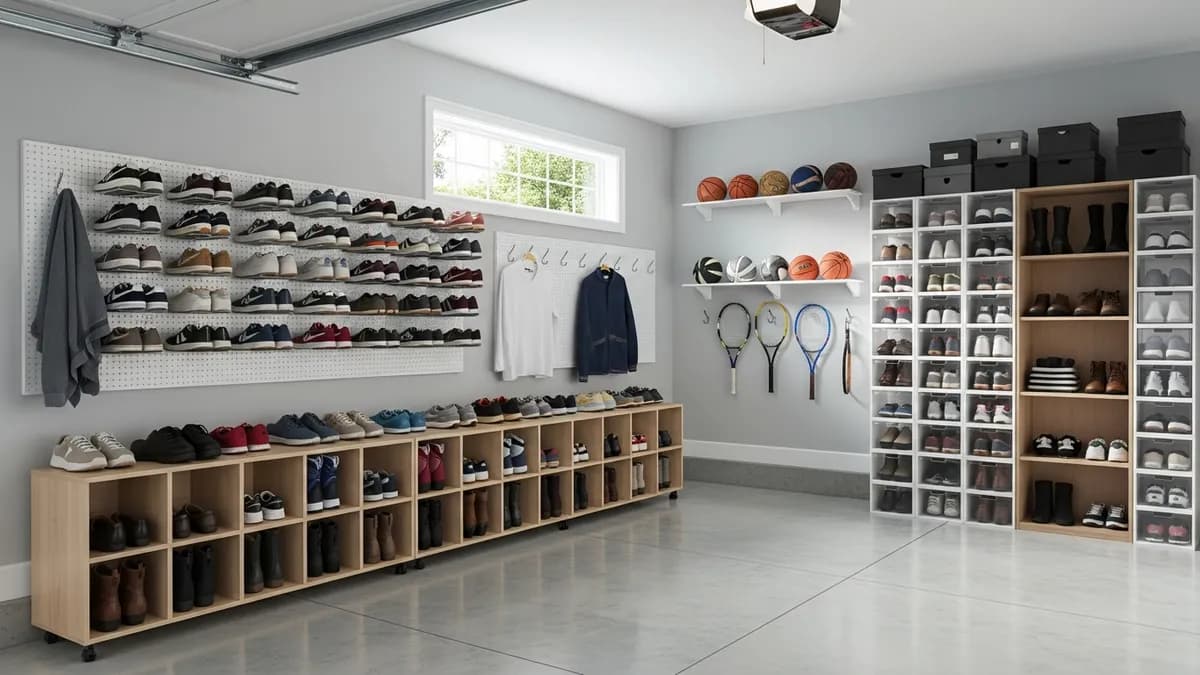
Shoe Storage Ideas for a Garage: Safe Layouts
The best shoe storage ideas for garage spaces keep everyday pairs near the house door, lift footwear off the concrete, allow damp shoes to dry, and preserve enough room to park and open vehicle doors. For most homes, that means a shallow open rack or ventilated cubbies for daily shoes, plus labeled upper shelves or cabinets for clean, occasional pairs. Measure the parked vehicle and door swing before buying anything, and mount every wall system according to its stated load rating and your wall type.
That is the short answer. The right setup is not the rack that holds the largest number of shoes. It is the one my household can use without blocking a walkway, trapping moisture, or turning parking into a daily puzzle. This guide consolidates the most useful shoe storage in garage ideas and shoe storage ideas for garage layouts into one practical plan for homeowners.
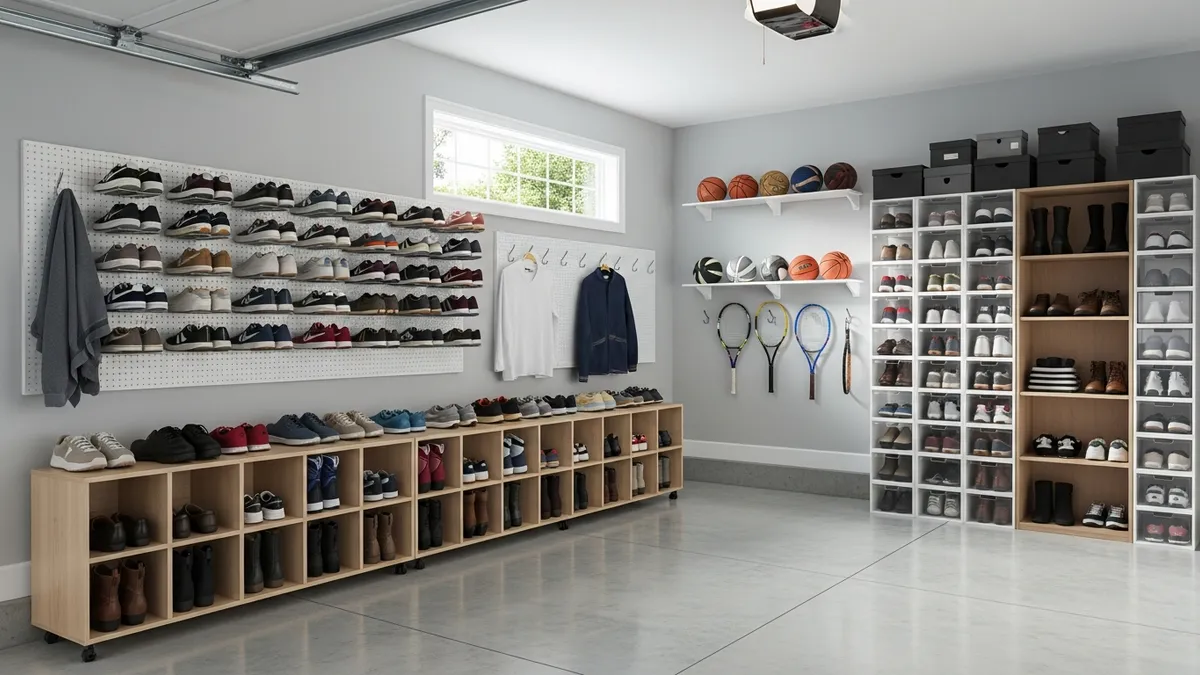
Choose the Right Garage Shoe Storage Layout
Start with behavior, not products. I look at where family members naturally remove their shoes, which pairs arrive wet or muddy, and how often each category is worn. A storage zone beside the door into the house usually works better than a beautiful cabinet across the garage because it follows the existing route. Keep daily sneakers, sandals, and work shoes between knee and shoulder height when possible. Reserve less convenient shelves for seasonal or occasional footwear.
A useful basic layout has three parts: a drying area for shoes that have just come in, an easy-access rack for dry daily pairs, and protected storage for clean footwear used less often. The drying area can be a removable tray under an open wire shelf. The daily rack can be a shallow metal unit, slatted bench, or individual cubbies. Lidded containers may suit clean seasonal shoes, but they should not become a place to seal in damp footwear.
Count pairs by category before choosing capacity. Include boots, cleats, garden shoes, and guest slippers, not just the sneakers visible by the door. Then remove pairs that no longer fit or serve the household. Our guide to decluttering your home offers a simple decision process, while home storage ideas can help if the garage must also hold tools, sports equipment, and household supplies.
For a narrow garage, prioritize wall-mounted or tall shallow storage. For a wide entry bay, a freestanding rack can be easier to clean behind and adjust later. If the garage doubles as a workshop, choose a movable unit with locking casters only when the manufacturer permits that configuration. A fixed cabinet near active tools may look tidy, but it can make access awkward and collect dust if its doors cannot open fully.
Control Moisture Before You Store Shoes
Moisture is the first condition to solve because a new organizer cannot fix a leak, wet slab, or persistently humid corner. The US Environmental Protection Agency explains that indoor mold growth is controlled by controlling moisture and advises drying wet or damp materials promptly in its home mold and moisture guide. Before installing storage, inspect the wall and floor after heavy rain, look for condensation, check weather seals, and investigate musty odors or visible staining.
Never put dripping shoes directly into a closed box. Knock off loose dirt outdoors, remove insoles when appropriate, loosen laces, and let the pair dry in an open area. A boot tray protects the floor, but standing water should be emptied rather than left below the rack. Give shoes space instead of pressing wet uppers together. If a material has special care instructions, follow the footwear maker's directions.
A small digital hygrometer can help identify patterns, but it is not a substitute for finding the source of water. The EPA's humidity lesson says indoor relative humidity should remain below 60 percent and ideally between 30 and 50 percent when possible. Treat that as general building guidance, not a promise that every shoe material will thrive in every garage. If readings stay high, address drainage, leaks, and air movement before storing leather, fabric, collectible, or sentimental footwear there.
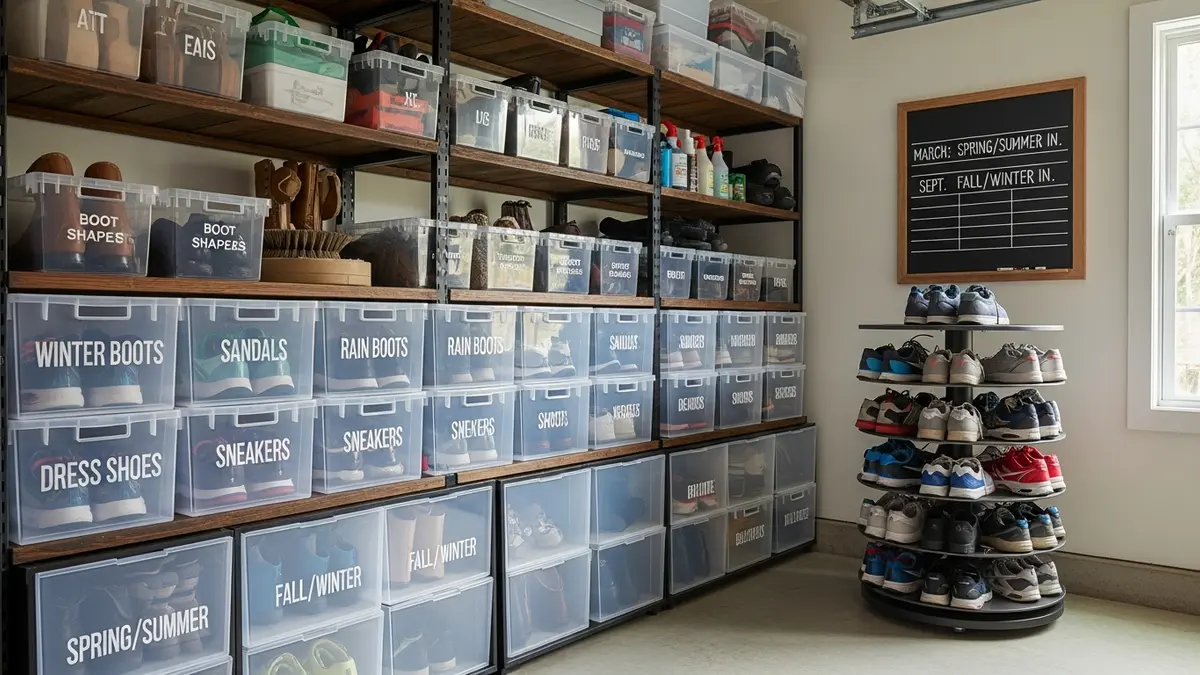
Do not assume an airtight tote is automatically moisture-proof storage. A sound container can keep outside dust and splashes away, but it can also retain moisture introduced by a damp shoe. Store only clean, dry pairs inside, leave appropriate breathing space in open systems, and inspect enclosed storage periodically. If the garage regularly experiences flooding, roof leaks, severe condensation, or large temperature swings, move valuable shoes indoors.
Plan Ventilation Without Bringing Garage Air Indoors
Ventilation matters for both drying and garage air quality. Open shelves, perforated baskets, slatted racks, and ventilated cabinet doors let residual moisture escape more readily than tightly packed solid cubbies. Leave a cleaning gap where the design allows, avoid pressing absorbent boxes against a damp exterior wall, and keep existing vents unobstructed. A fan pointed at shoes may move air locally, but it does not repair a water source or safely redesign the garage ventilation system.
An attached garage deserves extra care because vehicle exhaust and stored chemicals should not be drawn into living space. The US Department of Energy's single-family standard work specifications address garage exhaust, air sealing, and reducing contaminant movement toward the house. Keep the door from the garage to the home closed and maintain its weather seals. Never use that doorway as the ventilation path for a shoe cabinet.
If you are considering a new exhaust fan, a powered dehumidifier, or changes near combustion equipment, consult a qualified local professional. Local building rules, appliance venting, climate, and the garage's connection to the home all matter. Do not cover wall grilles, door undercuts, electrical panels, detectors, or equipment access with a rack. For the wider room layout, our best garage storage solutions guide helps coordinate shoe storage with other garage zones.
Use Wall-Mounted Storage Safely
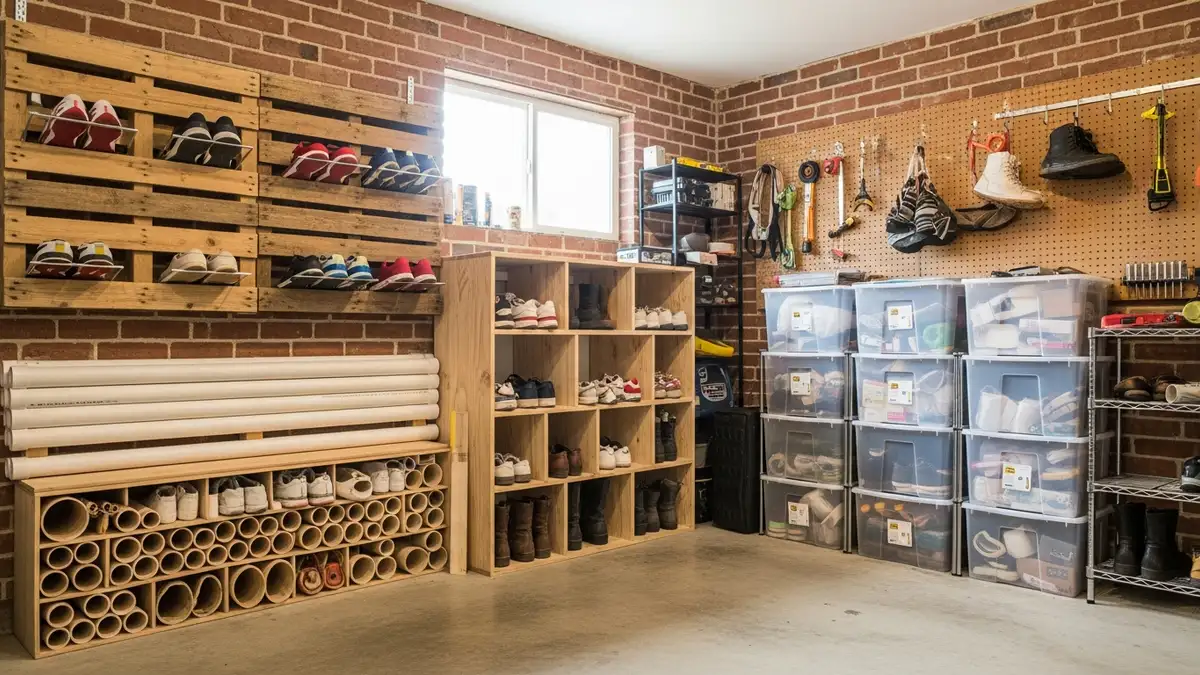
Wall systems are among the most efficient shoe storage ideas for garage walls because they keep the slab clear and can adapt to mixed shoe heights. Good options include adjustable track shelves, slatwall accessories approved for footwear, wire baskets, shallow shelves with a front lip, and pegboard accessories that are compatible with the panel. The storage depth should match the longest shoes without projecting farther than necessary into the parking lane.
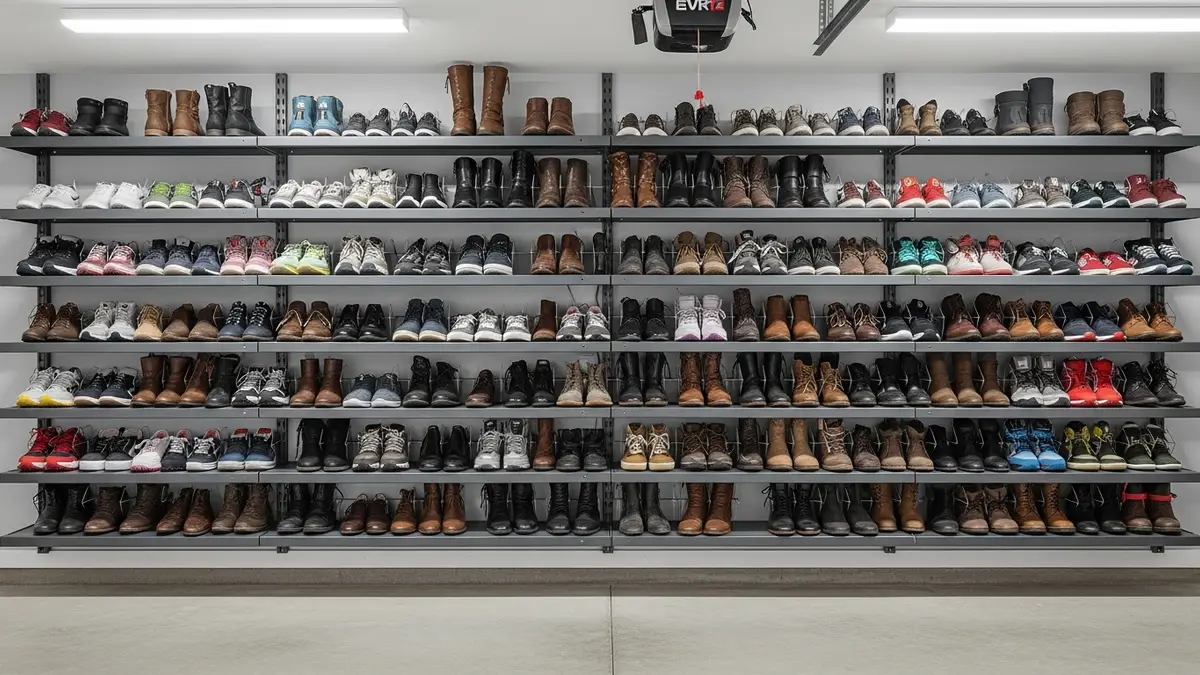
Wall load is not a guess. Add the empty weight of the system to the expected shoes, trays, and anything family members may later place on it. Compare that total with the manufacturer's rating for the complete assembly, including brackets and fasteners. A shelf rating is only meaningful when the product is installed in the wall construction and spacing specified by its instructions. Drywall alone, masonry, concrete block, and wood framing require different anchors and techniques.
Locate framing and concealed services before drilling. Do not assume every stud is in the expected position, and do not drill where electrical wiring, plumbing, or other utilities may be present. Heavy systems, uncertain wall construction, cracked masonry, or storage above a vehicle are sensible reasons to hire a qualified installer. The US Occupational Safety and Health Administration's material storage rule is written for workplaces, but its core safety principles are useful here: do not exceed safe floor loads and store materials so they cannot slide, collapse, or fall.
Anchor tall freestanding units too when the manufacturer instructs you to do so, especially in homes with children. Keep heavy boots low and lighter shoes higher. Do not create a climbable arrangement by placing tempting items at the top. For more planning options, compare garage wall shelf ideas and the broader storage shelving ideas guide before choosing hardware.
Compare Racks, Cubbies, Cabinets, and DIY Options
An open rack is the simplest choice for frequently worn shoes. Wire and slatted shelves promote airflow and shed loose dirt into a tray below. Adjustable shelf spacing accommodates low sneakers and taller boots without wasting vertical room. Check for stable feet, smooth edges, corrosion-resistant finishes, and a published load rating. A rack that rocks on the slab should be leveled or relocated, not wedged in place with improvised scraps.
Cubbies make ownership obvious, which helps children and adults return shoes to the right place. Avoid compartments so tight that shoes must be crushed or stacked while damp. A mix of short and tall openings is more useful than a uniform grid when the household owns boots. Removable bins inside cubbies simplify cleaning, but open-front bins are better for the drying stage.
Cabinets provide dust protection and a calmer appearance. They work best for clean, dry footwear and in garages where doors have room to open without entering the vehicle path. Choose ventilation designed into the unit rather than drilling random holes that could weaken it. The National Park Service's guidance on curatorial care of textile objects recommends physical support and adequate space for stored shoes so they do not touch. Home footwear does not require museum storage, but valuable fabric shoes still benefit from gentle support rather than being crushed into an undersized bin.
DIY shelves can fit an awkward recess and make use of sound leftover lumber. Build only if you can select appropriate material, make stable joints, seal rough edges, and anchor the finished unit correctly. Avoid unknown reclaimed wood that is oily, damp, infested, or chemically contaminated. Never repurpose a pallet without knowing its condition and treatment. See DIY garage storage ideas for project planning and shoe storage cabinet ideas for enclosed layouts.
Protect Vehicle Clearance and Walking Routes
Parking clearance must be tested with the actual vehicle, not estimated from an empty bay. Park in the normal position, fold mirrors only if that is part of the daily routine, and open every door used by passengers. Include the hatch or tailgate arc, charging-port access, and the route used to carry groceries or a child seat. Mark the closest safe edge with painter's tape before placing a rack. Then repeat the test with someone walking between the vehicle and storage.
A shallow shelf can still be a problem at mirror, shoulder, or door-handle height. Rounded corners, visible edges, and a toe-kick reduce bumps, but they do not replace adequate space. Keep footwear and trays completely inside the storage footprint so a loose boot cannot roll under a pedal area or become a trip hazard. If a vehicle barely fits, move shoes to the front wall, the house-entry wall outside the door swing, or a tall narrow zone that does not face the parking lane.
Garage door tracks, springs, sensors, opener rails, and manual release mechanisms need unobstructed movement and service access. Do not hang shoes from door hardware or mount a shelf where vibration, a moving panel, or the opener could strike it. Likewise, keep the electrical panel, water shutoff, fire equipment, and appliance service areas clear according to local requirements and manufacturer instructions.
Orderly storage also supports fire safety. The National Fire Protection Association's explanation of combustible-material storage provisions notes that storage should be orderly and should not be located in exits or interfere with sprinkler operation. Keep the path from the house door to the exterior clear, and do not let shoe boxes crowd ignition sources, heaters, chargers, or stored fuels. Coordinate bikes separately with these garage bike storage ideas so handlebars and shoes do not compete for the same passage.
Follow This Garage Measurement Checklist
Measure after decluttering but before shopping. Record dimensions in one unit system throughout, sketch the bay, and photograph fixed obstacles. A few careful measurements prevent the most common problem: an organizer that technically fits the wall but conflicts with parking, a door, or equipment access.
Use this checklist:
- Available wall width: Measure between trim, corners, appliances, and fixed cabinets. Check at floor, middle, and upper-shelf height because walls and obstacles may not align. - Usable height: Measure to the lowest obstruction, including tracks, pipes, outlets, windows, and controls. Keep frequently used storage reachable without stretching. - Maximum storage depth: Park the vehicle, open doors, and measure the space that remains after a comfortable walking route is preserved. - Door swings: Trace the full arc of the house door, cabinet doors, vehicle doors, and hatch. Include handles and trim. - Longest and tallest footwear: Measure the longest shoe and tallest boot, then add practical hand clearance so pairs slide in without scraping. - Pair count by type: Count daily pairs, boots, children's shoes, sports footwear, and occasional pairs separately. - Drying-zone footprint: Reserve space for a washable tray and open airflow around wet footwear. - Wall construction: Identify whether the intended mounting surface is framed drywall, masonry, or another system. Confirm fasteners with the storage manufacturer. - Expected load: Total the organizer, shoes, trays, and reasonable future additions. Keep the written rating and installation instructions. - Floor conditions: Note slope, cracks, drains, water entry, and uneven areas that can destabilize a unit. - Protected access: Mark vents, outlets, panels, detectors, shutoffs, appliances, and garage-door components that must remain clear. - Future change: Allow for a different vehicle, growing children's shoes, or a new mobility need rather than filling every centimeter now.
Tape a cardboard outline of the proposed unit to the wall and leave it in place for a normal day. Park, unload, take out the trash, and let every household member use the entry. This simple mock-up reveals conflicts that measurements can miss. If overhead space is part of the larger plan, read the overhead garage storage guide, but keep shoe storage within safe reach for routine use.
Organize Shoes for Daily Family Use
A system lasts when the easiest action is also the correct action. Give each person a clearly labeled section and put children's daily pairs at a safe reachable height. Group by use rather than by appearance: school, work, garden, sport, wet-weather, and occasional. Keep the most frequently worn pair at the front instead of filling prime space with special-event shoes.
Create a one-in, one-out rule only if it fits your household. More importantly, set a visible capacity for each zone. When a cubby is full, decide whether a pair belongs indoors, in seasonal storage, for repair, for donation, or for disposal. Do not solve overflow by stacking shoes in the walkway.
A bench can be useful when someone needs to sit, but confirm its stated seating load and purpose. A low shoe shelf is not automatically a seat. Position any real bench outside vehicle and house-door swings, and keep the floor in front dry. For homes where the garage entry functions like a foyer, the ideas in our entryway organization guide can help integrate bags, keys, and coats without overloading the shoe rack.
Labels should survive dust and changing temperatures, but they do not need to be elaborate. Large text, simple categories, and a consistent return spot are enough. A washable tray under dirty footwear and a brush nearby make the routine easier. Store cleaning products separately according to their labels, never in a shoe cubby that children can reach.
Maintain the System Through the Seasons
Weekly care can be brief: return stray pairs, empty standing water from trays, sweep loose grit, and check that no shoe blocks the walkway. Let mud dry enough to brush off safely, then clean the shoe according to its material instructions. Wipe shelves with a method compatible with their finish and let them dry before replacing footwear.
At each seasonal change, inspect the wall and floor for dampness, rust, loose hardware, swelling, mold, or pest signs. Tighten or repair only as the manufacturer directs. Stop using a leaning rack, bent bracket, cracked anchor point, or damaged shelf until it has been evaluated. Recheck vehicle clearance whenever the household changes vehicles or adds charging equipment.
Leather and delicate shoes need more caution than washable garden footwear. The National Park Service's leather and skin care guidance emphasizes stable environmental conditions, physical support, and periodic inspection. For a homeowner, the practical translation is straightforward: do not leave valued leather shoes in a garage that is persistently damp, very hot, very cold, or prone to rapid swings. Store them indoors if the environment cannot be improved.
Review capacity twice a year or whenever shoes begin landing on the floor. Edit the collection before adding another organizer. If the whole garage is crowded, use small home organization ideas to decide what belongs elsewhere rather than making the shoe zone carry unrelated items.
FAQ
Is it okay to store shoes in a garage?
Yes, if the garage is dry, reasonably stable, secure, and free from leaks or persistent condensation. Everyday rubber, synthetic, and work footwear usually tolerate garage storage better than valuable leather, delicate fabric, collectible, or sentimental pairs. Clean and dry shoes first, provide airflow, and move sensitive footwear indoors if the garage has moisture or temperature problems.
What is the best shoe storage for a small garage?
A shallow wall-mounted track system or a tall, narrow ventilated rack usually preserves the most floor space. Choose depth based on the actual shoe length and remaining vehicle clearance. Keep heavy pairs low, follow the system's mounting instructions, and avoid any location that interferes with doors, tracks, panels, or walking routes.
Should garage shoe storage be open or closed?
Use open, slatted, or wire storage for daily shoes and for the drying stage. Use a ventilated cabinet or clean container for dry occasional footwear that needs dust protection. Closed storage is not a cure for humidity and should never receive wet shoes.
How do I prevent mold and odor in stored shoes?
Fix water sources first, dry shoes completely, improve appropriate air movement, and avoid crowding. Empty wet trays and clean racks regularly. Odor absorbers may help with residual smells, but they do not replace drying or leak repair. If you find visible mold or recurring mustiness, isolate affected items and follow suitable professional or public-health guidance.
How deep should a garage shoe rack be?
There is no universal depth because shoe lengths and garage layouts differ. Measure the household's longest pair, add enough hand clearance for easy removal, and test that depth against the parked vehicle and every door swing. A cardboard mock-up is more reliable than choosing a rack from a generic dimension alone.
How much weight can a wall-mounted shoe shelf hold?
Only the product documentation and the completed installation can answer that. Capacity depends on the shelf, brackets, fasteners, spacing, wall construction, and workmanship. Add the unit's own weight to the planned contents, stay within the manufacturer's rating, and use a qualified installer when the wall type or concealed services are uncertain.
Can I put wet boots in a plastic bin?
No. A closed bin can trap the moisture brought in with the boots. Place wet boots on a washable tray in an open drying zone, remove liners or insoles when their care instructions allow, and transfer them to enclosed storage only when every part is dry.
Where should a shoe rack go in a garage?
Place it near the normal house entry if that location stays dry and does not obstruct the door, vehicle, or protected equipment access. A side wall can work when enough door-opening and walking clearance remains. Avoid active garage-door hardware, damp exterior corners, ignition sources, and any required exit route.
Are overhead racks a good place for shoes?
Overhead storage can hold clean, lightweight, infrequently used items when a rated system is professionally appropriate, but it is inconvenient for everyday shoes and creates access and falling-object concerns. Do not place loose footwear above a vehicle. Keep daily pairs at a reachable height and use overhead zones only within the system manufacturer's instructions.
What is the simplest way to start today?
Remove every pair from the garage, discard or donate what no longer serves the household, and separate wet, daily, and occasional footwear. Mark a safe storage footprint with tape, test the parked vehicle and doors, then install one correctly sized rack. Add containers or wall storage only after the basic routine works.
A successful garage shoe zone is dry, reachable, stable, and easy to reset. Begin with the measurement checklist, solve moisture before buying storage, and protect the vehicle route before trying to maximize capacity. Those priorities turn shoe storage in garage ideas into a system a real household can maintain.
Weekly Home Tips
Get home organization ideas, product picks, and exclusive deals delivered weekly.
No spam. Unsubscribe anytime.
Explore More Articles
- 30+ Best Closet Organization Ideas for Nursery: Create the Perfect Baby Storage Space in 2026
- Bathroom Storage Ideas to Keep a Small Bathroom Tidy
- Label Organizer: Smart Labeling System for a Super Organized Home
- 25+ Brilliant Bathroom Wall Shelf Ideas to Transform Your Space in 2026
- Eid Table Setting Tips for Small Homes
- Productive WFH Setup for a Small Home
- Bedroom Wall Shelf Ideas for Small Spaces
- 25+ Brilliant Storage Space Ideas for Small Bathroom: Maximize Every Inch in 2026