
Cat Wall Shelf Ideas: Safe, Stylish Climbing Routes for Indoor Cats
Cat wall shelf ideas for every home, from staircases and bridges to window perches, with tips on step spacing, mounting into studs, grippy materials and safety.
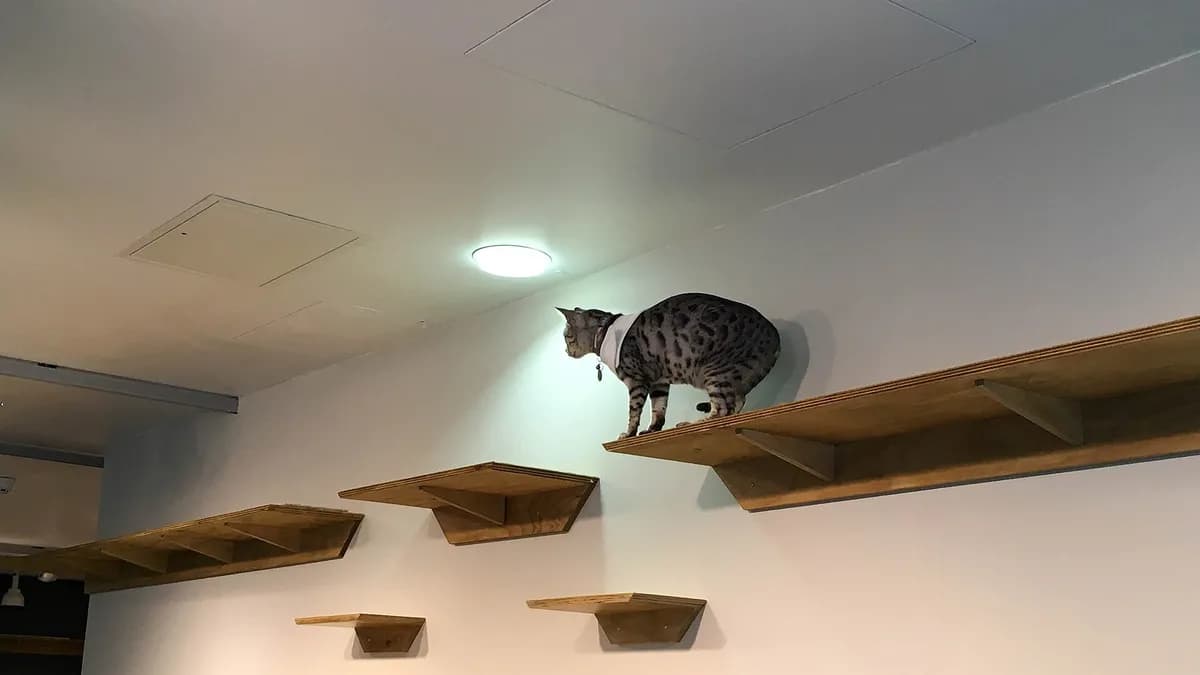
Cats experience a home in layers. The floor is only one of them; the windowsill, the top of the bookcase and the back of the sofa are just as much territory. If your cat keeps trying to reach places you would rather it left alone, the answer is often to give it a better route of its own. These cat wall shelf ideas show how to add safe, good-looking climbing space on your walls without filling the floor with furniture.
We cover why vertical space matters, the main layouts, how to plan step spacing and mounting, materials that are safe for paws and claws, and how to blend cat shelves into the rest of your decor. If you are styling the same wall for people, our living room wall shelf decor ideas and floating shelf ideas are good companions.
Hero photo credit: Mike Peel (www.mikepeel.net) / Wikimedia Commons, CC BY-SA 4.0
Why Cats Benefit From Wall Shelves
Animal welfare groups describe vertical space as enrichment, not just a nice extra. The Toronto Humane Society's guide to vertical space for cats explains that cats see the world in layers and that heights can be comforting: from above, a cat can watch what is happening, choose when to interact and step away to rest. The ASPCA's general cat care advice likewise emphasizes giving indoor cats places to scratch, play and rest.
In practical terms, wall shelves help in three situations:
- Small homes. Walls add usable territory without taking floor space from people.
- Multi-pet households. A second level lets a cat avoid a dog or another cat without leaving the room.
- Bored indoor cats. A route to a window perch gives a cat something to watch and a reason to climb.
A wall setup also protects the rest of your home. A cat with its own high route is less likely to clear the mantel or the top of the kitchen cabinets.
Plan the Route Before You Drill
The best cat wall shelf ideas start with the route, not the shelves. Watch where your cat already goes: favorite windows, the top of a bookcase, the spot where it sleeps in the afternoon sun. Then design a path that starts from something the cat can already reach, such as a sofa arm, a cat tree or a low console, and ends at a destination worth the climb.
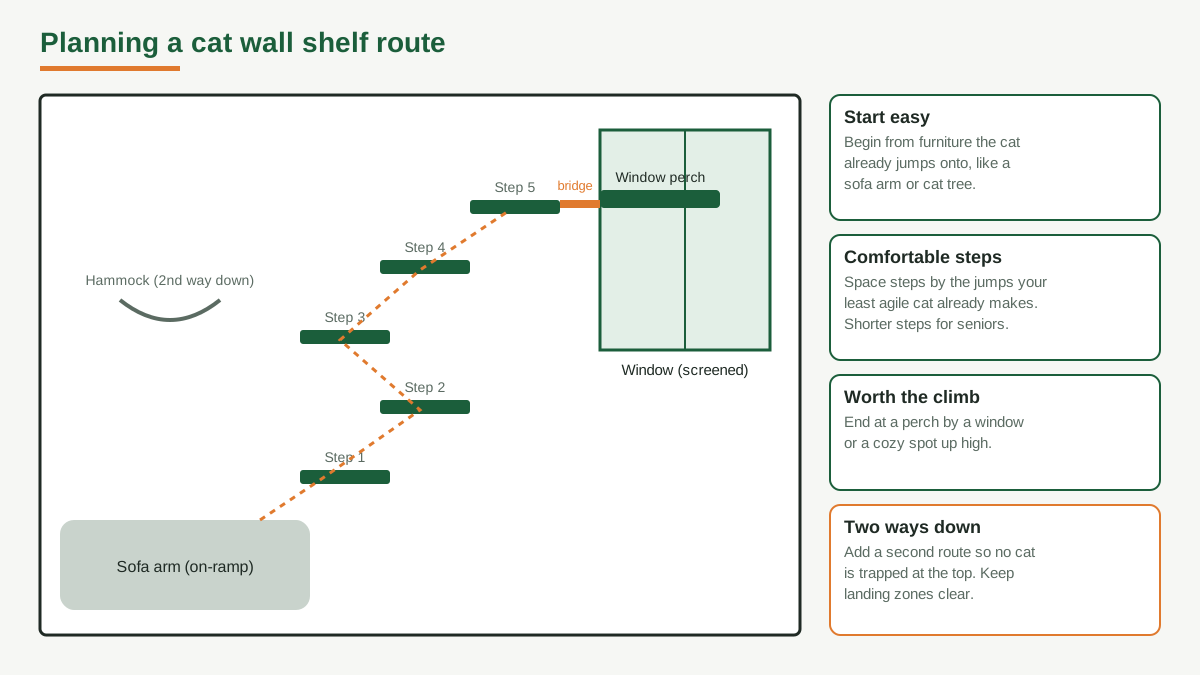
A good route has:
- An easy on-ramp from furniture or the floor.
- Steps the cat can reach comfortably, with no awkward stretches.
- A destination, such as a perch by a window or a cozy box near the ceiling.
- A second way down, so a cat is never trapped at the top by another pet.
- Clear landing zones without breakables, lamps or hot surfaces below.
Popular Cat Wall Shelf Layouts
Most cat walls combine a few standard building blocks. Use this table to pick the pieces that suit your wall and your cat.
| Layout | What it is | Best for | Things to consider |
|---|---|---|---|
| Staircase | Shelves rising diagonally across a wall | Most cats, first cat wall | Needs a clear wall section |
| Bridge | A plank or rope bridge between two shelves | Confident climbers, wide walls | Edges and supports must be solid |
| Window perch route | Steps leading to a perch at a window | Bird watchers, sunny rooms | Keep windows screened or closed |
| Corner tower | Shelves stacked on two walls of a corner | Small rooms, tight budgets | Fewer exit routes |
| Ceiling highway | A run of shelves near the ceiling | Multi-cat homes, high ceilings | Harder to clean and reach a stuck cat |
| Hammock or bed | A fabric or padded perch on brackets | Senior cats, nap spots | Check weight rating and fabric wear |
Step Spacing and Height
There is no single correct spacing, because a young athletic cat and a senior cat move very differently. The Toronto Humane Society guide notes that for kittens, senior cats or cats with mobility challenges, lower platforms or steps may be best. Plan for the least agile cat in your home, not the most agile.
A practical way to plan is to measure what your cat already does comfortably. Note the height of the sofa or bed it jumps onto without hesitation, and treat that as the most you ask for between steps. Many owners find shorter, more frequent steps encourage hesitant cats, while confident climbers enjoy a bigger jump now and then.
Before drilling, tape paper rectangles on the wall where each shelf will go and look at the pattern from across the room. Use a level and check the route with your hand: each step should leave the cat room to turn around and land with all four paws.
Mounting: The Part That Matters Most
A cat jumping onto a shelf puts much more force on it than the cat's resting weight, and it pushes outward from the wall. That is why mounting is the most important part of any cat wall.
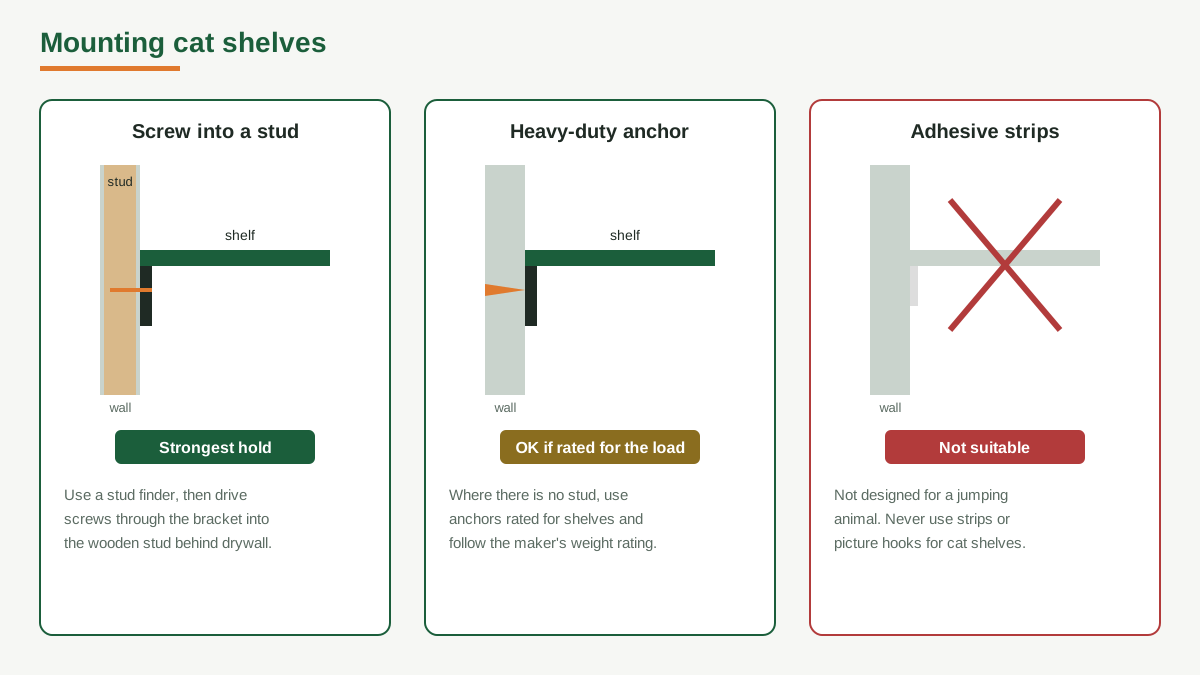
- Find the studs. Screwing brackets into wall studs gives the strongest hold in a typical framed wall. A stud finder makes this easy.
- Use rated anchors where there is no stud. Follow the anchor manufacturer's weight rating and choose heavy-duty types meant for shelves.
- Never rely on adhesive strips or picture hooks. They are not designed for a jumping animal.
- Follow the shelf maker's instructions and weight rating. If the shelf has no stated rating, treat that as a warning sign.
- Test before you invite the cat. Press down firmly on the front edge of each shelf. It should not flex, wobble or pull from the wall.
Renters can still build a cat wall: ask your landlord, keep to a few well-placed screws, and fill holes when you move out. A freestanding cat tree beside the wall can replace the lowest shelves if drilling is limited.
Materials and Surfaces Cats Like
Smooth painted wood looks clean but can be slippery for a landing cat. Add grip on every surface the cat lands on:
- Carpet or felt pads fixed to the top of each shelf.
- Sisal rope wrapped around a post or on a vertical panel doubles as a scratching surface.
- Solid wood or plywood with rounded edges feels sturdy and lasts.
- Washable fabric for hammocks and beds, so you can clean fur and dust.
Avoid glass, slick acrylic and thin particleboard that sags. Check edges for splinters and screw heads that stick out, and sand anything rough.
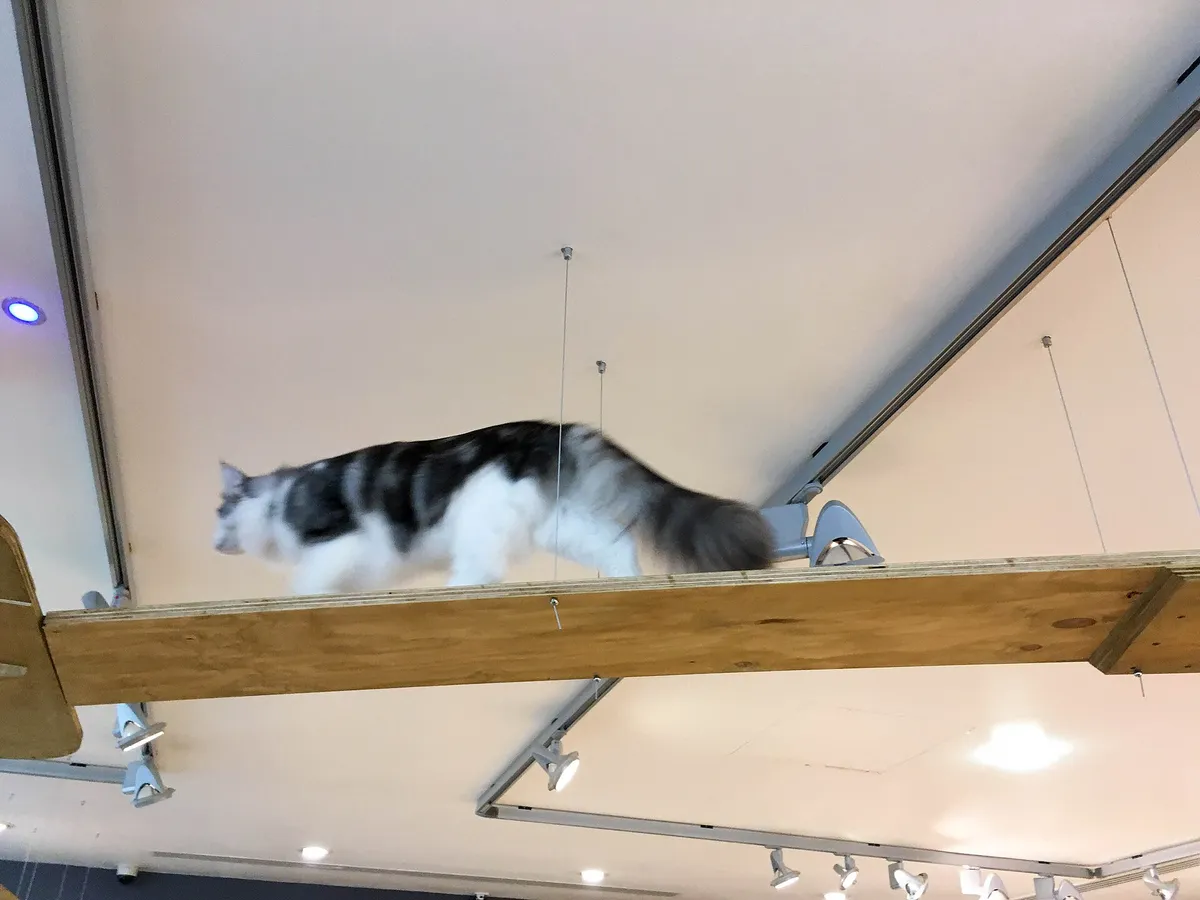
Photo: Mike Peel (www.mikepeel.net) / Wikimedia Commons, CC BY-SA 4.0
A plain plywood plank like this one is a good example of a surface that works: wide enough for a cat to walk with confidence and solid underfoot. For a home, add a strip of carpet or felt where the cat lands from a jump.
Blend Cat Shelves Into Your Decor
A cat wall does not have to look like a pet store display. A few design choices make it feel like part of the room:
- Match the wood tone to your floors, frames or other shelves.
- Repeat one shelf shape so the pattern reads as intentional.
- Leave negative space between groups instead of covering the whole wall.
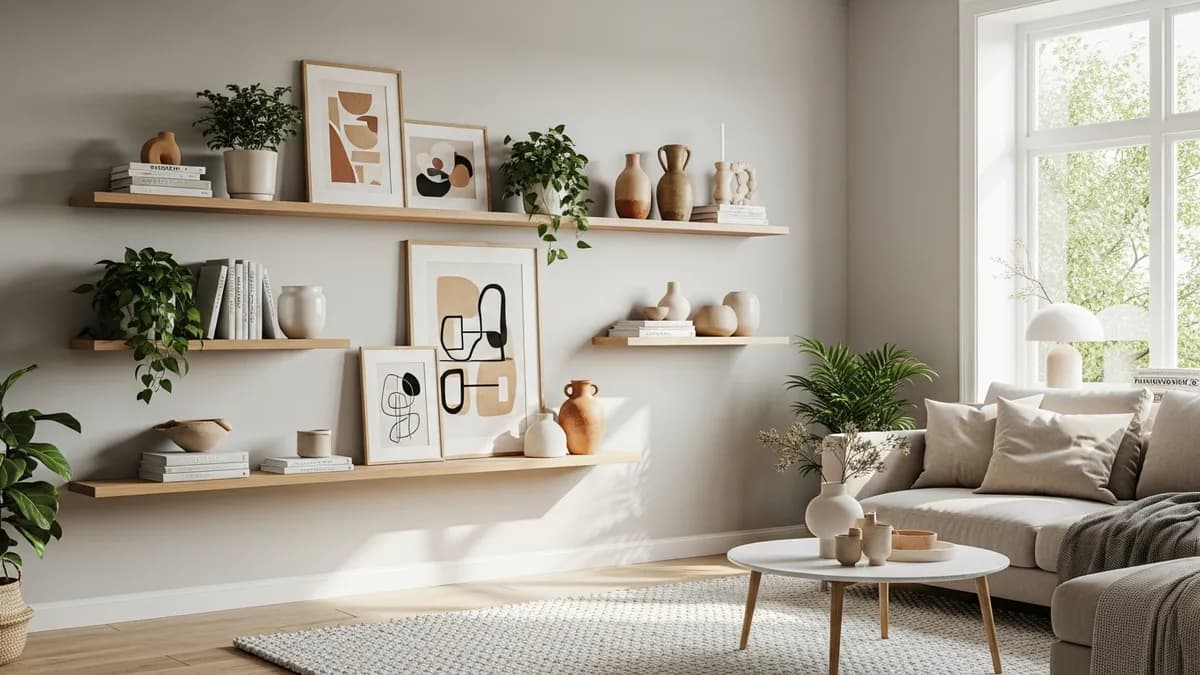
- Mix in people shelves for plants or books, placed where the cat route does not cross them. Our indoor plant wall shelf ideas can help, but check that any plant near the route is safe for cats.
- Hide cables and outlets so nothing dangles below the route.
In a living room, a cat route can frame a TV or a window. See our floating shelf TV wall ideas and living room shelving ideas for layouts that leave room for both.
Safety Checklist for Cat Wall Shelves
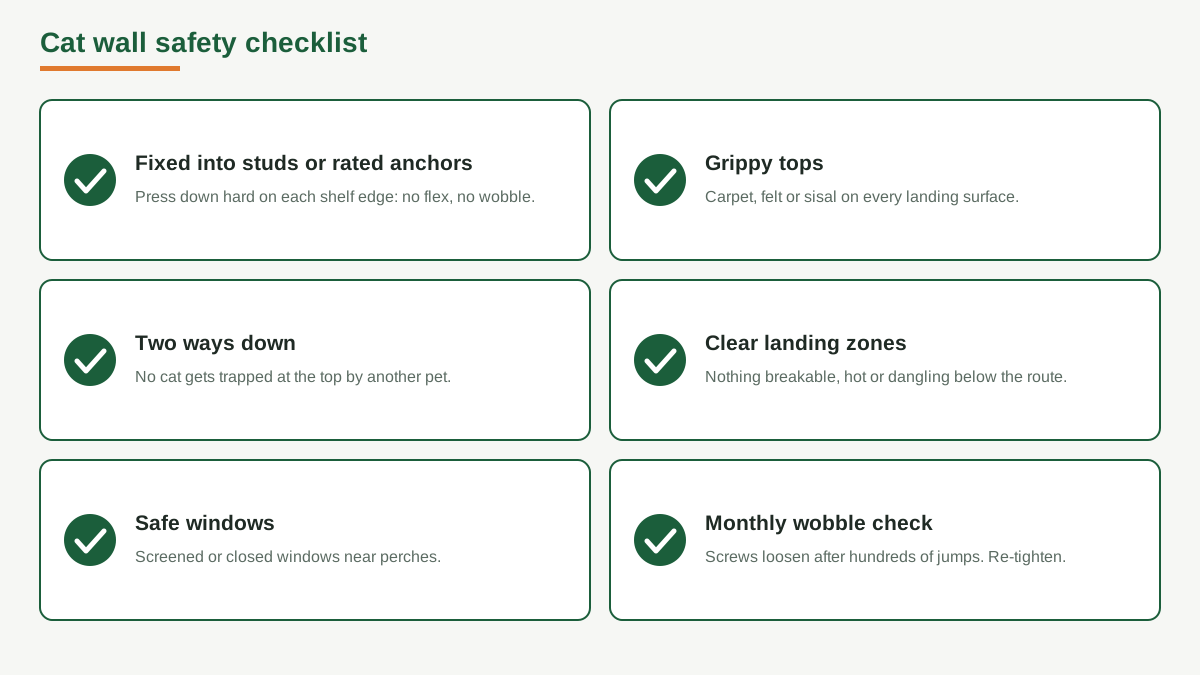
Before you call the project finished, walk through this list:
- Every shelf is screwed into studs or rated anchors and passes a firm press test.
- Every landing surface has grip.
- There are at least two ways down from the highest point.
- Nothing breakable, hot or dangling sits in the landing zones below.
- Windows near the route are screened, closed or fitted with a secure perch.
- Shelves are high enough to stay clear of door swings and walking paths.
- You can reach the top shelf with a step stool if your cat needs help.
Repeat the press test every month or two. Screws can loosen as a cat jumps on and off hundreds of times.
Help Your Cat Use the New Shelves
Some cats leap onto a new wall within minutes; others watch it for days. Encourage the cautious ones:
- Start low. Make the first step easy and familiar.
- Use treats and toys. Place a treat on the first shelf, then the second, over several days.
- Add a familiar blanket to the top perch so it smells like home.
- Play with a wand toy that leads up the route.
- Be patient. Never place a cat on a high shelf it has not reached on its own.
Keep the cat's other needs nearby but separate. Food stays on the floor in a calm spot; our pet food storage containers guide covers storing kibble neatly. Toys and brushes can live in a basket, and our hidden toy storage ideas work for pet toys too.
Accessories That Make a Cat Wall Better
Once the basic route is up, a few extras can make it more useful for your cat and easier for you to live with.
- A covered cube or box near the top gives a shy cat a hiding spot with a view. Choose one with an opening on the side facing the room.
- A vertical scratching panel next to the lowest step lets a cat stretch and scratch before it climbs, which can take pressure off your sofa.
- A window perch gives the route a reason to exist. Mount it only on a window that stays closed or has a secure screen.
- Removable, washable covers for shelf tops make cleaning fur and dust simple. Pick covers you can throw in the washing machine.
- A small step stool nearby lets you reach the top shelf to clean or to help a cat that freezes up high.
Add one accessory at a time and watch how your cat uses it. Some cats ignore a hammock for weeks and then claim it as their favorite spot, while others never warm to a bridge. The route can change as you learn what your cat enjoys.
Cat Wall Shelf Ideas for Small Spaces
An apartment wall can still hold a satisfying route. Try a corner tower of four or five shelves, a single window perch with two steps, or a narrow staircase beside a door. Combine the route with storage furniture the cat can use as an on-ramp, such as a low bookcase. For more space-saving layouts, see our small living room organization ideas and bedroom wall shelf ideas.
Frequently Asked Questions About Cat Wall Shelf Ideas
Are cat wall shelves good for cats?
Yes. Animal welfare groups describe vertical space as enrichment: it lets cats watch their surroundings, choose when to interact and rest somewhere they feel secure.
How far apart should cat wall shelves be?
There is no single rule. Base the spacing on the jumps your cat already makes comfortably, and use lower, closer steps for kittens, senior cats and cats with mobility issues.
How do I mount cat shelves securely?
Screw brackets into wall studs wherever possible, use heavy-duty anchors rated for the load where there is no stud, and never rely on adhesive strips. Press down on each shelf before letting the cat use it.
Can I put up cat shelves in a rental?
Ask your landlord first and keep to a small number of well-placed screws that you can fill when you move out. A freestanding cat tree can replace lower steps if drilling is restricted.
What material is best for cat wall shelves?
Solid wood or plywood with rounded edges, topped with carpet, felt or another grippy surface. Avoid slippery glass or acrylic and thin boards that sag.
How do I get my cat to use new wall shelves?
Start with an easy first step, lead the way with treats and wand toys over several days, and add a familiar blanket to the top perch. Never place a cat on a high shelf it has not reached by itself.
Are cat wall shelves safe for older cats?
They can be, with lower platforms, shorter gaps, wider steps and a ramp or extra step where needed. Watch how your cat moves and adjust the route if it hesitates.
How many shelves does a cat wall need?
Enough to create a route from an easy starting point to a worthwhile destination with a second way down. For many rooms, four to six pieces including a perch or hammock is a practical start.
Conclusion: A Wall Your Cat Can Call Its Own
The best cat wall shelf ideas balance three things: a route that suits your cat's ability, mounting you can trust, and a look that fits your home. Plan the path from an easy on-ramp to a sunny destination, screw everything into studs or rated anchors, add grip to every landing and leave two ways down. Your cat gets a world of its own, and your shelves of breakables get some peace.
For more wall storage ideas, explore our wall shelf storage ideas and living room storage ideas.
Liked this guide?
Get new organizing guides and the occasional new product by email. No spam, unsubscribe anytime.
Related articles

Explore more articles
- 30+ Best Lego Storage Ideas to Tame the Brick Chaos in 2026
- DIY Shelves: How to Build Beautiful, Functional Shelves on Any Budget in 2026
- Spice Rack Organization: The Complete 2026 Guide to a Tidy, Functional Kitchen
- Coffee Station Organization: The Complete 2026 Guide to a Beautiful, Functional Setup
- 30+ Best Makeup Organization Ideas to Transform Your Beauty Space in 2026
- Suitcase Packing Tips: The Ultimate 2026 Guide to Stress-Free Travel
- 25+ Best Indoor Plant Stand Ideas to Elevate Your Home Decor in 2026
- Small Linen Closet Organization: 20+ Smart Tips to Maximize Every Inch in 2026