
How to Organize a Spice Drawer: A Step-by-Step System You Can Keep
How to organize a spice drawer step by step: measure, edit, choose jars and inserts, label tops, sort by how you cook, and keep the system tidy with a simple routine.
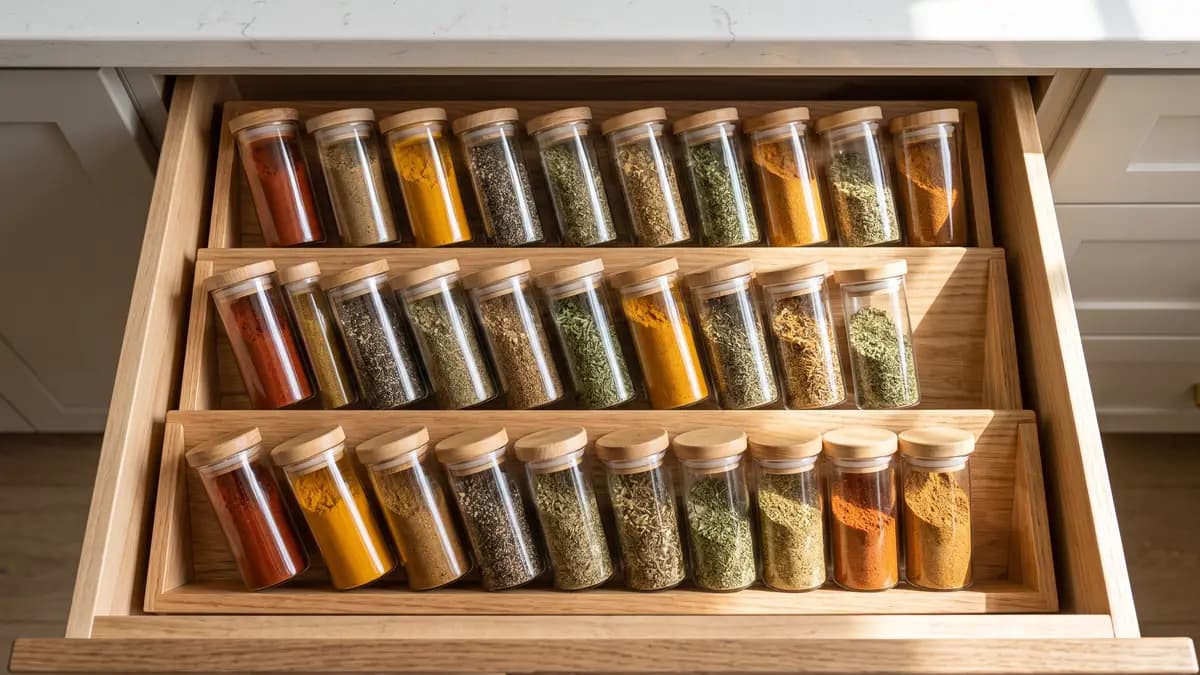
Spices are small, numerous and used in a hurry, which is exactly why they turn into chaos so quickly. Jars get pushed to the back of a cabinet, duplicates pile up because you cannot see what you already own, and a recipe stalls while you dig for the cumin. Moving spices into a drawer fixes much of this, because you look down at every lid at once. But a drawer only helps if it has a system. This guide explains how to organize a spice drawer from start to finish, in a way that stays tidy after the first week.
We cover choosing the right drawer, measuring it, editing your collection, picking jars and inserts, labeling, sorting by how you cook and keeping the drawer under control. If your kitchen has no spare drawer, we also include cabinet alternatives that give you the same at-a-glance view. For broader kitchen planning, our kitchen drawer organizer ideas and spice rack organization guides are good companions.
Why a Drawer Beats a Cabinet for Spices
In a cabinet, jars sit in rows, and you can only read the front row. Tiered risers help, but the back still disappears. In a drawer, every jar faces up, so the whole collection is visible in a single glance. That visibility saves time while cooking and money at the store, because you stop buying a third jar of paprika.
A drawer near the stove also keeps spices where you use them. You can open it with one hand while stirring with the other, which is not true of a high cabinet that requires reaching over a hot pan.
The trade-off is that drawers are shallow and jars must lie down or stand on short inserts. That makes jar choice and labeling more important than in a cabinet. The steps below handle both.
Step 1: Choose and Measure the Drawer
The best spice drawer is within arm's reach of the stove or main prep area. A top drawer works best because it is the easiest to see into. Avoid the drawer directly under the cooktop if it gets warm, since heat speeds up the loss of flavor in ground spices.
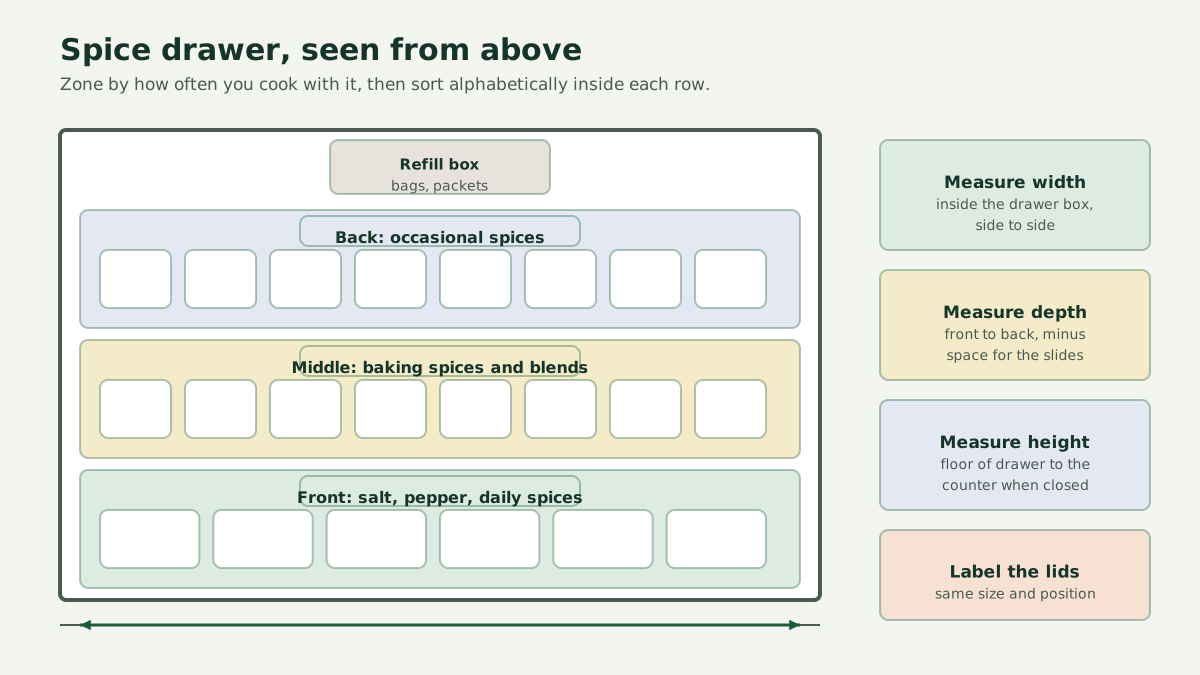
Measure three things before you buy anything:
- Interior width, from side to side, inside the drawer box.
- Interior depth, from front to back, minus any space the drawer slides need.
- Usable height, from the drawer floor to the underside of the countertop or the drawer above when it closes.
Write the numbers down and take them shopping. Height is the one people forget, and it decides whether jars can stand upright or must lie on an angled insert.
Step 2: Empty, Check and Edit Your Spices
Take every spice out of every cabinet, drawer and pantry shelf and put them on the counter together. This is the only way to see duplicates and forgotten jars.
Check each one. Ground spices and dried herbs lose aroma over time, so open the jar and smell it. If the scent is faint or the color has faded, the spice will add little flavor, and it can be replaced. Whole spices such as peppercorns, cinnamon sticks and cumin seeds generally keep their flavor longer than ground versions, which is one reason many cooks buy whole and grind as needed.
Combine duplicates into one container where the spices are the same. Set aside anything you bought for a single recipe and never used again. If you are not sure whether you will use it, put it in a small "maybe" box and revisit it in a few months.
The goal is a collection that reflects how you actually cook. Many households use a core set of spices weekly and the rest rarely. Knowing which is which shapes the layout in Step 5.
Step 3: Choose Jars That Fit the Drawer
Matching jars make a spice drawer far easier to scan, because the eye reads labels instead of a mix of shapes and colors. They also pack more tightly than mismatched store containers.
| Jar style | Best for | Things to check |
|---|---|---|
| Small round glass jars | Most ground spices and herbs | Lid label space, fit on an angled insert |
| Square glass jars | Maximizing space in a row | Corners waste less room than round jars |
| Flat tins with clear lids | Shallow drawers, lying flat | Label the lid; check the seal |
| Original store jars | Keeping costs low | Mixed heights make inserts harder to use |
| Larger jars | Salt, pepper, everyday blends | Keep them at the front where you reach most |
Glass is easy to clean and does not hold odors. Whatever you choose, a tight lid matters more than looks, because air and moisture are what make spices stale and clumpy.
If you decant spices from bags or bulk bins, use a small funnel and fill jars over a tray so spills are easy to tip back in. Write the purchase month on a small sticker under the lid so you know how old each refill is.
Step 4: Pick the Right Insert
Inserts keep jars in rows so they do not roll every time the drawer opens. There are three main types:
- Angled tiered inserts hold jars at a slant, so labels on the lid or the side face you. They suit drawers with moderate height.
- Flat grid or slotted inserts hold jars lying down, label side up, which works in shallow drawers.
- Expandable inserts adjust to the drawer width, which is handy if your drawer is an odd size.
Non-slip drawer liner under the insert stops the whole thing from sliding. If you prefer not to buy an insert at all, rows of small rectangular containers or even a rolled kitchen towel between rows can keep jars from rolling, though they look less tidy.
If your kitchen has no free drawer near the stove, you can create one. A slide-out drawer mounted inside a base cabinet gives you the same top-down view.
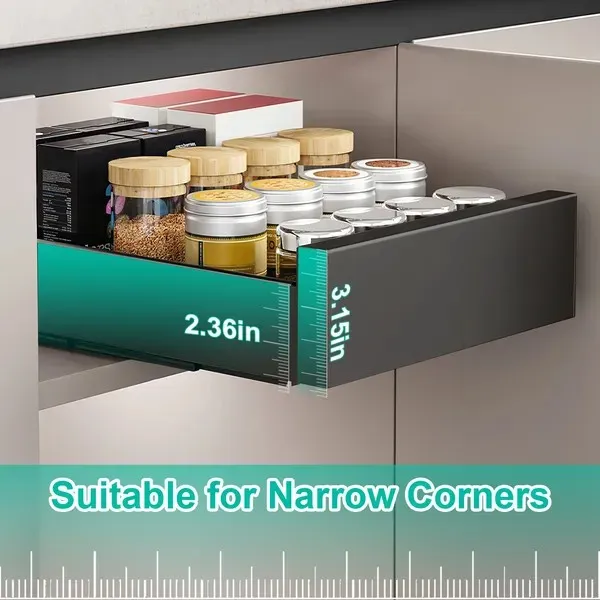
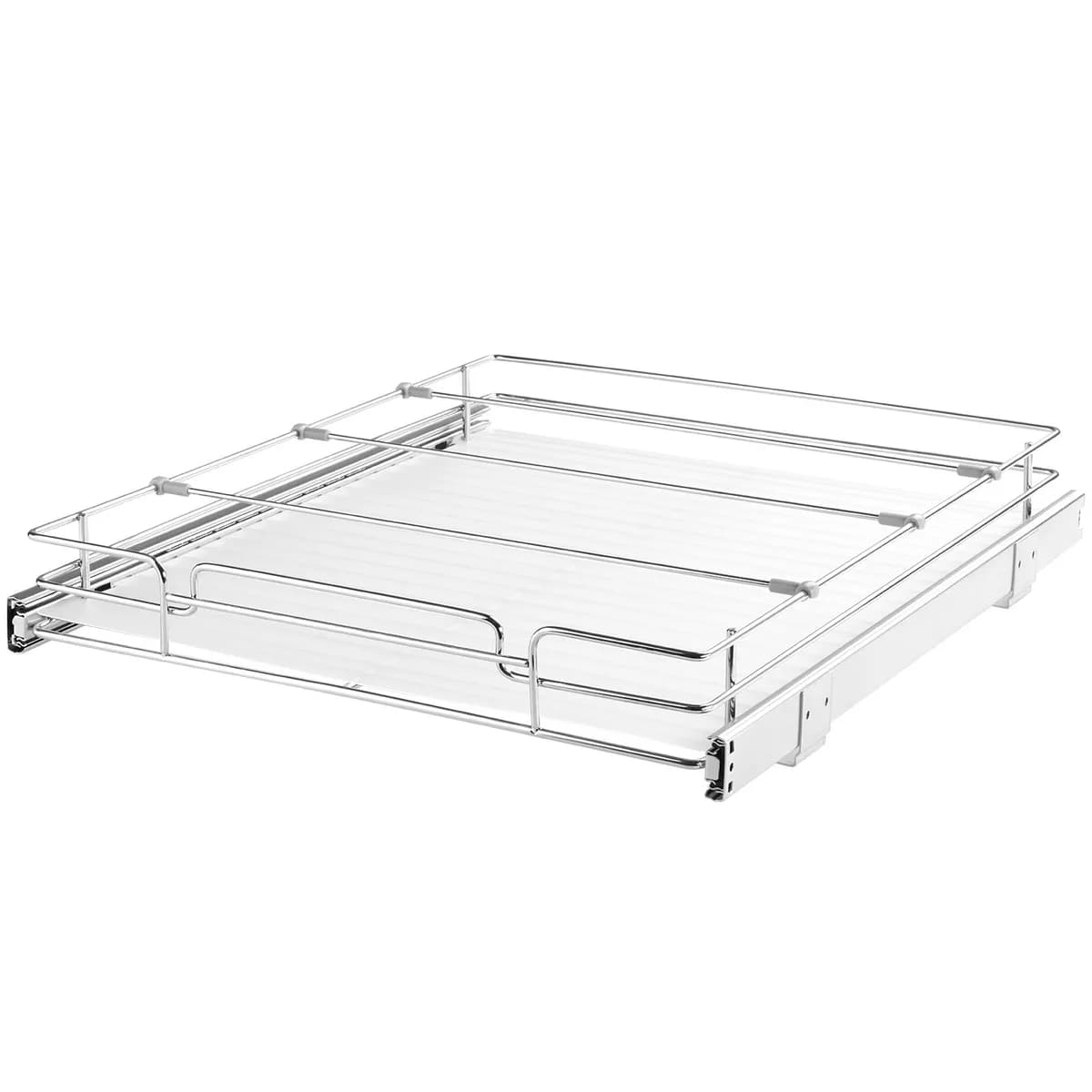
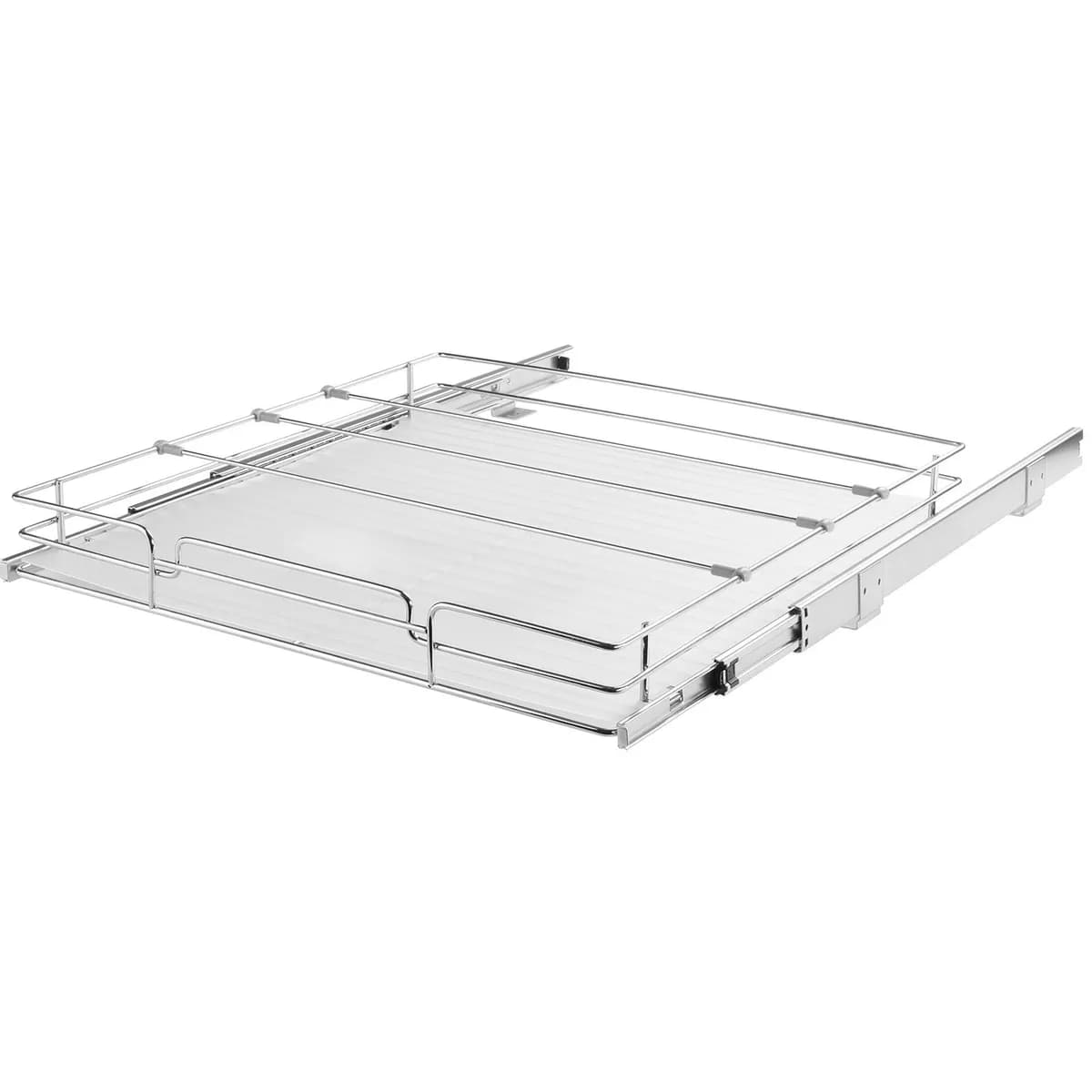
Our Slide-Out Cabinet Drawer is a carbon steel drawer on side rails with an 11.81 x 16.92 in. footprint. It mounts inside a cabinet with adhesive tape rather than screws and slides out up to 13 in., which turns a deep cabinet shelf into a spice drawer you can see into.
Step 5: Label Smart and Sort by How You Cook
Label every jar on the lid if the jars lie flat or stand upright, because the lid is what you see from above. If you use an angled insert, label the side that faces you. Use the same font, size and position on every jar. Printed labels are easiest to read, but neat handwriting on round stickers works just as well.
Then decide on an order. Three common systems:
- Alphabetical: simple and easy for everyone in the house to follow. Best for large collections.
- By frequency: everyday spices at the front, occasional ones at the back. Fastest for daily cooking.
- By cuisine or use: baking spices together, chili and cumin together, Italian herbs together. Great if you cook a few styles often.
Many cooks combine them: frequency decides which zone a spice goes in, and alphabetical order applies within each zone. Salt, pepper and your two or three most used spices sit closest to the front of the drawer.
Step 6: Handle Refills, Blends and Packets
Bulk bags and spice packets are where drawer systems usually break down. Give refills their own home instead of letting them float around. A small lidded box at the back of the spice drawer, or a labeled bin in the pantry, works well. Fold bags tightly and clip them, or decant them into a larger jar.
Seasoning packets for tacos, chili or gravy can stand on edge in a narrow container like files in a cabinet, so you can flip through them. Homemade blends deserve a jar and a label with the date you made them.
Keep a short list on the inside of a cabinet door or on your phone of spices that are running low. When you use the last of a jar, add it to the list right away, and your next shopping trip will cover it.
Cabinet Alternatives When You Have No Drawer
Not every kitchen has a spare drawer near the stove. A few cabinet options give you similar visibility.
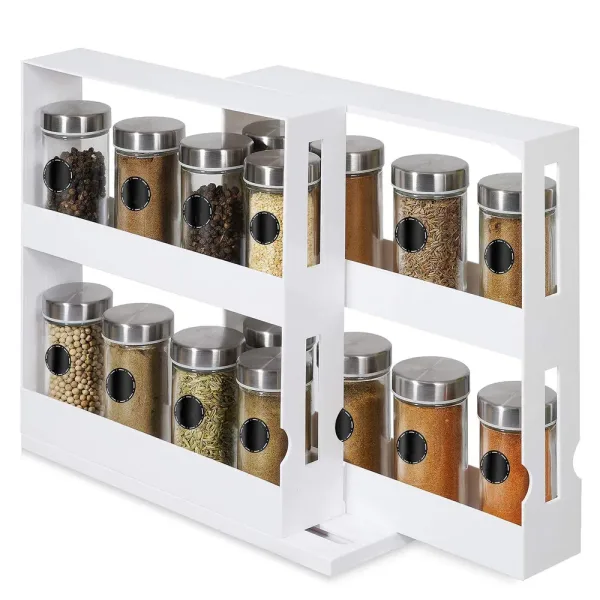
A pull-out or swivel rack brings the back of the cabinet forward. Our Swivel Cabinet Spice Rack has two 2-tier racks, and the front one pulls out and swivels 90 degrees. It holds up to 20 bottles, five per shelf, for bottles up to 1.8 in. wide, and needs no tools or mounting.
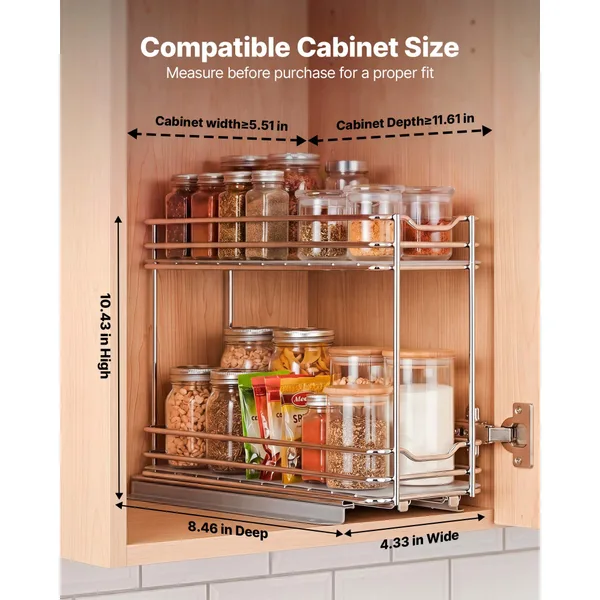
For a narrow gap, our Pull-Out Spice Rack, 2 Tiers is 4.33 in. wide on ball-bearing slides. It fits cabinet openings at least 5.51 in. wide and 11.61 in. deep, so measure first. Other options include a wall-mounted spice rack near the stove or tiered risers on a shelf, covered in our kitchen cabinet organization ideas.
Keep the Spice Drawer Organized
A spice drawer stays organized when putting a jar back is easier than leaving it out. Return each jar to its labeled spot right after use. Wipe spills promptly, since spilled turmeric or paprika can stain a drawer liner.
Every few months, do a quick check: smell a few jars from the back, merge any new duplicates and move spices you have started using more often toward the front. Wash and dry empty jars before refilling, and make sure they are completely dry, because moisture causes clumping.
If the drawer starts overflowing, that is a sign to edit rather than to buy a bigger insert. Our guide on how to keep your kitchen organized covers daily habits that support every zone of the kitchen, not just spices.
Related Products from Sesoris
If you want to turn this guide into a real setup, start with the Slide-Out Cabinet Drawer to create a spice drawer inside a cabinet, or use the Swivel Cabinet Spice Rack and the Pull-Out Spice Rack when a drawer is not an option. For more ideas, browse our Kitchen & Dining collection.
Our practical rule: choose one product that solves the main clutter problem first, then add supporting organizers only when the daily workflow is already clear.
Frequently Asked Questions About How to Organize a Spice Drawer
Q: What is the best way to organize a spice drawer?
Empty and edit your spices, move them into matching jars, use an angled or slotted insert so jars stay in rows, label the lids, and place the spices you use most at the front of the drawer.
Q: Should spice jars lie down or stand up in a drawer?
It depends on drawer height. In shallow drawers, lay jars down with labels on top or use an angled insert. In deeper drawers, jars can stand upright with labels on the lids.
Q: Where should a spice drawer be in the kitchen?
Close to the stove or main prep area, ideally a top drawer, but not directly under the cooktop if that drawer gets warm, since heat makes spices lose flavor faster.
Q: Should I organize spices alphabetically?
Alphabetical order is easy for everyone to follow and works well for large collections. Many cooks keep their most used spices at the front and sort the rest alphabetically.
Q: How do I know if a spice is too old to use?
Open the jar and smell it. If the aroma is weak or the color has faded noticeably, the spice will add little flavor and is worth replacing.
Q: What do I do with spice refills and bulk bags?
Give them a dedicated home, such as a lidded box at the back of the drawer or a labeled pantry bin. Decant into larger jars or fold and clip the bags tightly.
Q: Can I organize spices without matching jars?
Yes. Group store jars by height, label the lids, and use a tiered insert so taller jars sit at the back. Matching jars simply make the drawer easier to scan.
Q: How do I make a spice drawer if my kitchen has none to spare?
Add a slide-out drawer inside a base cabinet, or use a pull-out or swivel spice rack in a cabinet so the back row comes forward when you need it.
Conclusion: A Spice Drawer That Saves Time Every Day
Learning how to organize a spice drawer comes down to six steps: pick the right drawer and measure it, edit your collection, choose jars that fit, add an insert, label and sort by how you cook, and give refills their own home. With every lid visible and every spice in a predictable spot, cooking gets faster and duplicate purchases stop.
Start with the edit, then build the system around what you actually use. For more kitchen ideas, see our kitchen drawer organizer for large utensils and small kitchen organization ideas.
Liked this guide?
Get new organizing guides and the occasional new product by email. No spam, unsubscribe anytime.
Related articles
Explore more articles
- 20+ Best Towel Rack Ideas for Kitchen: Stylish & Functional Solutions in 2026
- Sustainable Living: Eco-Friendly Home Organization
- Ultimate Cleaning Closet Organization: 25+ Smart Solutions to Transform Your Storage Space in 2026
- 35+ Creative Wall Book Shelf Ideas to Transform Your Home Library in 2026
- 30+ Creative Kitchen Counter Organizer Ideas to Transform Your Cooking Space in 2026
- 15 Brilliant Toy Storage Ideas for Living Room: Transform Your Family Space in 2026
- Best Organizer Travel Bags: Ultimate Guide to Smart Packing in 2026
- Best Garage Storage Solutions: Practical Guide