
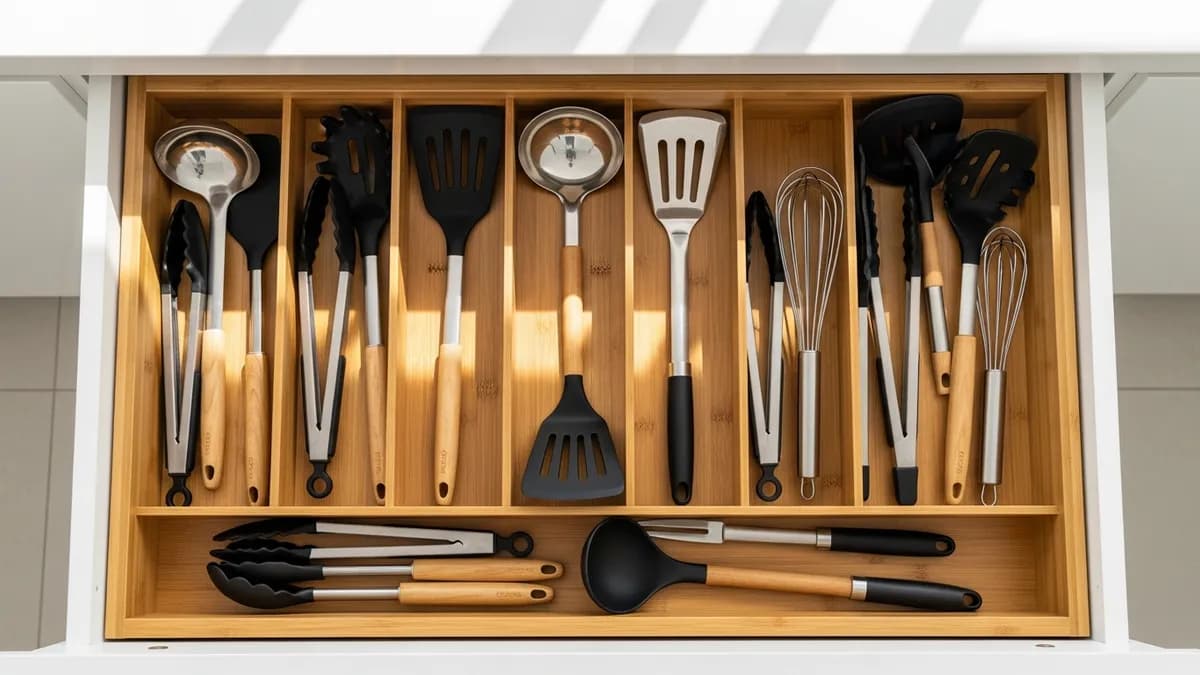
Best Kitchen Drawer Organizer for Large Utensils: Complete 2026 Review & Buying Guide
If you've ever dug through a cluttered drawer just to find your favorite spatula buried under a pile of ladles and tongs, you already know how much a good kitchen drawer organizer for large utensils can change your daily routine. In 2026, the market is flooded with options, from expandable bamboo trays to heavy-duty stainless steel dividers, and picking the right one can feel overwhelming. I've spent time researching and evaluating the most popular styles so you can shop with confidence. Whether you're outfitting a brand-new kitchen or finally tackling that one chaotic junk drawer, this guide covers everything you need to know.
Why You Need a Kitchen Drawer Organizer for Large Utensils
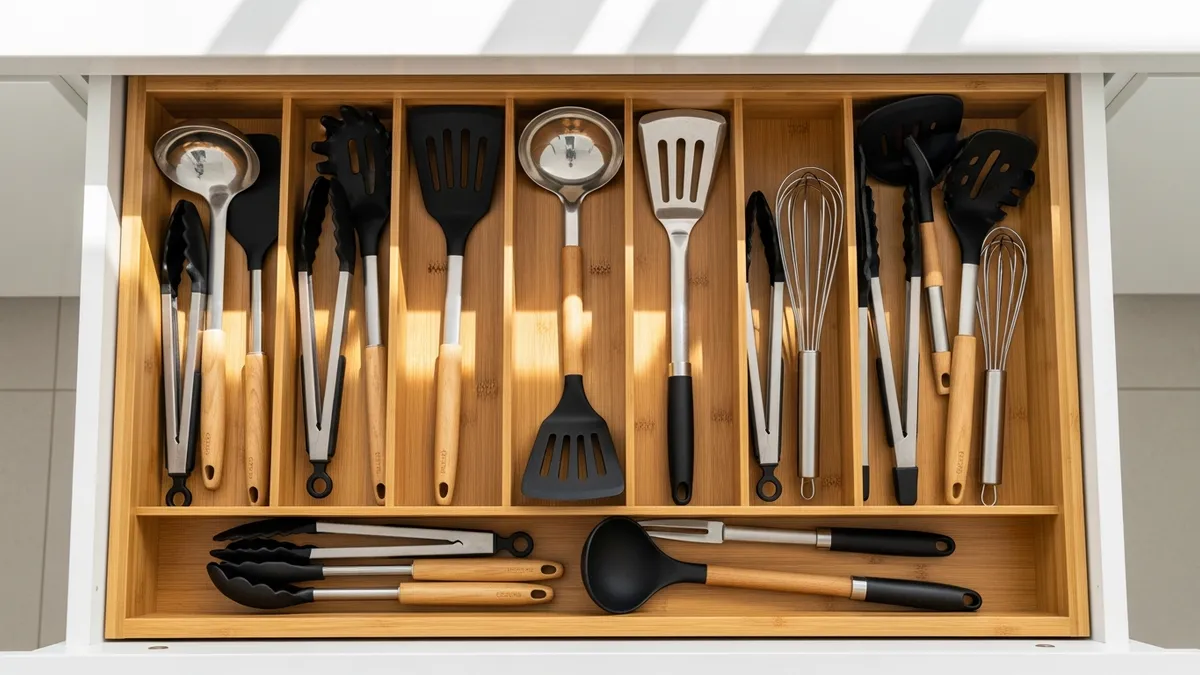
Most kitchen drawers are designed as a one-size-fits-all solution, but large cooking tools simply don't behave like silverware or small gadgets. A standard flatware tray won't accommodate a 14-inch pasta server or a pair of heavy tongs. Without a dedicated kitchen drawer organizer for large utensils, those tools get tossed in together, scratch each other, and take twice as long to find when you're mid-cook.
Beyond convenience, organization actually protects your tools. Silicone-tipped spatulas can crack when crushed, and sharp-edged metal tools can nick wooden handles over time. Giving each utensil its own designated space extends the life of your gear and keeps your kitchen looking intentional rather than chaotic.
One common planning mistake is treating oversized tools like standard flatware. Measure the longest and widest utensils first, then choose an organizer around those dimensions so handles, ladles, and turners do not jam the drawer.
Types of Kitchen Drawer Organizers for Large Utensils
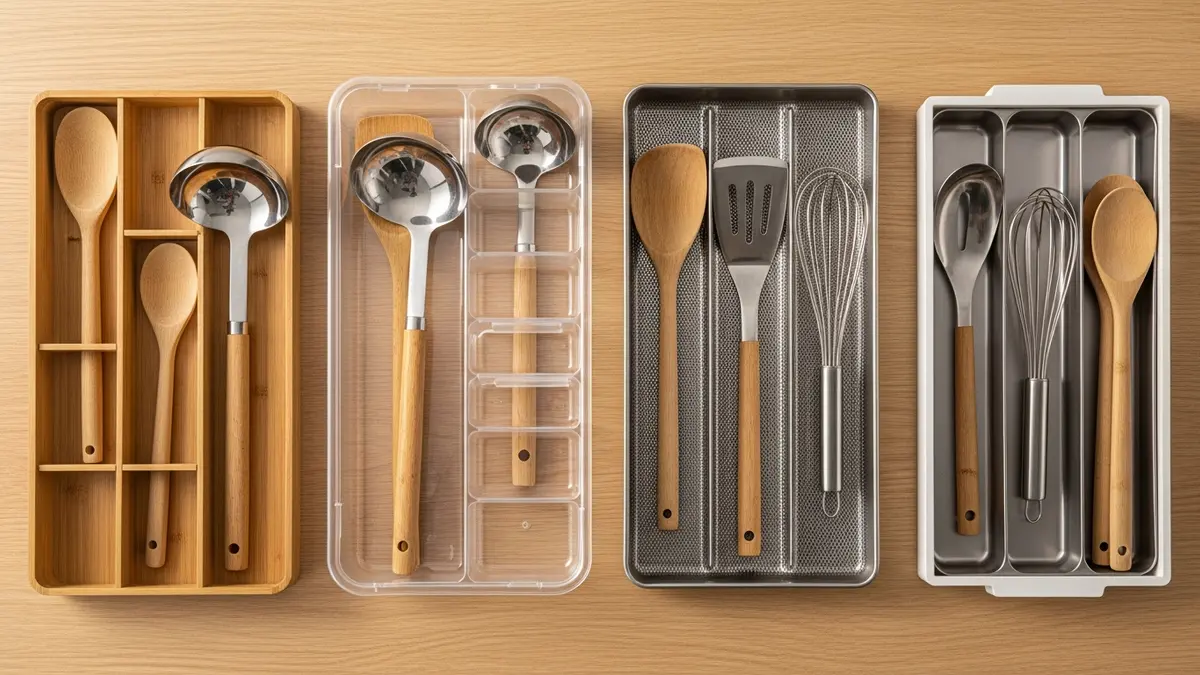
Not all drawer organizers are built alike, and the material and structure you choose will significantly affect both function and longevity. Here are the main types I looked at for this review.
Bamboo Drawer Organizers
Bamboo is one of the most popular choices in 2026, and for good reason. It's sustainably sourced, naturally moisture-resistant, and visually appealing. Bamboo organizers typically come with multiple slots sized 2 to 4 inches wide, which is ideal for fitting ladles, spatulas, and whisks upright or laid flat.
- Pros: Eco-friendly, attractive natural look, doesn't scratch utensils, naturally antibacterial
- Cons: Can warp if exposed to standing water, fixed slot sizes may not fit every utensil shape
- Best for: Home cooks who want an aesthetically pleasing setup that pairs well with wood or neutral kitchen decor
Expandable Plastic Drawer Organizers
Expandable organizers are a godsend for drawers that don't follow standard sizing. These trays feature sliding panels that stretch from about 13 inches up to 21 inches or more in length, making them adaptable to almost any drawer depth.
- Pros: Adjustable fit, budget-friendly, lightweight, available in a wide range of colors
- Cons: Plastic can stain over time, less visually premium than bamboo or metal
- Best for: Renters, budget-conscious shoppers, or kitchens with non-standard drawer depths
Stainless Steel Drawer Organizers
For those who want maximum durability, stainless steel organizers are built to last decades. They resist staining, don't absorb odors, and can handle even the heaviest utensils without bending or warping.
- Pros: Extremely durable, rust-resistant, easy to wipe clean, professional look
- Cons: Heavier than other options, higher price point, can rattle if utensils shift
- Best for: Serious home cooks, professional-style kitchens, or anyone who wants a lifetime purchase
Silicone-Lined Divider Sets
Silicone dividers slot into the drawer itself and create custom compartments without a fixed tray. They're especially good at protecting tool finishes because the soft material prevents scratching.
- Pros: Flexible, protects tool finishes, easy to rearrange, machine washable
- Cons: May shift around unless the drawer has a tight fit, limited structure for very heavy tools
- Best for: Drawers with non-stick pans nearby, or homes with a mix of delicate and sturdy utensils
How to Measure Your Drawer for the Right Fit
This is the step most people skip, and it's exactly why so many organizers get returned. Before you add anything to your cart, grab a tape measure and record three dimensions.
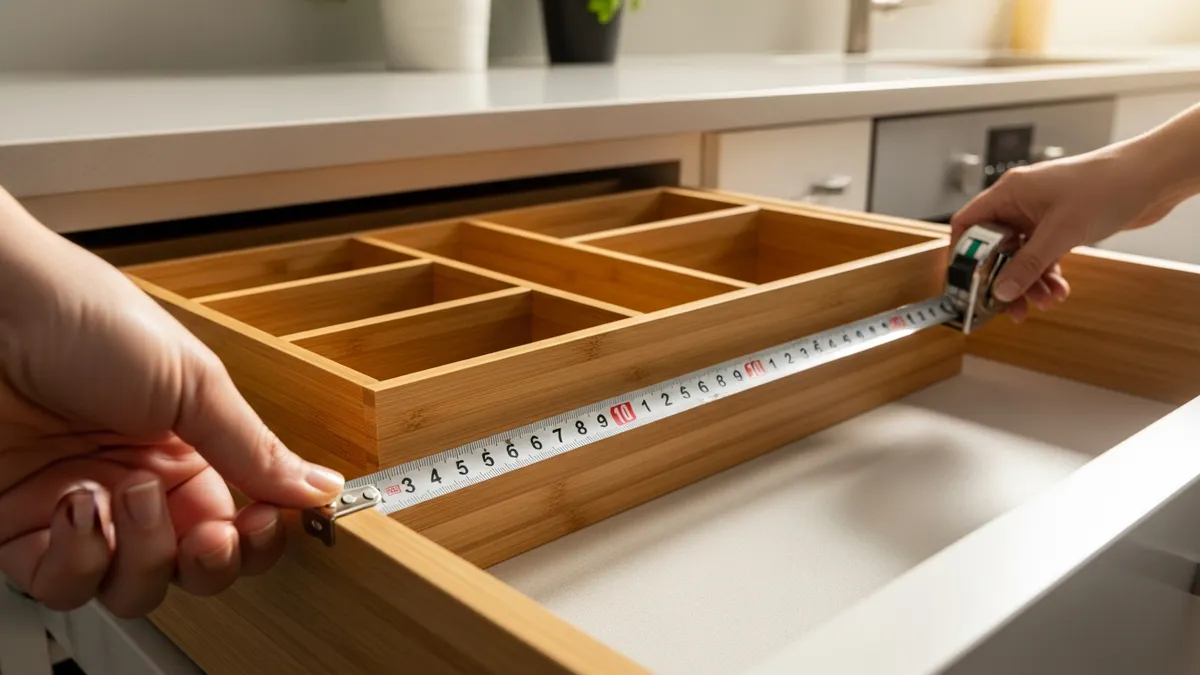
- Width: Measure the interior width of the drawer from one side wall to the other. Most standard kitchen drawers run between 12 and 24 inches wide.
- Depth (front to back): This is the measurement most people forget. Large-utensil drawers are often 18 to 24 inches deep, and not all organizers account for that.
- Height: Measure from the bottom of the drawer to the underside of the counter above it. This tells you how tall your utensils can stand upright without blocking the drawer from closing.
Pro tip: Add at least half an inch of clearance on all sides when selecting your organizer. A snug fit is ideal, but a tray jammed in with no wiggle room will be impossible to remove for cleaning.
Once you have your measurements, compare them against the product specs carefully. Many organizers list their outer dimensions, not the inner slot sizes, so check both. If you're working with a deep drawer (20 inches or more), look specifically for organizers labeled as "deep drawer" or "large capacity" to ensure your longest tools fit without hanging over the edge.
For more ideas on making every inch of your kitchen work harder, check out our small kitchen organization tips and kitchen counter organization ideas.
Top Features to Look for in a Kitchen Drawer Organizer for Large Utensils
After reviewing dozens of products, I narrowed down the features that actually make a difference when organizing large cooking tools. Here's what to prioritize.
Slot Size and Depth
This is the most critical spec for large utensils. Look for slots that are at least 2.5 inches wide and 18 inches long to accommodate standard-sized ladles, pasta servers, and flat-head spatulas. If you own oversized silicone spatulas or extra-long tongs, aim for slots of 3 inches wide or more.
Compartment Count
More compartments don't always mean better organization. For large utensils, you want fewer but wider slots rather than many narrow ones. A 5-to-8-compartment layout is typically ideal for a standard utensil drawer.
Non-Slip Base
Organizers that slide around every time you open the drawer are endlessly frustrating. Look for models with a rubberized or textured bottom, or plan to add a sheet of non-slip drawer liner underneath your organizer.
Easy-to-Clean Surface
Grease and food residue find their way into drawers faster than you'd expect. Smooth surfaces, minimal crevices, and dishwasher-safe materials make maintenance effortless. Bamboo organizers should be hand-washed and dried immediately, while plastic and stainless steel can typically go in the dishwasher.
Expandability
If you're not sure about your drawer's exact sizing, or if you plan to move in the future, an expandable model gives you much more flexibility. Look for spring-loaded or sliding-panel designs that extend without tools.
You can also browse Sesoris Best Sellers for top-rated kitchen organization products that our customers love in 2026.
My Top Picks: Best Kitchen Drawer Organizers for Large Utensils in 2026
Based on features, value, and overall usefulness for large cooking tools, here are the organizer styles I'd recommend most.
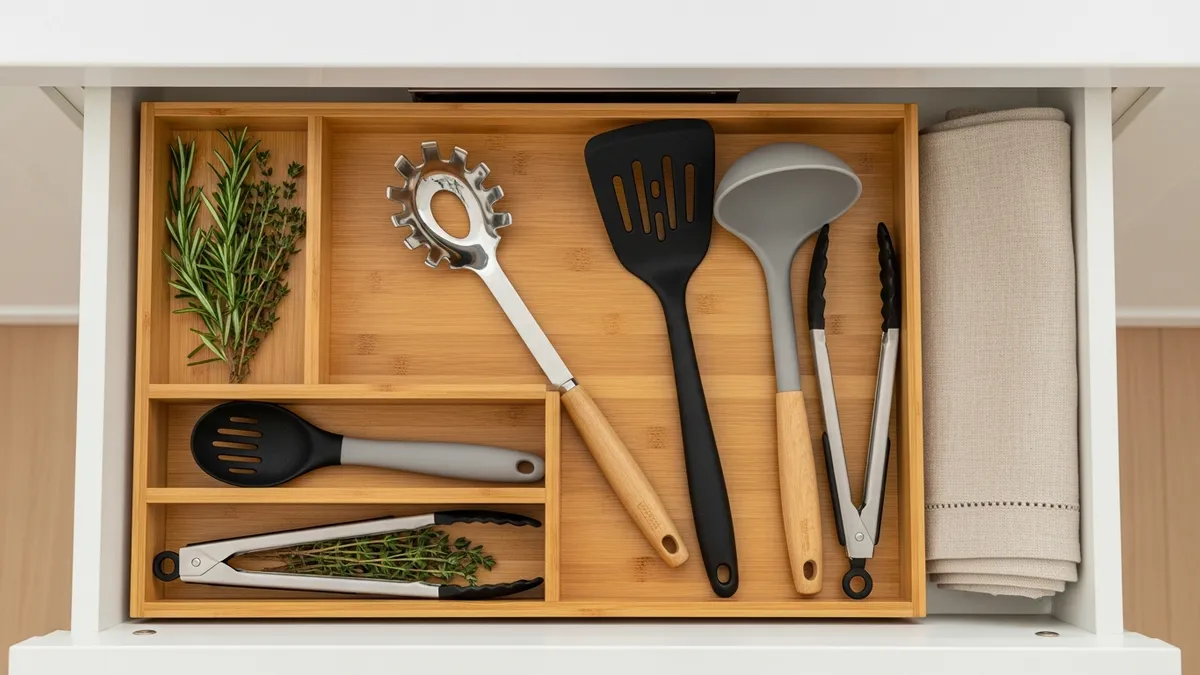
Best Overall: Expandable Bamboo Drawer Organizer
An expandable bamboo model is my top pick for most households in 2026. The combination of adjustable sizing, natural aesthetics, and durable construction makes it the most versatile option. Look for models that expand from at least 13 to 21 inches and include at least 5 compartments of varying widths. The natural bamboo finish pairs beautifully with almost any kitchen style, from modern farmhouse to Scandinavian minimalist.
What I love about it:
- Adjustable length fits a wide range of drawer sizes
- Wide compartments handle large ladles and tongs comfortably
- Sustainable material that looks premium
- Easy to wipe down between deep cleans
Best Budget Pick: Expandable Plastic Drawer Organizer
If you want a functional solution without spending a lot, a well-made expandable plastic organizer delivers impressive results. Look for BPA-free options with smooth interior surfaces and a spring-loaded expansion mechanism. These typically retail in the US$10 to US$20 range, making them accessible for any budget.
Best Premium Pick: Stainless Steel Utensil Drawer Tray
For those who want a forever product, a brushed stainless steel drawer tray is the gold standard. These are heavier and pricier, typically US$30 to US$60, but they'll outlast every other material by years. Look for trays with rolled edges to prevent scratching the drawer interior.
Best for Non-Standard Drawers: Modular Silicone Dividers
If your drawers are an unusual size or L-shaped, modular silicone dividers are the most adaptable option. You configure them to fit exactly what you have rather than buying a fixed tray and hoping it fits.
To explore the full range of kitchen and home organization options, visit the Sesoris Collections page.
How to Style and Maintain Your Utensil Drawer Like a Pro
Getting the right organizer is just half the job. How you arrange your tools inside and how often you clean the drawer determines how long your system stays functional.
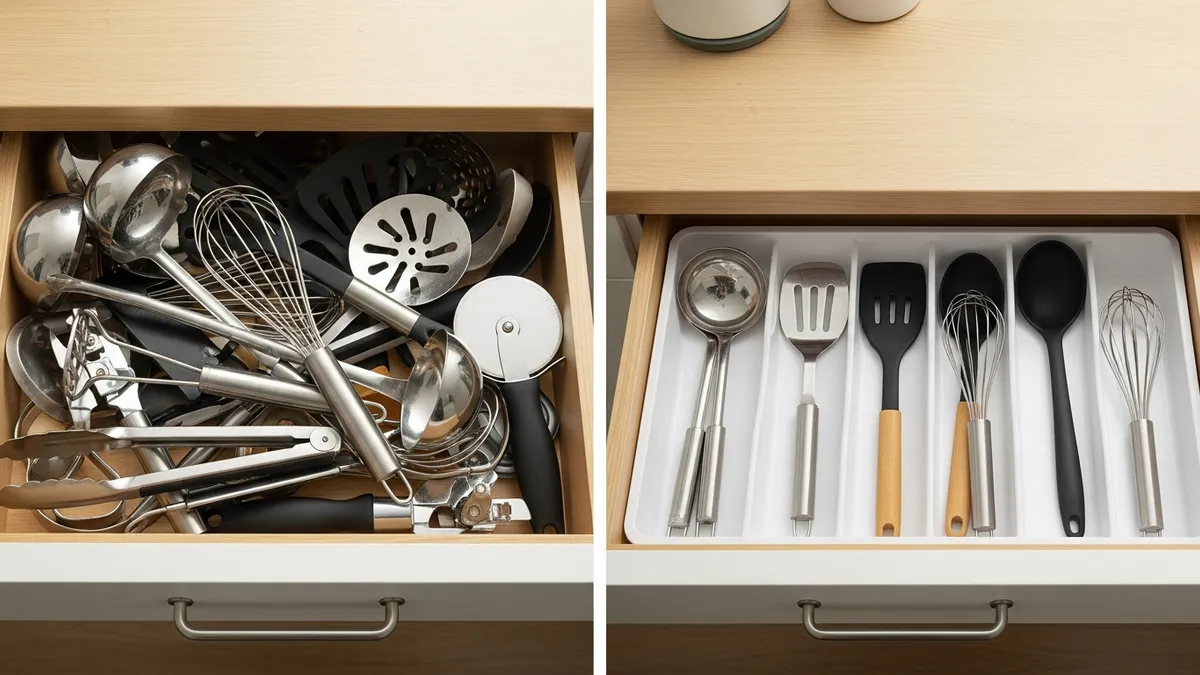
Group by Function, Not by Material
It's tempting to put all wooden utensils together and all metal ones in another section. But a more practical approach is grouping by how often you use them. Keep your daily essentials, like your main spatula, favorite ladle, and tongs, in the front slots. Specialty tools like a pasta server or a basting brush can live in the back.
Limit Yourself to One Drawer
A common mistake is allowing large utensils to overflow into multiple drawers. Commit to one dedicated utensil drawer and edit your collection down to what actually gets used. Review the drawer every six months and remove duplicate or damaged tools that no longer earn their space.
Clean the Organizer Monthly
Even with clean hands, grease and crumbs migrate into the drawer. Pull the organizer out once a month, dump any debris, and wipe down both the tray and the drawer itself. For bamboo models, use a damp cloth and dry immediately. Plastic and stainless models can be rinsed in the sink or run through the dishwasher.
Use Drawer Liners for Extra Grip
A non-adhesive shelf liner cut to fit the bottom of your drawer adds traction so the organizer won't slide and also makes cleanup easier since the liner catches stray crumbs.
For more ideas on keeping your entire kitchen neat and functional, read our kitchen pantry organization ideas and kitchen cabinet organization ideas.
What Real Home Cooks Say About Large Utensil Drawer Organizers
I browsed through verified product reviews and home organization communities to get a sense of what everyday users genuinely find useful. Here are the themes that came up repeatedly.
"I never realized how much time I was wasting searching for the right tool. After getting a proper drawer organizer sized for my big utensils, cooking prep feels so much smoother."
The most consistent complaint across reviews was products being marketed as "large" while only fitting standard dinner-sized utensils. If a product listing doesn't specifically mention slot lengths of 15 inches or more, it's likely designed for smaller tools.
Users with deeper drawers (20 inches or more) consistently recommended expandable bamboo or modular divider systems over fixed plastic trays, noting that fixed trays left significant wasted space in the back of the drawer.
Home organization enthusiasts on Pinterest also frequently highlight the aesthetic upgrade that comes with replacing a random pile of tools with a clean, organized bamboo tray. The visual transformation alone motivates many people to maintain the system long-term.
Related Products from Sesoris
If you want to turn this guide into a real setup, start with Stainless Steel 2-Tier Dish Rack and Portable Blender. For broader options, browse the Kitchen & Dining collection so the article journey does not stop at reading only.
Our practical rule: choose one product that solves the main clutter problem first, then add supporting organizers only when the daily workflow is already clear. This keeps the shopping path useful, not pushy.
FAQ: Frequently Asked Questions About Kitchen Drawer Organizers for Large Utensils
Q: What size drawer organizer do I need for large utensils?
For most large cooking utensils, you want an organizer with slots at least 15 to 18 inches long and 2.5 to 3.5 inches wide. Standard full-size spatulas and ladles typically measure 12 to 14 inches, so you need a tray that gives at least an inch or two of extra length on each end.
Q: Can I use a regular silverware organizer for large utensils?
A standard silverware tray is usually too short and too narrow for large cooking tools. The slots in a typical flatware organizer run 7 to 9 inches long and less than 2 inches wide, which won't accommodate most spatulas, ladles, or tongs. You'll need a dedicated large-utensil organizer.
Q: How many utensils should I keep in one drawer?
This depends on your drawer size, but a good rule of thumb is to keep no more than 8 to 10 large utensils in a single drawer. Any more than that and the drawer becomes difficult to use efficiently. Edit your collection to keep only the tools you reach for regularly.
Q: Is bamboo or plastic better for a kitchen drawer organizer?
Both are excellent depending on your priorities. Bamboo looks more premium and is eco-friendly, but it requires hand-washing and careful drying. Plastic is dishwasher-safe, more affordable, and available in more size configurations. For a forever piece, stainless steel beats both.
Q: How do I keep my drawer organizer from sliding around?
Place a non-slip drawer liner cut to the size of your drawer underneath the organizer. Alternatively, look for organizers with a rubberized or textured bottom built in. Some bamboo models also have notched corners that grip the drawer walls when expanded.
Q: Do expandable organizers work for very large or deep drawers?
Yes, expandable models are specifically designed for this. Look for ones that extend to at least 20 to 21 inches in depth to cover a large drawer fully. Some modular silicone systems can be configured to fill even deeper or oddly shaped drawers.
Conclusion
Finding the right kitchen drawer organizer for large utensils is one of those small upgrades that has an outsized impact on how smoothly your kitchen runs every single day. In 2026, there's genuinely something for every kitchen type, budget, and organizational style, whether you gravitate toward a natural bamboo expandable tray, a sleek stainless steel model, or a flexible silicone divider system. The key is measuring your drawer first, identifying which utensils you actually use most often, and choosing an organizer with slots wide and long enough to accommodate your biggest tools properly.
Once you make that switch from chaotic pile to structured order, you'll wonder how you cooked without it. Ready to take the next step toward a fully organized kitchen? Explore the Sesoris shop for a curated selection of kitchen and home organization solutions designed to help you live more organized. You can also check out our new arrivals for the latest products hitting our shelves in 2026.
Weekly Home Tips
Get home organization ideas, product picks, and exclusive deals delivered weekly.
No spam. Unsubscribe anytime.
Explore More Articles
- Simple Ramadan Decoration Ideas to Create a Festive Home Atmosphere
- 25+ Creative Walk In Pantry Organization Ideas to Transform Your Kitchen Storage in 2026
- Stove Cabinet: Integrated Design Solutions for Organized Kitchens
- Shoe Storage Ideas for Garage Spaces: A Homeowner's Guide
- Entryway Wall Organization: 15 Smart Ideas to Transform Your Home's First Impression in 2026
- Aluminum Stove Tables: Lightweight & Rust-Resistant Kitchen Solutions 2026
- Small Kitchen Cabinet Ideas: 2026 Design and Storage Guide
- 25+ IKEA Closet Organization Ideas to Transform Your Wardrobe Storage in 2026