
Ideas for Linen Closet Organization: A Practical, Source-Backed Guide for 2026
Discover practical ideas for linen closet organization in 2026. Source-backed tips, product specs, and smart storage strategies for every home.
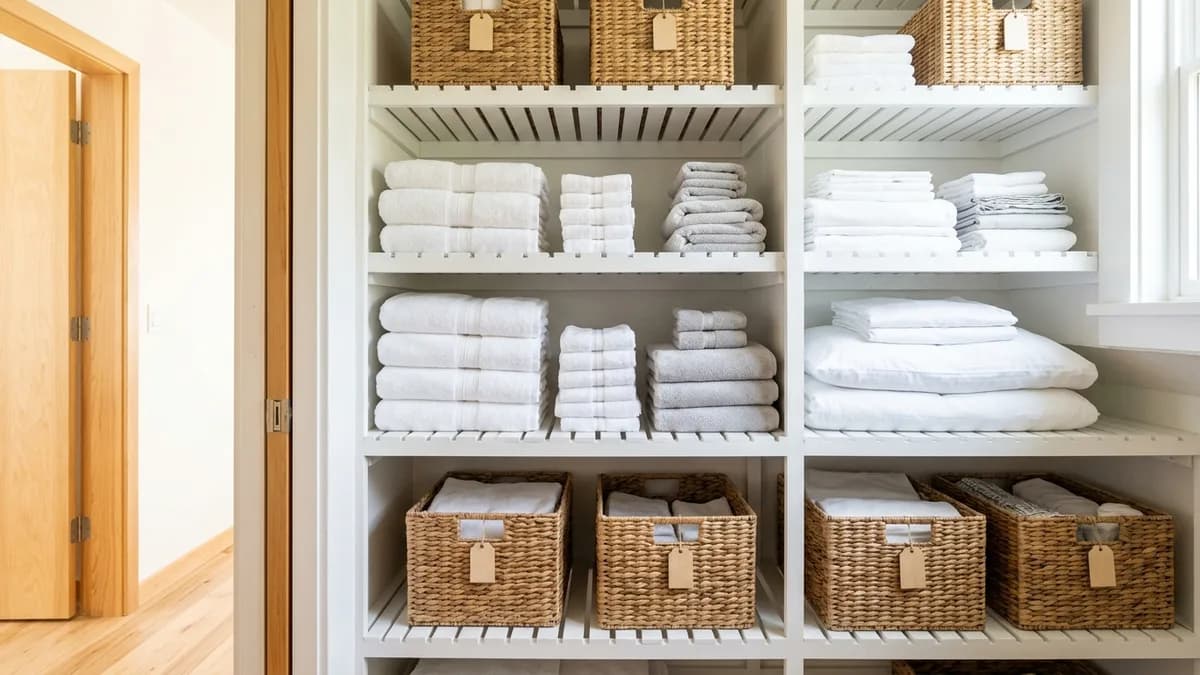
If your linen closet has become a catch-all for mismatched sheets, half-used toiletries, and teetering towers of towels, you are not alone. Finding real, workable ideas for linen closet organization that hold up over time is something most households genuinely need. This guide takes a source-backed, practical approach: I break down what actually makes a linen closet function well, what organizational tools are worth buying based on their documented specs and materials, and how to maintain the system once it is set up. Whether your closet is a narrow single-rod space or a generous walk-in, these strategies apply.
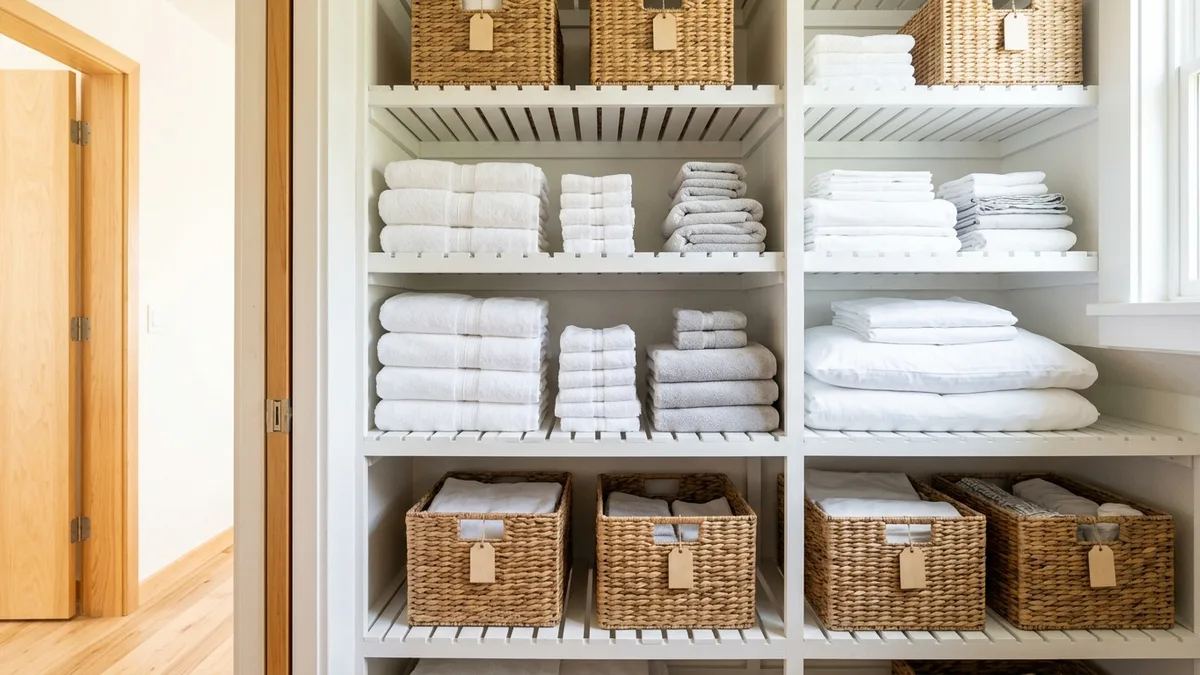
Why Most Linen Closets Fail and What the Research Says
Most linen closets do not fail because of a lack of storage space. They fail because of how that space is used. According to The Spruce, the single biggest organizational mistake people make in linen closets is not grouping like items together and not using vertical space efficiently. The average US linen closet is between 24 and 36 inches wide and roughly 12 to 16 inches deep per shelf. That is actually enough room for most households if the space is used methodically.
The core problem is that linen closets tend to hold items from multiple categories: bath towels, hand towels, washcloths, bed sheets sorted by room, pillowcases, spare blankets, extra toiletries, cleaning supplies, and sometimes first aid items. Without a clear system, these categories collapse into one another and the closet becomes impossible to navigate.
Understanding your closet's actual dimensions is the first practical step. Measure shelf height, depth, and width before buying a single organizational product. This one action prevents wasted money on bins that do not fit.
The Practical Framework Behind Good Ideas for Linen Closet Organization
Before picking products, establish a framework. The best ideas for linen closet organization follow a consistent logic: categorize first, assign zones, then containerize. This order matters.
Step 1: Categorize Everything in the Closet
Pull everything out. Sort into categories:
- Bath towels (full-size, by household member or by bathroom)
- Hand towels and washcloths (guest sets vs. everyday use)
- Bed linens (sorted by bed size: twin, full, queen, king)
- Pillowcases (matched or separated)
- Extra blankets and throws
- Toiletry backstock (soap, shampoo, toilet paper)
- Cleaning supplies (if your closet doubles as a utility space)
- First aid or medicine (only if the closet is accessible and cool)
Anything that does not belong in a linen closet should be relocated now. Do not organize clutter. Remove it.
Step 2: Assign Zones Based on Frequency of Use
Eye-level shelves, typically between 48 and 60 inches from the floor, should hold what you reach for daily: everyday bath towels and the bed linens currently in rotation. Upper shelves work for seasonal blankets and guest linens. The floor or lowest shelf handles bulky or overflow items like toilet paper backstock or cleaning caddies.
Real Simple recommends treating a linen closet the same way you treat kitchen cabinets: the most-used items get the most accessible spots, and everything else stacks up or goes low.
Step 3: Containerize by Zone
Only after the first two steps should you buy organizational products. Containerizing before categorizing is what leads to buying the wrong bins in the wrong sizes.
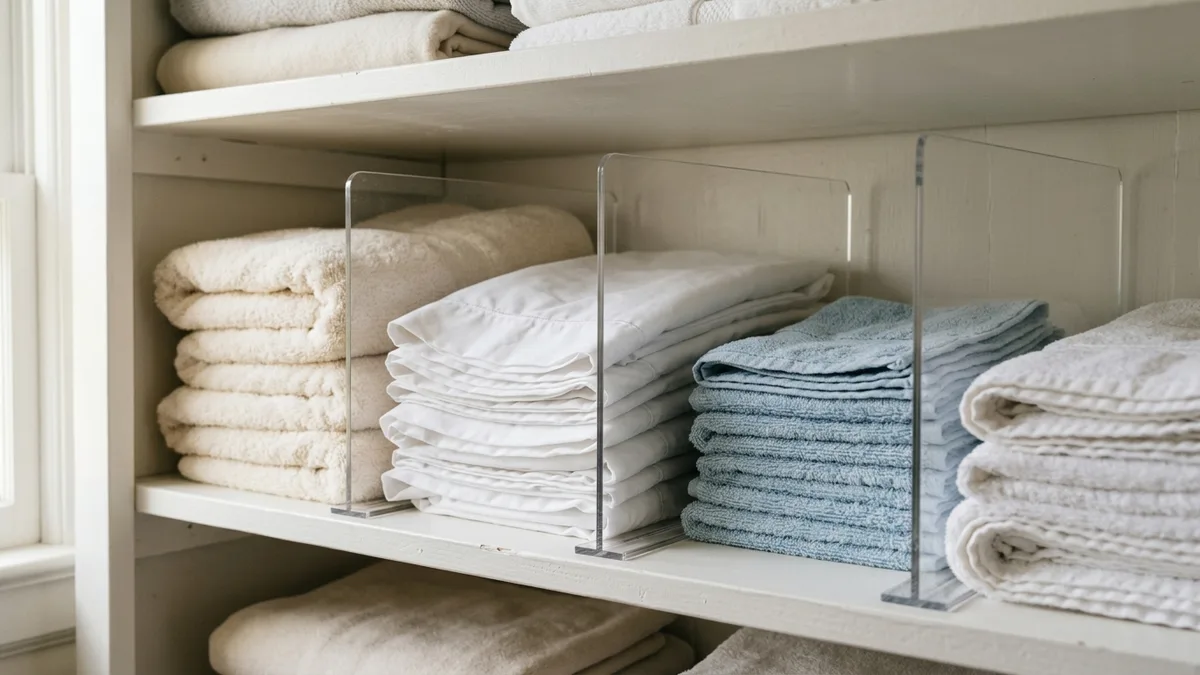
Shelf Dividers: A Low-Cost Tool With Documented Impact
Shelf dividers are one of the most underrated linen closet organization ideas available. They clip onto existing shelves and create defined columns within a shelf. Acrylic versions are easy to clean and let you see what is in each column at a glance. Metal or coated-wire dividers are more durable for heavier towel stacks.
Based on product specs commonly documented by home organization retailers, most shelf dividers accommodate shelf depths of 10 to 14 inches and clamp onto shelves up to 1 inch thick. Before buying, confirm your shelf thickness. A divider that does not clamp properly is a safety hazard.
Shelf dividers work especially well for:
- Separating folded towels by type within the same shelf
- Keeping pillowcase stacks from toppling into sheet stacks
- Creating a clear visual boundary between bedroom sets
They do not work well on wire closet shelves without an adapter, so check your shelf type first.
Bins, Baskets, and Labeled Containers: The Foundation of a Working System
Matching bins and baskets do more than look good. They create uniform visual rows that make the closet feel intentional, which psychologically makes it easier to maintain. Good Housekeeping notes that labeled storage containers significantly reduce the time it takes household members to find and return items correctly, which in turn maintains the organization system over time.
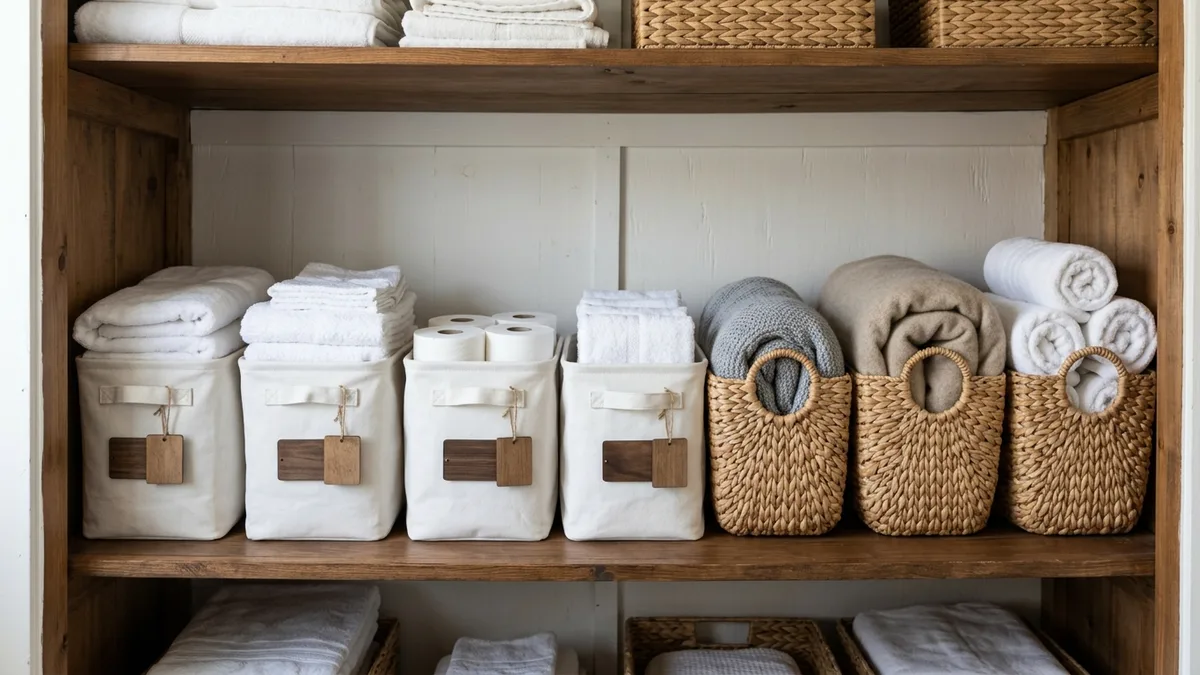
Canvas Bins
Canvas bins are lightweight, collapsible when empty, and available in sizes that typically span 10 to 14 inches wide and 8 to 11 inches tall. They work well for washcloths, rolled hand towels, and toiletry backstock. Look for bins with reinforced handles if you plan to pull them in and out frequently.
Wicker and Rattan Baskets
Natural wicker baskets bring warmth to a closet and handle well for heavier items like extra blankets. They are harder to clean than canvas or plastic, so keep them away from moisture-prone areas. Most standard wicker baskets fit shelves 12 inches deep comfortably.
Clear Plastic Bins
Clear bins with lids are ideal for toiletry backstock. You can see the contents without opening the bin, which is a documented advantage in reducing time spent searching. Look for bins with smooth interior surfaces that resist staining from soap or shampoo bottles.
Labeling
Printed labels beat handwritten ones for long-term readability. A label maker or printed adhesive labels on bin fronts or edges immediately communicate what belongs where. Categories to label include: Bath Towels, Hand Towels, Queen Sheets, King Sheets, Guest Linens, Toilet Paper, Cleaning, and any bedroom-specific groupings your household uses.
For a deeper look at labeling systems that work across the whole home, check out our Storage Bin Labels guide.
Over-the-Door Organizers: Turning Dead Space Into Active Storage
The inside of a linen closet door is one of the most consistently wasted surfaces in American homes. An over-the-door organizer, either a pocket-style fabric unit or a metal rack with hooks and small shelves, can add 15 to 25 functional storage slots without touching a single shelf.
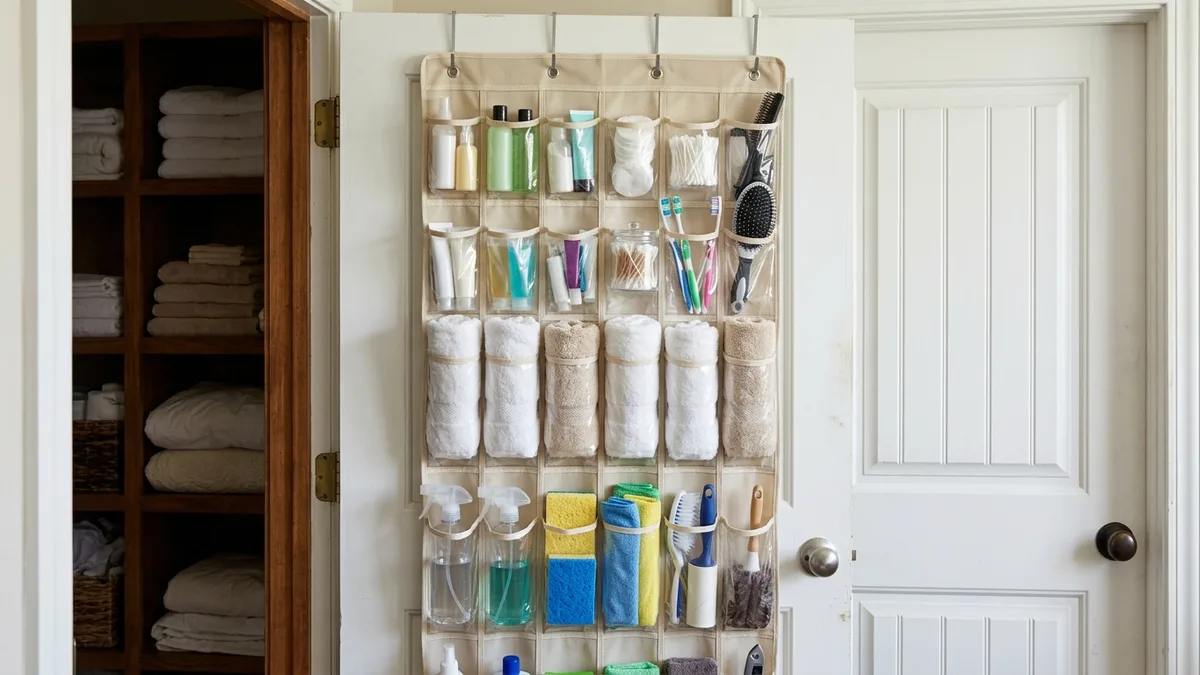
Over-the-door pocket organizers with clear pockets are particularly useful for:
- Small toiletry bottles (travel size shampoo, conditioner, lotion)
- First aid supplies (bandages, pain relievers, thermometers)
- Rolled hand towels or washcloths
- Cleaning brushes, sponges, or rubber gloves
Before purchasing, measure the door clearance: the gap between the door and the first shelf when the door is closed. Most over-the-door rack systems require 1.5 to 2 inches of clearance. A rack that catches on shelving when you close the door is dangerous.
Houzz design guides frequently highlight door-mounted storage as one of the most space-efficient upgrades for smaller linen closets specifically because it adds capacity without requiring new shelving or structural changes.
The Right Way to Fold and Store Linens
No organizational system compensates for poor folding technique. Inconsistent folding is why towel stacks topple and sheet piles expand uncontrollably. Two folding methods are consistently recommended by home organization experts:
The Ranger Roll for Towels
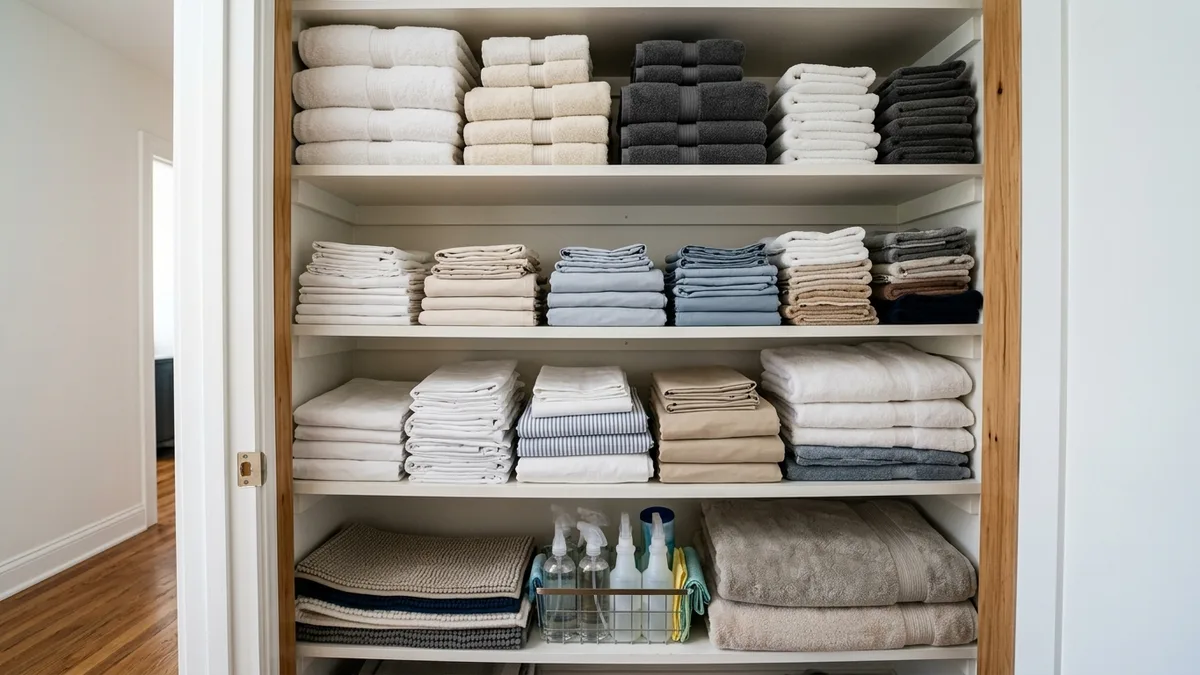
The ranger roll (a tight cylinder fold originally used in military packing) stores towels standing upright in a bin. Upright storage lets you see every towel at a glance and grab one without disturbing the others. It also tends to fit more towels per linear foot of shelf than flat stacking.
The Bundle Fold for Sheet Sets
Store each sheet set as a bundle inside one of its own pillowcases. The pillowcase acts as a self-contained pouch. The complete set (flat sheet, fitted sheet, and remaining pillowcase) stays together and takes up less space than individually folded pieces stored side by side. This method eliminates the "orphan sheet" problem where components of a set become separated.
Folding Washcloths for Vertical Display
Fold washcloths into thirds and store them standing upright in a canvas bin, similar to the ranger roll method. This is sometimes called the "file fold" method, which became widely documented through professional organizer workflows. Vertical storage of washcloths in a bin allows you to see all of them at once and removes the pressure of keeping a perfect stack.
Shelf Depth and Adjustability: What to Know Before You Modify
Standard linen closet shelves in US homes are typically 12 inches deep and fixed at intervals of about 12 to 16 inches. This works for folded towels and sheet bundles but can be limiting for bulky blankets or taller storage bins.
If your closet has adjustable shelving, reconfigure shelf heights before buying organizational products. Raising one shelf by 4 inches can allow a taller bin to fit underneath, which dramatically increases usable volume.
If your closet has fixed shelves you cannot adjust, consider these workarounds:
- Stackable shelf inserts: These sit on an existing shelf and create a second level within the same shelf opening. They are particularly useful when shelf spacing is wider than what your folded linens require.
- Tension rod dividers: Installed vertically within a shelf bay, tension rods create columns without permanent hardware.
- Hanging shelf organizers: These hook over a fixed shelf and add one or two hanging canvas shelves below it, effectively multiplying storage tiers.
For households thinking about a full closet system upgrade, our Modular Closet Organization guide covers adjustable systems in detail.
Maintaining the System: The Most Overlooked Part of Linen Closet Organization
Setting up a great organizational system is the easy part. Maintaining it is where most households struggle. These habits make maintenance realistic:
One in, one out rule: Every time a new set of sheets or towels enters the closet, an old one leaves. This prevents gradual overflow back to baseline chaos.
Designated donation bin: Keep a small bin or bag on the floor of the closet or nearby for items to donate. When it fills, it goes.
Seasonal resets: Twice a year (spring and fall work naturally with the change of bedding weight), do a full pull-out and reorganize. This catches items that have migrated out of their zones and allows you to reassess what is actually being used.
Household buy-in: If other household members cannot find something, they pile it rather than file it. The labeling system mentioned earlier directly addresses this. A label tells every person in the house exactly where something goes.
Budget Considerations: What to Prioritize When You Cannot Buy Everything at Once
A full linen closet makeover with matching bins, new shelf systems, and an over-the-door organizer can add up quickly. If budget is a constraint, here is the priority order based on impact per dollar:
- Labels and a label maker (under US$20 for most basic options) deliver the highest behavioral impact because they make the system self-maintaining.
- Shelf dividers (typically US$10 to US$25 for a set of six) immediately prevent pile collapse and cost very little.
- Two or three matching bins for the most problematic categories (usually washcloths and toiletry backstock) bring visual cohesion to the eye-level shelf.
- An over-the-door organizer (US$20 to US$45 for most fabric pocket versions) adds substantial capacity without touching shelves.
- A full bin set to standardize all shelf storage is the finish line, not the starting point.
Buying one or two bins at a time from the same product line is a practical approach because you can expand incrementally while maintaining a consistent look. You can browse Sesoris storage collections to find bins and baskets that match across multiple purchases.
Related Products from Sesoris
If you want to turn this guide into a real setup, start with Stackable Storage Bins, 24 Pack and Pull-Out Cabinet Organizer, 17 in. Wide. For broader options, browse the Home & Decor collection so the article journey does not stop at reading only.
Our practical rule: choose one product that solves the main clutter problem first, then add supporting organizers only when the daily workflow is already clear. This keeps the shopping path useful, not pushy.
FAQ: Frequently Asked Questions About Ideas for Linen Closet Organization
Q: How many sets of sheets should I keep per bed?
Two to three sets per bed is the generally accepted standard for most US households: one on the bed, one clean and ready, and optionally one spare for guests or emergencies. More than three sets per bed tends to create overcrowding in the closet.
Q: Should towels be stored folded or rolled?
Both methods work. Rolled towels stored upright in a bin take up less horizontal space and make individual towels easier to grab without disturbing the stack. Flat-folded towels stacked on a shelf work well when you have plenty of shelf depth and a divider keeping the pile contained. Choose based on your shelf dimensions.
Q: How do I keep the linen closet smelling fresh?
Store linens completely dry before closing the closet. Even slightly damp towels cause musty odors and mildew. Cedar blocks, small pouches of dried lavender, or unscented baking soda sachets placed on shelves absorb odors without adding artificial fragrance. Replace or refresh these every few months.
Q: Can I store cleaning supplies in a linen closet?
Yes, but keep them on the lowest shelf in a contained caddy so they cannot drip onto linens. Keep cleaning chemicals away from any first aid items. If children are in the household, a childproofed lower shelf or a locked caddy is the safer choice.
Q: What if my linen closet has only wire shelves?
Wire shelves make bin placement tricky because bins can tip into the gaps. Shelf liner boards cut to size and laid over the wire provide a flat, stable surface. These are inexpensive and widely available at home improvement stores.
Conclusion: Ideas for Linen Closet Organization That Actually Stick
The best ideas for linen closet organization are not about buying the most products or having the prettiest closet on social media. They are about creating a system that every person in your home can use and return to correctly, every single time. Start by measuring your space, categorizing what you have, assigning zones by frequency of use, and then selecting containers that fit your actual shelf dimensions. Layer in shelf dividers, an over-the-door organizer, and consistent labeling, and you have a system that works in 2026 and beyond.
If you are ready to shop for the storage bins, baskets, and organizers that make this happen, explore our best sellers and new arrivals at Sesoris. Every product we carry is chosen to help you live more organized.
Liked this guide?
Get new organizing guides and the occasional new product by email. No spam, unsubscribe anytime.
Related articles



Explore more articles
- Best Storage Food Containers: Complete 2026 Review & Buying Guide for a Fresher, More Organized Kitchen
- Kitchen Food Storage Containers: The Ultimate 2026 Guide to Fresh, Organized Kitchens
- Stainless Food Storage Containers: The Ultimate 2026 Guide to Durable, Healthy Kitchen Organization
- Best Pet Food Storage Containers in 2026: Complete Buyer's Guide to Keeping Kibble Fresh
- Best Storage Solutions in Garage: 30+ Smart Ideas to Transform Your Space in 2026
- Food Storage Containers with Lid: The Complete 2026 Buyer's Guide to Fresh, Organized Kitchens
- 25+ Best Organization Ideas for a Small Closet to Maximize Every Inch in 2026
- Storage Containers for Dog Food: Complete 2026 Guide to Keeping Your Pet's Kibble Fresh