
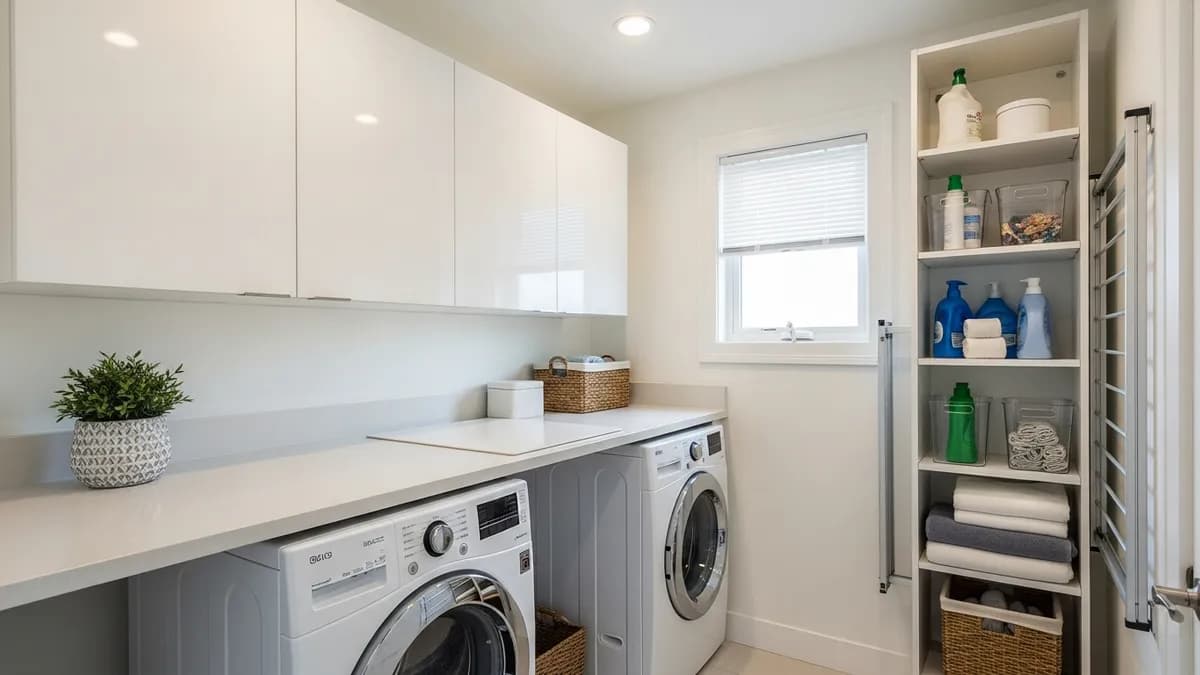
Laundry Room Organization: Simple Guide for Small Homes
Laundry room organization is a system for arranging your washing, drying, folding, and detergent storage so the laundry routine runs faster, safer, and without clutter. The key is not a big room. The key is dividing the space into work zones, using vertical storage, labeling everything, and placing items along the path you actually walk every day.
In my experience, laundry room problems rarely come from a family not trying hard enough. They come from a room with no rules. Detergent lives on the floor, clothespins wander, clean clothes mix with the to-be-ironed pile, and the whole thing starts to feel like a chore that never ends.
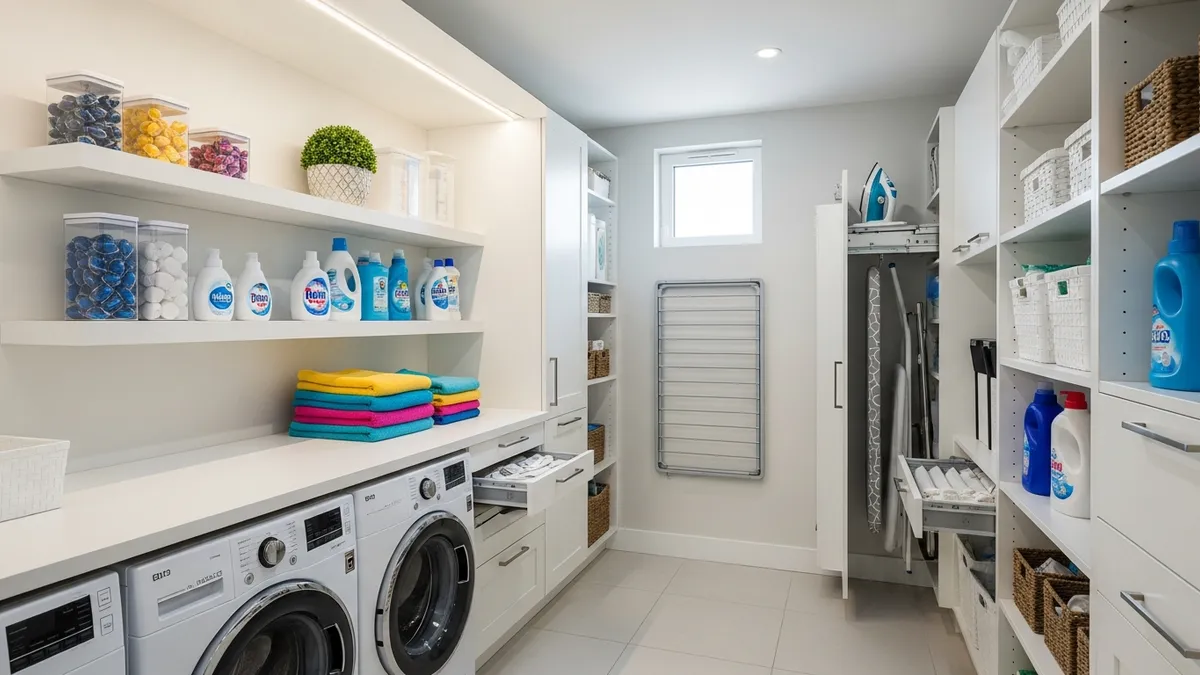
Key Takeaways: > - Separate zones for washing, drying, folding, ironing, and backup stock > - Use vertical shelving so the floor stays clear > - Store detergent and chemicals out of children's reach > - Use labels so everyone in the house knows where things go back > - Audit the laundry area weekly, not only when it overflows
Why Laundry Room Organization Matters
Laundry room organization matters because the laundry area in most homes has to juggle several jobs at once. Often it is not a dedicated room at all, but a corner near the bathroom, a utility nook, or a spot behind the kitchen. Left unmanaged, one small corner turns into a dumping ground for clothes, cleaning tools, detergent, hangers, and seasonal odds and ends.
In my view, the most common mistake is treating the laundry area like a mini warehouse. Everything without a home ends up there. Yet its core job is simple: move dirty clothes toward clean clothes. Once that job gets blurry, the daily process falls apart with it.
Start with one simple principle: every item in the space must support the laundry process. Detergent, fabric softener, laundry baskets, hangers, clothespins, brushes, and ironing gear belong here. Old boxes, decor stock, and project tools belong somewhere else.
Energy use deserves attention too. The <a href='https://www.energy.gov/energysaver/laundry'>Energy Saver guide from the U.S. Department of Energy</a> explains how washing habits, drying choices, and water temperature affect energy efficiency. So a tidy laundry room is not just easier on the eyes; it helps the whole house run leaner and more predictably.
Start with an Audit of the Laundry Area
The first step is not buying new shelves; it is pulling everything out of the laundry area. Lay it all on the floor or a table, then sort into four groups: used weekly, used monthly, backup stock, and things that have nothing to do with laundry at all.
From the Sesoris team's experience, this audit tends to reveal funny truths. Many homes own three half-empty bottles of fabric softener, two identical brushes, and clothespins scattered across several bags. Once everything is visible, the duplicate buying stops.
Use the 90-day rule. If a laundry item has not been used in three months and has no clear seasonal purpose, consider relocating it or letting it go. For detergent stock, keep at most one backup per type. Overstocking fills the shelves fast and sometimes leaves products expired or clumped.
Do not skip the safety check. Cleaning chemicals should never be stored in old drink bottles. If you must decant into a container, use a large, unmistakable label. In homes with small children, the ideal spot is a high shelf or a closed cabinet.
Create Zones for Washing, Drying, Folding, and Ironing
A laundry room that is pleasant to use always has zones. You do not need a big room. Even a 3 x 6 foot corner becomes far more functional when every activity has a fixed spot. The washing zone sits by the machine or basin. The drying zone holds hangers, clothespins, and baskets. The folding zone needs a flat surface. The ironing zone needs a rack or rod for finished clothes.
In my opinion, the folding zone is the most commonly forgotten piece. Plenty of people wash diligently, but clean clothes pile up on a chair because there is nowhere to fold. The fix can be simple: a wall-mounted folding table, a folding board on top of the washer, or a large tray you can move around.
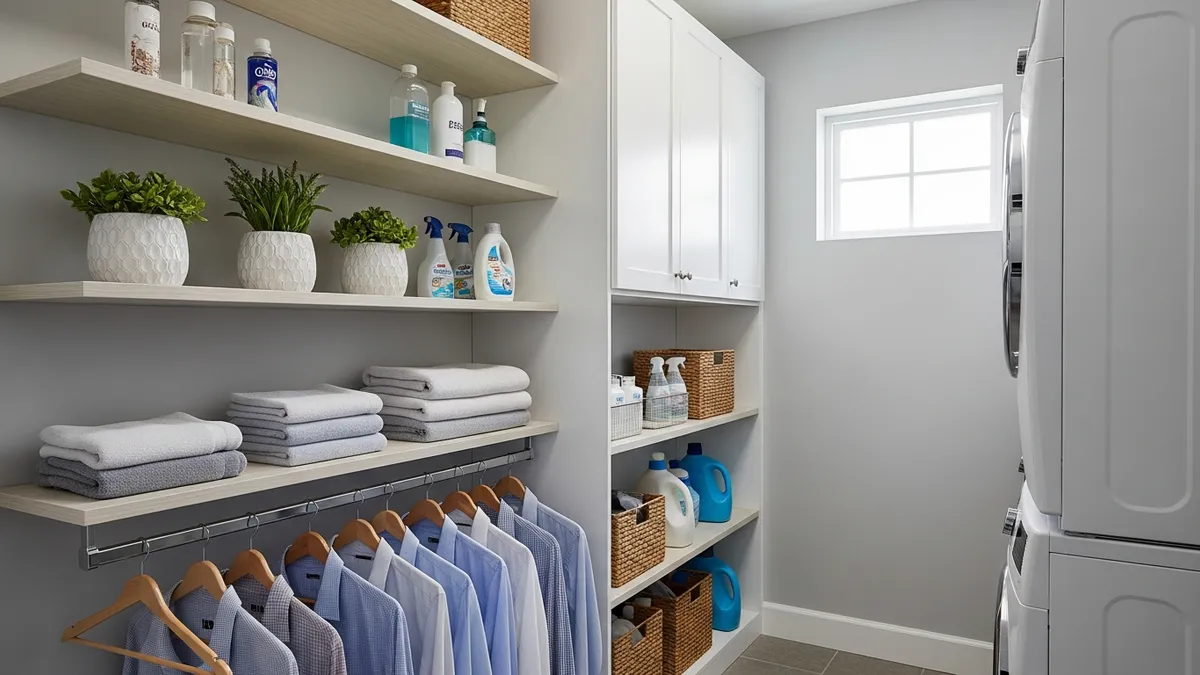
The best flow is one-directional. Dirty clothes enter the basket, move to the wash, continue to drying, then land in the folding and ironing zone. If the path doubles back on itself, the laundry area descends into chaos fast.
For homes without a washing machine, the same principle applies. Use two separate baskets for dirty and clean clothes. Never rotate a single basket between both jobs without washing it, because that quietly makes the whole area less hygienic.
Use Vertical Storage to Keep the Floor Clear
Small laundry rooms need vertical storage. Wall shelves, floating boards, pegboards, and over-the-door hooks lift everything off the floor. An empty floor makes the space feel bigger, easier to clean, and safer when wet.
Many people buy a big floor rack because it looks sturdy. But in a narrow utility space, a floor rack eats the walking path. I prefer a combination: wall shelves for light stock and a low cabinet for heavy items.
Choose shelving by weight. Large jugs of liquid detergent are safest on a low shelf. Tissues, rags, laundry bags, and softener refills can go up high. Clothespins, brushes, and gloves belong in small pull-out containers.
If you use open shelving, use matching containers. Not for aesthetics, but because uniform shapes stack and line up easily. Clear containers show their contents; solid ones look calmer. Choose based on how your family actually behaves.
A Label and Container System for the Laundry Area
Labels are what keep a laundry room tidy after the first week. Without labels, everyone shelves things from memory, and every memory is different. With labels, the return spot is obvious. This matters when laundry duty rotates between partners, parents, and teenagers.
Use short labels: detergent, softener, clothespins, hangers, rags, refills, stain treatment, ironing gear. Do not write essays. A label must be readable in one glance while your hands are full.
For containers, sort by frequency of use. Daily items need open bins or the easiest drawer. Monthly items can live in closed boxes. Backup stock can sit higher up, as long as it stays safe to retrieve.
One opinion of mine: a beautiful label that is hard to read helps no one. Choose high contrast, generous lettering, and wording every member of the household understands.
How to Organize Detergent, Softener, and Cleaning Products
Detergent, bleach, softener, and stain removers need to be arranged with safety in mind. Keep products in their original packaging when possible so the instructions and warnings stay visible. If you use dispensers, label the contents and never mix chemicals.
The <a href='https://www.epa.gov/saferchoice/products'>EPA Safer Choice</a> program is a solid reference when picking safer household cleaning products. It is especially relevant for the laundry room, where products get used repeatedly and stored close to family spaces.
Use a small tray under the bottles. The tray catches detergent drips before they reach the shelf. Wipe it weekly. For sachets and small refills, use a closed box so nothing scatters.
Never store bleach near colored clothes or clean towels. A single drop leaves a permanent mark. Give it a dedicated, clearly labeled shelf. It is a small detail that saves a lot of clothing.
A Checklist of Laundry Gear You Will Actually Use
Not every laundry gadget deserves a purchase. Start with the core list: two laundry baskets, one detergent tray, a small shelf, hangers, clothespins, a stain brush, gloves, microfiber cloths, and one container for refills. If you have a washing machine, add an anti-vibration mat and an over-machine shelf if space allows.
Avoid hyper-specific organizers before you know your actual problem. A big detergent dispenser looks appealing, but it is a poor fit if your family switches brands often or uses sachets. An over-the-door rack is useless if the laundry door regularly gets rained on.

I suggest a two-week trial. Run the basic system first, note which items keep going missing or feel hard to reach, and only then buy additional organizers. It is far cheaper than buying everything at once.
For rentals, choose non-permanent solutions: a slim freestanding shelf, tension rods, collapsible baskets, and drill-free hooks. In a home you own, permanently mounted wall shelves are more stable and longer lasting.
A Weekly Routine That Keeps the Laundry Room Tidy
Organization is never a one-time project. The laundry area needs a small routine so it does not slide back into chaos. Schedule 10 minutes each week to wipe the shelves, top up stock, toss empty packaging, and return items to the right containers.
I trust small routines over big makeovers. A makeover feels satisfying on day one, but the routine is what protects the result. If the laundry area gets used almost daily, it is only fair that it gets a weekly reset.
Make a simple checklist: empty the washer's lint filter, wipe up detergent drips, check stock levels, straighten the hangers, separate the to-be-ironed pile, and remove anything that does not belong. Tape the checklist inside a cabinet door or keep it in your phone notes.
For big households, set a one-basket-per-status rule. Basket one for dirty clothes, basket two for clean but unfolded, basket three for needs ironing. That way everyone can see exactly where the work stands.
Common Laundry Room Organization Mistakes
Mistake one is cramming too much into the laundry area, until the room becomes a mini warehouse. Mistake two is buying shelves without measuring. A shelf that is too deep can block the door, the walkway, or the washer lid.
Mistake three is ignoring humidity. The laundry area lives next to water, so choose materials that wipe clean. Avoid open cardboard for long-term storage, because it absorbs moisture and falls apart.
Mistake four is giving clean clothes no landing spot, so freshly washed laundry ends up mixed back in with everything else. Mistake five is inconsistent labeling: some labels spelled out, some abbreviated into codes only one person can decipher.
Honestly, a laundry room does not need to look like a catalog. What matters is a system that works on your busiest day. A slightly less photogenic room that stays consistent beats a beautiful room the family cannot actually use.
FAQ: Laundry Room Organization
What is the first step to organizing a small laundry room?
Pull everything out, remove what does not belong, then divide the space into washing, drying, folding, and stock zones.
Do I have to buy new shelves?
Not necessarily. Start with the baskets, hooks, and containers you already own. Buy shelving only after you know the room's real problem.
Where is the best place to store detergent?
On a low shelf or in a closed cabinet, away from children, direct heat, and clean clothes.
How do I stop clean clothes from piling up?
Dedicate a basket to clean clothes and set a fixed folding time, for example right after the laundry dries or in the evening.
Which labels should I make first?
Start with detergent, softener, clothespins, hangers, rags, refills, stain treatment, and ironing gear.
Are open shelves better than closed cabinets?
Open shelves are easier to reach, but closed cabinets look tidier and are safer for chemicals. A combination of both is usually the most practical.
How often should the laundry room be reorganized?
Do a light reset once a week and a full item audit every 1 to 2 months.
Conclusion
Good laundry room organization makes wash day lighter because every item has a home and every step has a zone. Start with an audit, put the walls to work with vertical storage, add labels, then protect it all with a weekly reset.
If you want a more orderly home without buying a mountain of stuff, starting with the laundry area is a realistic first move. For more storage and organizer inspiration, explore the home essentials at Sesoris.


Weekly Home Tips
Get home organization ideas, product picks, and exclusive deals delivered weekly.
No spam. Unsubscribe anytime.



Explore More Articles
- 35+ Best Small Home Organization Ideas to Maximize Every Inch in 2026
- 25+ Best DIY Garage Storage Ideas to Transform Your Space in 2026
- 25+ Best Indoor Plant Shelf Ideas to Greenify Your Home in 2026
- Compression Packing Cubes: The Complete 2026 Review & Buying Guide for Smarter Travel
- Cheap Kitchen Storage Racks: Best Budget-Friendly Options to Organize Your Kitchen in 2026
- Tidy Minimalist Home Inspiration: 30+ Ideas to Create a Calm, Clutter-Free Space in 2026
- 3 Tier Spice Rack: Complete 2026 Buying Guide
- 25+ Under Sink Organizer Ideas for a Tidy 2026