
Hidden Shoe Storage Ideas: 14 Ways to Keep Shoes Out of Sight
Hidden shoe storage ideas that keep shoes close to the door but out of sight: lift-top benches, tilt-out cabinets, under-bed boxes, door racks and window seats.
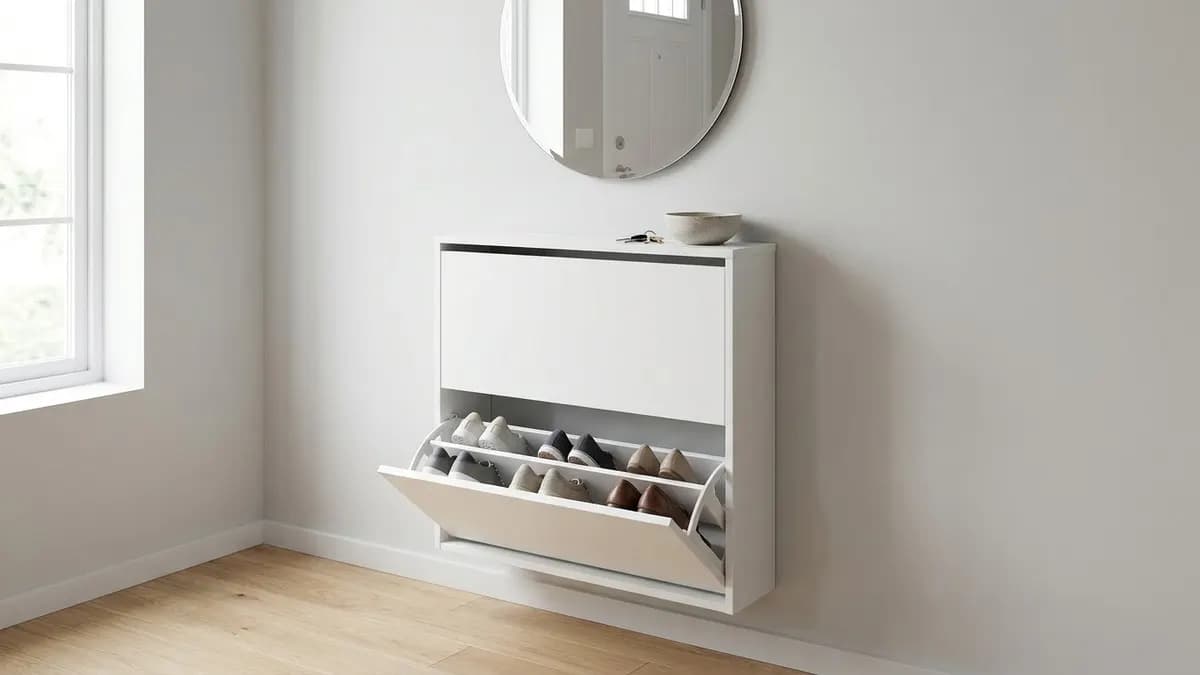
The best hidden shoe storage ideas put shoes inside furniture you already need: a lift-top bench, a slim tilt-out cabinet by the door, a box under the bed, a rack on the inside of a closet door or a drawer in the base of a staircase. The shoes stay close to where you take them off, but the room looks calm because nobody sees the pile. Pick the spot first, then choose storage that closes, breathes and is easy enough to use every single day.
Open racks work, but they turn every pair into decoration, and most shoes are not that pretty. If your entry, bedroom or living room keeps looking busy no matter how often you tidy, hiding the shoes is usually the fastest fix. This guide covers 14 practical ideas, how the main options compare, which rooms suit which pieces, and how to keep closed storage fresh and safe. If you would rather show your shoes off, our guide to shoe rack ideas is the better place to start.
What Counts as Hidden Shoe Storage
Hidden shoe storage is any setup where shoes are stored out of sight but still within reach. That covers three broad groups.
The first group is furniture with a second job. A storage bench, an ottoman, a console table with doors or a window seat already earns its place in the room, and the shoes simply live inside it.
The second group is dead space you are not using yet. The gap under a bed, the back of a door, the space under the stairs, the toe kick under a cabinet and the top shelf of a closet are all places where shoes can disappear without taking any floor space.
The third group is purpose-built shoe furniture that does not look like shoe furniture. A slim tilt-out shoe cabinet, for example, looks like a plain wall unit from the front, yet each flip-down drawer holds a row of shoes.
The best hidden setups mix groups. A family might keep everyday sneakers in a tilt-out cabinet by the front door, boots in a lidded bench in the mudroom and dress shoes in a box under the bed.
Hidden Shoe Storage Options Compared
Each hidden option trades capacity, cost and convenience differently. Use this comparison to narrow your choice before you measure anything.
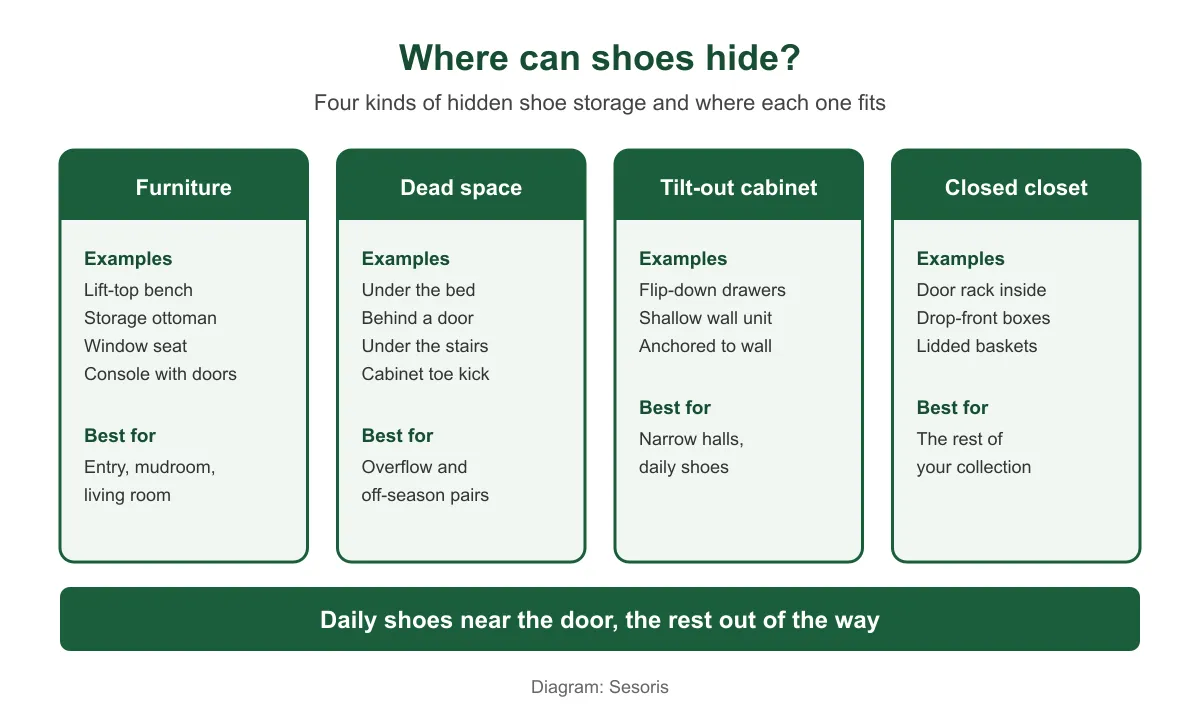
| Option | Best spot | Capacity | Daily convenience | Watch out for |
|---|---|---|---|---|
| Lift-top storage bench | Entryway, mudroom, foot of bed | Medium | High, you sit and store in one move | Lids that slam, no airflow |
| Slim tilt-out cabinet | Narrow hall, beside the front door | Medium | High | Must be anchored to the wall |
| Under-bed shoe box | Bedroom | Medium per box | Medium, you bend and pull | Dust, forgetting what is inside |
| Rack inside a closet door | Bedroom closet, coat closet | High | High | Door thickness and clearance |
| Window seat or built-in | Living room, landing, bay window | High | Medium | Cost of carpentry |
| Under-stair drawers | Hall with an open staircase | High | High once built | Needs a carpenter |
| Storage ottoman | Living room, bedroom | Low | Medium | Small capacity |
Capacity here is relative, for adult shoes. Boots, kids' shoes and high-tops change the numbers a lot, so always check the inside dimensions of a piece against your bulkiest pair.
14 Hidden Shoe Storage Ideas
- Use a lift-top bench by the door. A bench with a hinged lid gives you a place to sit while you pull boots off and a box underneath that swallows the pile. Look for a soft-close hinge so the lid cannot slam on small fingers. 2. Install a slim tilt-out shoe cabinet. These cabinets are much shallower than a standard cabinet, so they fit hallways where a regular cabinet would block the way. Each drawer tilts forward and holds shoes at an angle. 3. Hang a rack on the inside of a closet door. A rack on the back of a wardrobe or coat closet door holds dozens of pairs and disappears the moment you close the door. 4. Slide a shoe box under the bed. A low box with a clear lid keeps off-season or occasional shoes dust free and invisible. 5. Build a window seat with a lift-up top. If you have a bay window or a wide sill, a built-in seat turns wasted floor space into deep shoe storage. 6. Add drawers under the stairs. The triangle under an open staircase can hold pull-out drawers sized for shoes. It is a carpentry project, but it adds a lot of storage without taking any room. 7. Use a console table with doors. A narrow entry console with cabinet doors looks like a normal piece of furniture and hides two shelves of shoes. 8. Put a storage ottoman at the foot of the bed. Ottomans hold fewer pairs, but they are perfect for the slippers and house shoes you wear every day. 9. Hide shoes in baskets on an open shelf. If you already have open cubbies, matching lidded baskets turn them into hidden storage for a few dollars. 10. Use the toe kick space in built-in cabinets. In a mudroom or custom closet, a shallow drawer in the toe kick is a clever home for flat shoes and flip-flops. 11. Stack drop-front shoe boxes inside the closet. Clear or opaque drop-front boxes let you pull one pair without unstacking the tower, and they keep shoes on a high shelf neat. 12. Add a curtain to an open rack. A simple tension rod and a fabric panel turn an exposed rack in a nook or under a sink into hidden storage overnight. 13. Choose a bed frame with drawers. A storage bed with deep drawers is one of the biggest hidden spaces in any home, and one drawer can be given to shoes. 14. Mount a cabinet over the dryer or in the laundry nook. If your family enters through the laundry room, a closed cabinet near that door catches shoes before they spread through the house.
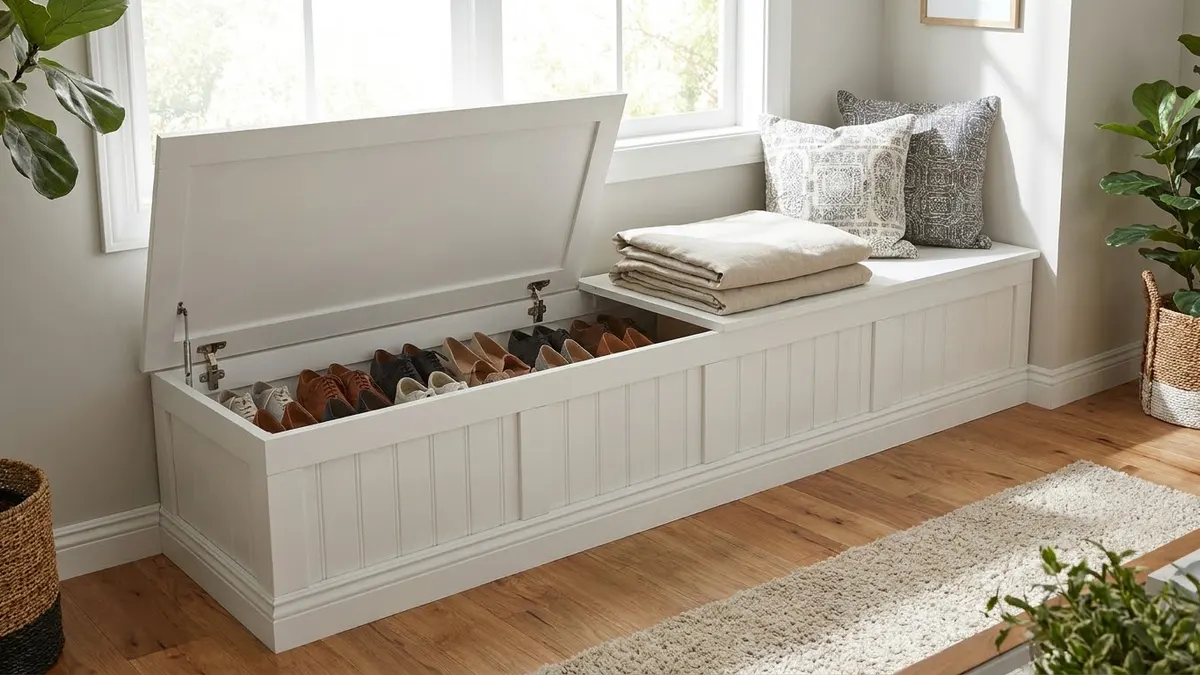
The window seat idea is worth a closer look because it solves two problems at once. You get a comfortable reading spot, and the box below holds far more than a freestanding rack of the same footprint. If you plan one, keep the lid light or add a lid support, and line the box with something washable.
Use the Dead Space Under the Bed
The space under a bed is the most overlooked shoe closet in most homes. It is dark, dust can collect there and it is easy to forget what you stored, but a good box fixes all three problems.
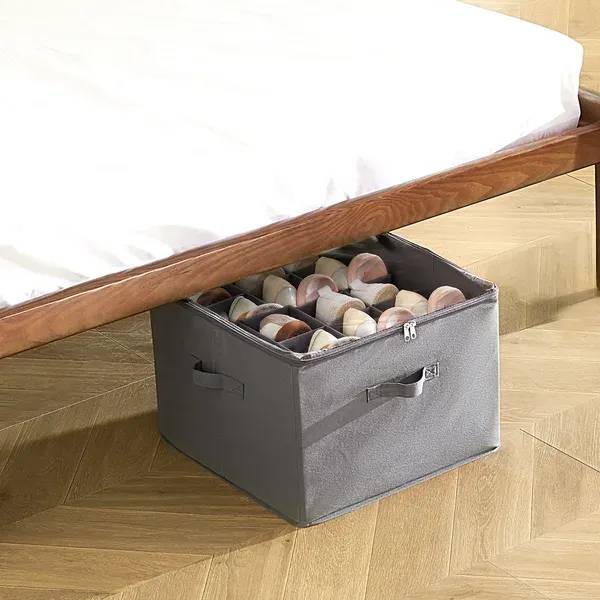
A box with dividers keeps each pair separate so shoes do not scuff each other, and a clear zip-top lid lets you see every pair without pulling everything out. Our under-bed shoe storage box with 16 compartments measures 17 x 17 x 12.4 inches, which suits beds with average clearance. Measure the gap under your bed frame before you buy any box, and leave a little room so it slides easily.
Use under-bed storage for shoes you do not wear every day: dress shoes, sandals in winter and boots in summer. Shoes you wear daily belong closer to the door. For more ways to use this space, see our guide to under-bed storage.
Hide Shoes Behind a Door
Doors are vertical storage that most people never use. A rack on the inside of a closet or wardrobe door holds a surprising number of pairs in a space only a few inches deep.
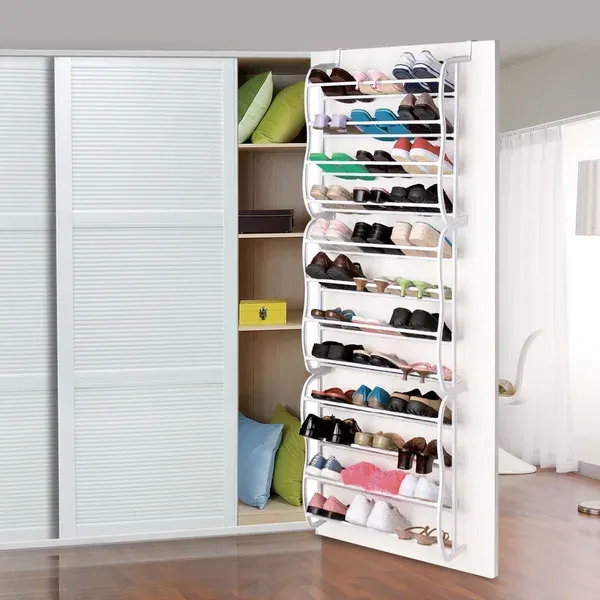
Our over-the-door shoe rack with 12 tiers holds up to 36 pairs and hangs from adjustable hooks for doors up to 1.57 inches thick. Before you buy any over-the-door rack, check three things: the thickness of the door, whether the door closes with the hooks in place and whether the rack clears the shelves or rod behind it when the door is shut.
Door racks suit flats, sneakers and sandals best. Tall boots are usually too deep, so give those a bench or a closet floor spot instead. If your closet is tight, our guide to shoe storage ideas for a small closet has more space-saving layouts.
Match Hidden Storage to the Room
The right hidden storage depends on how each room is used. Shoes you take off at the door need fast storage, and shoes you only wear on weekends can live somewhere slower.
| Room | Best hidden option | Good backup | What to store there |
|---|---|---|---|
| Entryway or front hall | Slim tilt-out cabinet | Console table with doors | Daily shoes for each person |
| Mudroom | Lift-top bench | Lidded baskets in cubbies | Boots, sports shoes, kids' shoes |
| Bedroom | Under-bed box | Storage bed drawer, ottoman | Dress shoes, off-season pairs |
| Walk-in or reach-in closet | Door rack | Drop-front boxes on a shelf | The rest of your collection |
| Living room | Window seat | Storage ottoman | Slippers and house shoes |
| Hall with stairs | Under-stair drawers | Curtained nook | Overflow and guest shoes |
If your entry is the problem spot, our guides to shoe storage ideas for a small entryway and shoe storage cabinet ideas go deeper on doors, depths and layouts. In a bedroom, our shoe storage ideas for the bedroom cover the options that look best next to a bed.
Keep Hidden Shoes Fresh and Dry
Closed storage has one weakness: it can trap moisture. A damp pair of sneakers shut inside a bench overnight will smell, and in the worst case it can grow mildew.
The U.S. Environmental Protection Agency advises keeping indoor humidity below 60 percent, ideally between 30 and 50 percent, to limit mold growth, according to its brief guide to mold, moisture and your home. Inside a closed box the air is still, so a little extra care goes a long way.
- Let wet shoes dry in the open first. Leave rain-soaked or sweaty shoes on a mat or a boot tray overnight, then put them away. 2. Choose pieces with airflow. Slatted bottoms, vent holes or a small gap at the back of a bench help air move. 3. Do not overfill. Shoes packed tightly dry slowly and get crushed. Leave a little room between pairs. 4. Add an odor absorber. A small sachet of baking soda or cedar blocks in each compartment keeps things smelling neutral. 5. Clean the inside every season. Empty the piece, vacuum the dust, wipe it down and let it air out before you refill it.
Leather and suede need extra care. Store them clean and dry, stuff the toes with paper to keep their shape and keep them away from sweaty gym shoes.
Safety: Anchor Tall and Tilt-Out Cabinets
Slim cabinets are shallow by design, and a shallow piece with heavy drawers pulled open can tip forward. That matters most in a home with young children who may pull on a drawer or try to climb.
The U.S. Consumer Product Safety Commission runs the Anchor It! campaign, and its core message is that anchoring all furniture with drawers, doors and shelves to the wall prevents tip-over injuries and deaths. Most tilt-out shoe cabinets ship with a wall bracket for exactly this reason. Use it, fix it into a stud or a suitable wall anchor and give the cabinet a firm tug once it is installed.
A few more safety habits help:
- Load the lowest drawers with the heaviest shoes, such as boots. - Teach children not to stand on drawers or the edge of a bench. - Choose benches and window seats with soft-close or supported lids.
How to Choose the Right Hidden Storage
Use this short process before you buy anything. It takes ten minutes and prevents the most common mistake, which is buying a nice piece that does not fit the shoes or the space.
- Count your daily pairs. Count only the shoes each person wears in a normal week. That is the number your door-side storage must hold. 2. Measure your bulkiest pair. Measure the length and height of the largest daily pair, often a boot or a high-top sneaker. Your storage must fit that pair, not your flats. 3. Measure the spot. Note the width, depth and height available, and check door swing, outlets and baseboard heaters. 4. Pick one daily spot and one overflow spot. Daily shoes go near the door. Everything else goes under a bed, behind a door or on a closet shelf. 5. Check how it opens. If a lid, drawer or door is awkward, people will leave shoes on the floor in front of it. Easy beats pretty.
If you like to build your own, our DIY ideas for shoe storage include simple projects that can be fitted with doors or a lid.
Common Hidden Storage Mistakes
Hiding the daily shoes too far away. If the closest storage is upstairs, the pile will come back by the front door. Keep daily pairs within a step or two of where they come off.
Buying a cabinet that is too shallow for your shoes. Large sneakers and boots may not fit a narrow tilt-out drawer. Check the drawer depth against your biggest pair.
Forgetting airflow. A sealed box full of damp shoes will smell within days. Dry shoes first and choose storage that breathes.
Skipping the wall anchor. A tall, shallow cabinet without an anchor is a real tip-over risk, especially with kids around.
Mixing everything in one box. A deep bench with no dividers turns into a jumble. Add a shelf, a divider or a couple of bins so pairs stay together.
If your shoe problem is really a whole-entry problem, our mudroom storage solutions explain how to split shoes, coats and bags so each has a home.
Frequently Asked Questions
What is the best hidden shoe storage for a small entryway?
A slim tilt-out shoe cabinet is usually the best choice. They are much shallower than a regular cabinet, so they fit beside the door without blocking the way, and they look like a plain wall unit when closed. Anchor it to the wall.
How do you hide shoes in a living room?
Use furniture that already belongs in the room: a storage ottoman, a window seat with a lift-up top or lidded baskets on an existing shelf. Keep only the slippers and house shoes you wear there.
Is it bad to store shoes in a closed box or bench?
No, as long as the shoes go in dry and the box has some airflow. Let wet shoes dry overnight first, avoid packing pairs too tightly and clean the inside each season.
How many shoes fit in an over-the-door shoe rack?
It depends on the number of tiers and the size of the shoes. Our 12-tier rack holds up to 36 pairs on a door up to 1.57 inches thick. Tall boots usually do not fit.
Can you store shoes under the bed?
Yes. Under-bed storage is ideal for shoes you do not wear every day. Use a box with a lid and dividers to keep out dust and keep pairs together, and measure the clearance under your bed first.
Do tilt-out shoe cabinets need to be anchored to the wall?
Yes. They are tall and shallow, and open drawers can make them tip forward. Use the wall bracket that comes with the cabinet and fix it into a stud or a suitable anchor.
How do I stop hidden shoe storage from smelling?
Only store dry shoes, leave space between pairs, add baking soda sachets or cedar blocks and air the storage out regularly. If one pair always smells, wash or replace its insoles.
What is the cheapest way to hide shoes?
Lidded baskets on a shelf you already own or a curtain on a tension rod in front of an open rack. Both cost very little and hide shoes immediately.
Final Thoughts
Hidden shoe storage is not about owning fewer shoes. It is about giving every pair a closed home in the right place: daily shoes in a bench or slim cabinet by the door, occasional shoes under the bed or behind a closet door and everything stored dry, with a little room to breathe. Start with the spot where the pile always forms, choose one piece that closes and is easy to use, and the room will look calmer the same day.
Liked this guide?
Get new organizing guides and the occasional new product by email. No spam, unsubscribe anytime.
Related articles

Explore more articles
- Bathroom Corner Shelves: Make Use of Dead Space
- 20+ Best Towel Rack Ideas for Kitchen: Stylish & Functional Solutions in 2026
- 35+ Brilliant Small Space Clothing Storage Ideas to Maximize Your Wardrobe in 2026
- Nursery Dresser Drawer Organization: Complete Guide to Perfect Baby Storage in 2026
- Multi-Purpose Spice Racks: Ultimate Guide to Versatile Kitchen Storage Solutions in 2026
- Overhead Garage Storage Solutions: Ultimate Guide to Transform Your Garage Space in 2026
- 15 Shoe Storage in Garage Ideas: Safe Layouts for 2026
- Complete Guide to Home Office Organization for Maximum Productivity in 2026