
Outdoor Shoe Storage Ideas: 12 Ways to Keep Shoes Dry by the Door
Outdoor shoe storage ideas that keep shoes off the ground, out of the rain and in moving air: lidded benches, vented cabinets, boot trays and the right materials.
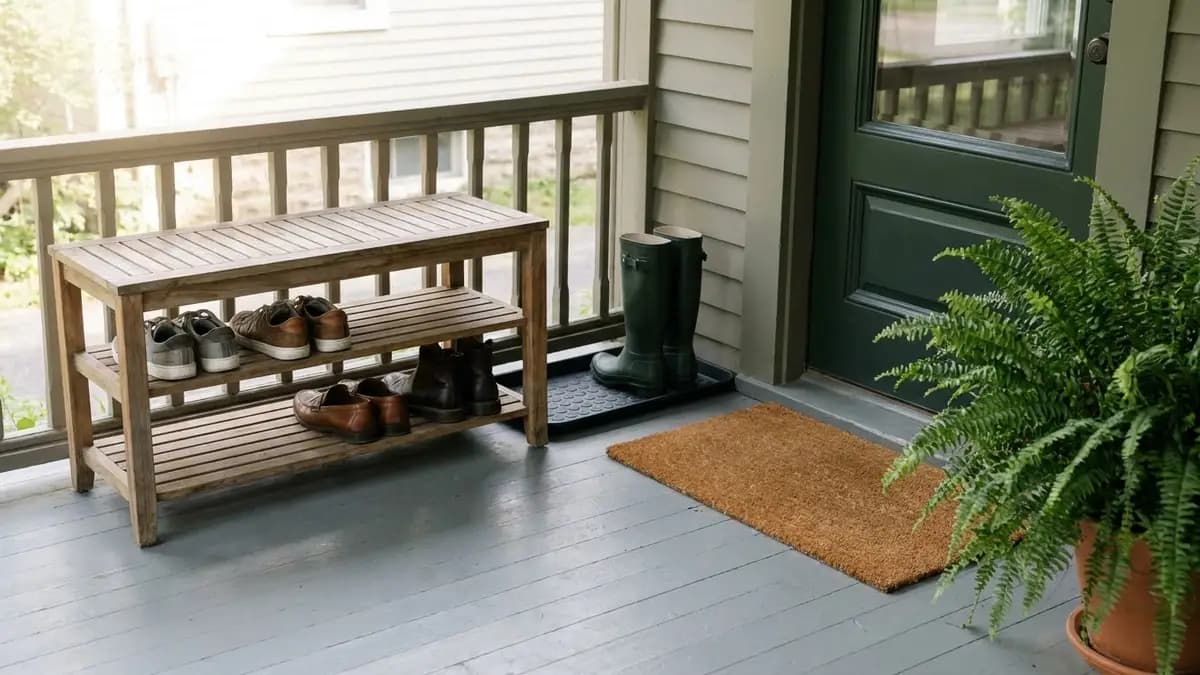
The best outdoor shoe storage ideas keep shoes off the ground, out of the rain and in moving air. A lidded bench or a vented cabinet protects pairs on an open step, a slatted bench and a boot tray suit a covered porch, and wall hooks or a slim rack handle the garage or side door. Whatever you choose, keep everyday sneakers and mud boots outside, and bring leather shoes and anything you care about indoors for the night.
Leaving shoes by the door is one of the simplest ways to keep dirt out of the house. The problem is that a pile of shoes on a porch soon looks messy, collects water and leaves, and gives spiders a place to hide. This guide covers 12 practical ideas, how to match storage to the weather your spot gets, which materials last outside and the small habits that keep the whole setup working. If your shoes live inside the house instead, our main shoe storage ideas guide is the better starting point.
Why Outdoor Shoe Storage Needs Its Own Plan
Indoor shoe storage only has to fight clutter. Outdoor shoe storage also has to fight water, sun, temperature swings and bugs, and each of these damages shoes in a different way.
Water is the biggest threat. Shoes that sit in a puddle or get soaked by blown rain stay damp inside for days, and damp shoes smell and grow mildew. The U.S. Environmental Protection Agency advises keeping indoor humidity below 60 percent, ideally between 30 and 50 percent, to limit mold, according to its brief guide to mold, moisture and your home. Outdoors you cannot control humidity, so the job of outdoor storage is to stop shoes from sitting wet and to let air move around them.
Sun is the second threat. Many plastics, rubbers and dyes break down under ultraviolet light, a process described in the UV degradation entry on Wikipedia. On a bright porch, rubber soles can crack and fabric uppers can fade faster than they would in a closet.
The third problem is creatures. An open shoe on a porch is a dark, sheltered pocket, which is exactly what spiders, beetles and sometimes small frogs look for. Closed doors help, and so does a habit of tapping each shoe out before you put it on.
The good news is that one well-chosen piece of storage solves most of this. You just need to pick it for the spot it will actually live in.
Match the Storage to Your Spot
Before you buy anything, stand where the shoes will go and ask how much weather that spot gets. An open front step, a covered porch and a garage entry need different solutions, and the most common mistake is buying indoor storage for an outdoor spot.
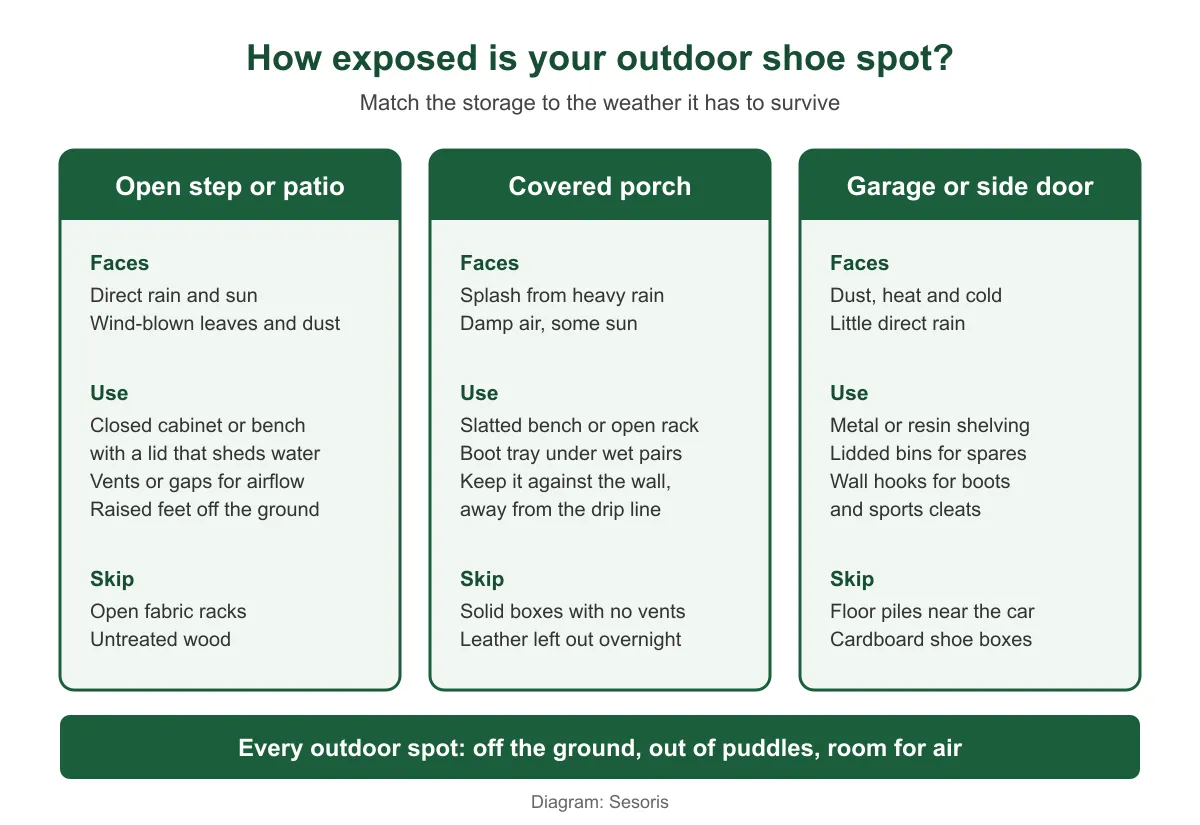
| Spot | Main exposure | Storage that works | What to avoid |
|---|---|---|---|
| Open step or patio | Direct rain, full sun, wind | Lidded bench, closed cabinet with vents, raised feet | Open fabric racks, untreated wood |
| Covered porch | Rain splash, damp air, some sun | Slatted bench, open rack, boot tray | Airtight boxes, leather left out overnight |
| Garage or side door | Dust, heat, cold, little rain | Metal or resin shelving, wall hooks, lidded bins | Floor piles, cardboard shoe boxes |
| Back door to a yard | Mud, wet grass, kids' traffic | Boot tray with rocks, cubbies, hooks | Light-colored mats that show every mark |
If your spot falls between two of these, plan for the harsher one. A porch that is covered but faces the prevailing wind behaves more like an open step during a storm.
12 Outdoor Shoe Storage Ideas
- Use a lidded storage bench. A bench with a hinged lid gives you a place to sit while you tie laces and a closed box underneath for shoes. Choose one with a gap or vents at the back so the inside can dry. 2. Choose a vented cabinet for open spots. A cabinet with louvered doors keeps rain off while air still moves through the slats. It is the closest thing to a closet you can put outside. 3. Add a boot tray. A shallow tray under muddy boots catches water and dirt before it reaches the porch boards. It is the cheapest upgrade on this list. 4. Fill the tray with river rocks. A layer of smooth stones lifts soles above the water, so boots drain and dry instead of sitting in a puddle. 5. Pick a slatted bench for covered porches. Open slats let air reach the soles from underneath, which is exactly what damp shoes need. 6. Raise everything off the ground. Even a few inches of height keeps shoes out of puddles, leaves and the path of bugs. Look for feet or legs, not a flat base. 7. Hang boots upside down. Boot hooks or a peg rail on the wall let tall boots drain and keep the inside dry. They also free up floor space. 8. Go vertical on a tiny porch. A slim tower or a wall-mounted rack uses height instead of floor space. It suits narrow stoops and apartment balconies. 9. Give each person a cubby or bin. On a busy family porch, a labeled bin per person ends the morning search for the second sneaker. 10. Add a seat. People put shoes away when they can sit down to do it. Any storage that doubles as a bench gets used more. 11. Keep a brush and a mat nearby. A boot brush and a rough coir mat remove most dirt before shoes go into storage, so the storage itself stays clean. 12. Set an indoor backup spot. Keep a slim rack just inside the door for leather shoes, good sneakers and anything you would hate to see rained on.
You do not need all twelve. Most homes need one main piece, one tray and one habit. Start there and add only what the spot proves it needs.
Benches, Cabinets and Racks
The three main types of outdoor shoe storage each suit a different spot. A bench is the most flexible, a cabinet gives the most protection and a rack is the cheapest and easiest to move.
A lidded bench works on open steps and covered porches alike. The lid sheds rain, and the seat gives you somewhere to sit. Check how the lid closes: a lid that seals completely can trap moisture inside, so look for a small gap, vent holes or slatted sides. Put a tray or a rubber mat inside the box so wet soles do not soak the base.
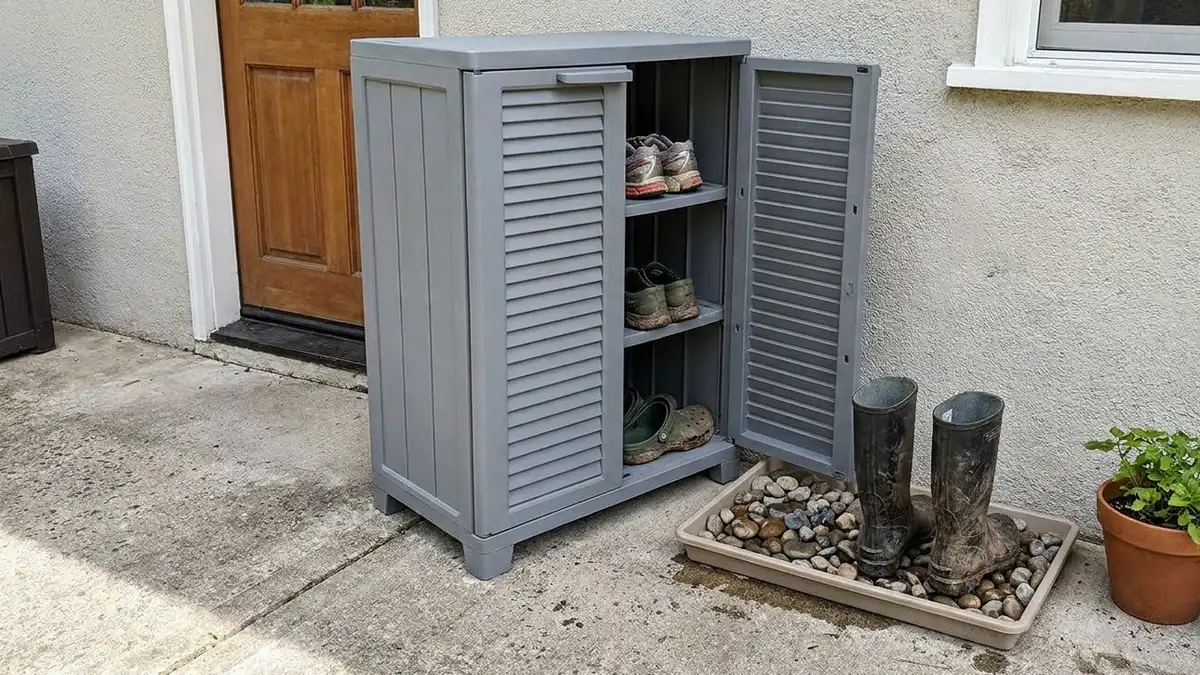
A vented cabinet is the best choice for a spot that gets direct rain. Resin cabinets with louvered doors are common, and the louvers matter: they keep driving rain out while letting air through. Our shoe storage cabinet ideas cover cabinet styles in more detail, and most of the advice there carries over to outdoor models.
An open rack is the simplest option for a covered porch or a garage entry. It costs less, it lets shoes air out completely and you can move it when the seasons change. On its own it offers no rain protection, so keep it against the wall and well back from the edge of the porch roof. Our shoe rack ideas guide compares rack styles if you want to see more options.
Whichever you pick, measure first. Note the width of the wall, the depth you can spare without blocking the door and the clearance under any window. A bench that blocks the door swing will be moved within a week.
Choose Materials That Survive Outside
Material decides how long outdoor shoe storage lasts. Wood, metal and plastic can all work, but only in the right form.
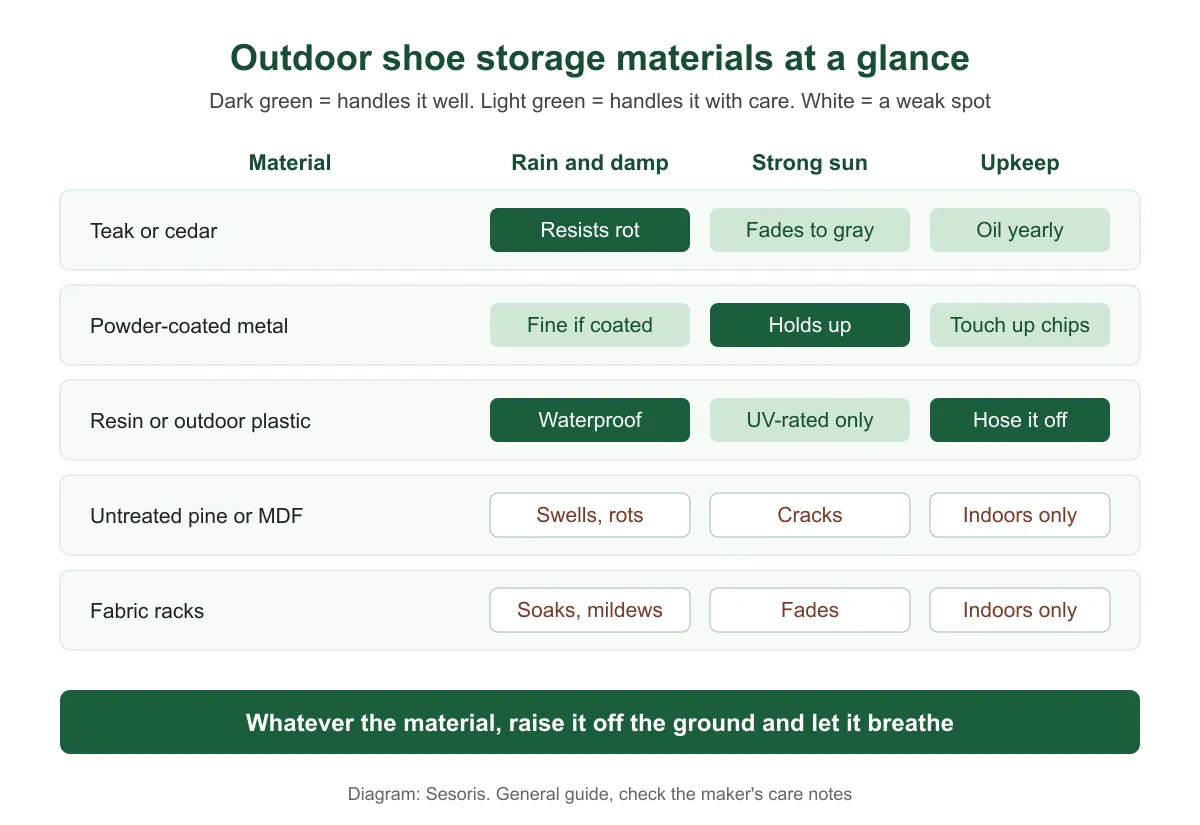
Teak and cedar are the classic outdoor woods. Teak is highly resistant to rot, fungi and mildew, according to the teak entry on Wikipedia, and western red cedar wood is also known for resisting decay, as the Thuja plicata entry notes. Both weather to a silver gray in the sun. That is normal, and a coat of outdoor oil restores the color if you prefer it.
Powder-coated metal is strong and handles sun well. The coating is what keeps rust away, so check for chips now and then and touch them up before rust spreads.
Resin and outdoor plastics are waterproof and easy to hose clean. The weak point is the sun, so look for products described as UV-resistant if your spot gets direct light for much of the day.
Untreated pine, MDF and particleboard do not belong outside. They soak up water, swell and fall apart, sometimes within a single wet season. Fabric racks have the same problem: they hold water and grow mildew. Keep both indoors.
| Material | Rain and damp | Sun | Upkeep | Best spot |
|---|---|---|---|---|
| Teak or cedar | Resists rot | Fades to gray | Oil about once a year | Covered porch, open step with a lid |
| Powder-coated metal | Fine while coating is intact | Holds up well | Touch up chips | Garage entry, covered porch |
| Resin or outdoor plastic | Waterproof | Choose UV-resistant | Rinse with a hose | Open step, patio |
| Untreated pine or MDF | Swells and rots | Cracks | Not suited | Indoors only |
| Fabric | Soaks and mildews | Fades | Not suited | Indoors only |
Boot Trays and Wet Shoe Solutions
Wet shoes are where most outdoor setups fail. A shoe that goes into a closed bench soaking wet comes out a week later smelling of mildew.
The fix starts with a boot tray. A rubber or plastic tray with a raised edge catches water and mud, and you can tip it out and rinse it in seconds. For boots that come in muddy every day, add a layer of smooth river rocks. The stones lift the soles above the water so the boots drain instead of sitting in a puddle, and mud falls between the rocks instead of building up on the soles.
Next, think about airflow. Shoes dry from the inside out, so a pair left in a sealed box stays damp. Leave space between pairs, choose slatted shelves or vented doors and never stack wet shoes on top of each other. Tall boots dry best upside down on a peg or boot hook.
Finally, have a rule for really wet shoes. After a storm, a soaked pair should come inside to dry at room temperature, away from direct heat, before it goes back to outdoor storage. If you hike or run in the rain often, a garage shelf works well as a drying station. Our garage shoe storage ideas show how to set one up.
Outdoor Shoe Storage for Small Porches and Stoops
A small stoop or an apartment balcony leaves very little floor space, but you still have walls and height.
Wall hooks and peg rails hold boots and sandals without taking any floor. A narrow vertical rack holds several pairs in a footprint the size of a doormat. A slim lidded box can sit under a window or beside the door frame. If you rent, look for freestanding pieces and adhesive hooks rated for outdoor use, so you do not have to drill into the siding.
Keep the walkway clear. On a narrow stoop, the door swing and the path to the steps come first, and storage goes in whatever space is left. For more space-saving ideas, see our guide to small entryway shoe storage, many of which also work just outside the door.
Keep an Indoor Backup Spot
Not every shoe belongs outside. Leather dress shoes, suede, expensive running shoes and anything you wear to work last longer indoors, away from damp air and sun. A simple rule works for most families: everyday sneakers, garden clogs and mud boots live outside, and everything else comes in.
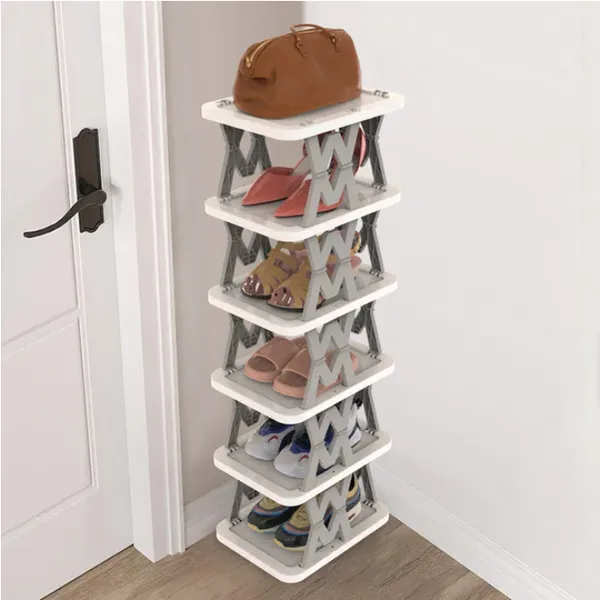
A slim rack just inside the front door gives those shoes a home without cluttering the hall. A narrow tower like our 6-tier foldable narrow shoe rack fits beside a door frame on a footprint of about 12 by 10 inches, and a taller option such as the 9-tier narrow shoe rack holds more pairs in the same kind of corner. If your house has a mudroom between the porch and the hall, our mudroom storage solutions explain how to split shoes, coats and bags between the two spaces.
How to Tell What Your Outdoor Spot Needs
If you are not sure where to start, look at the problem you see most often. Each one points to a different fix.
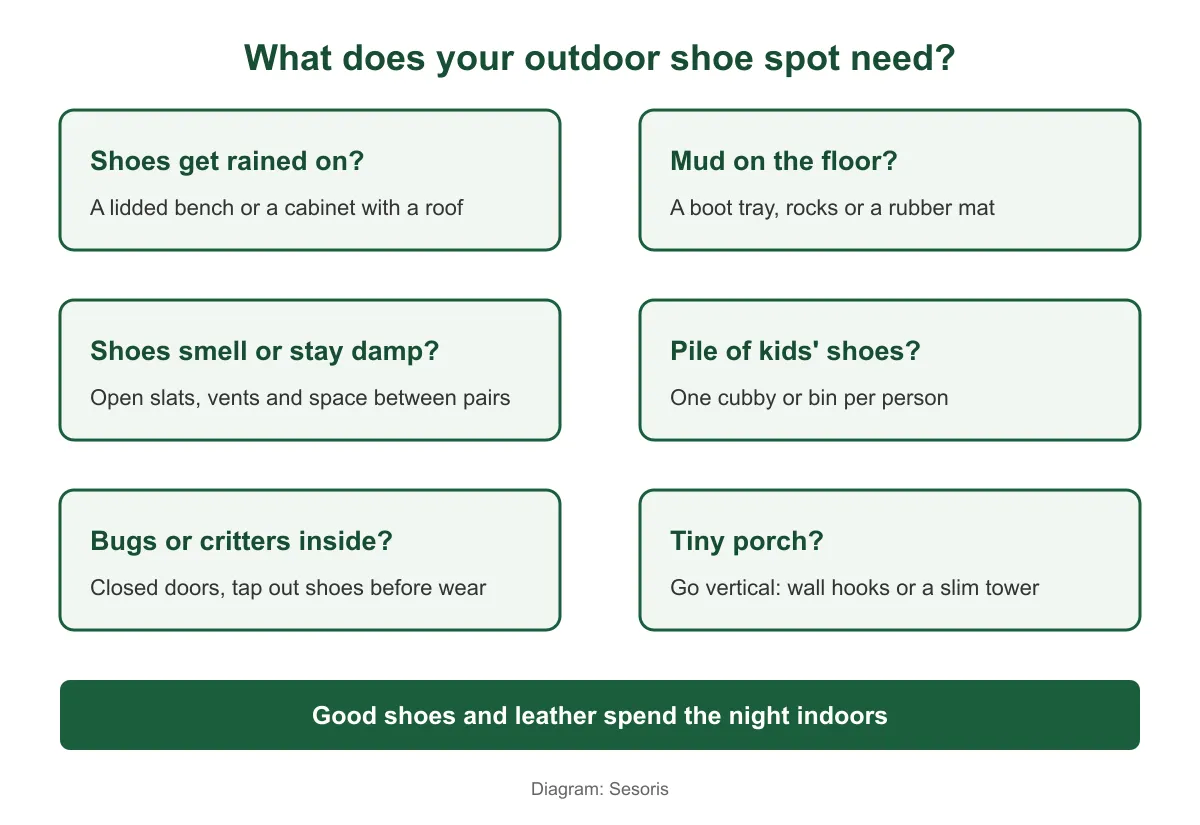
Shoes that get rained on need a lid or a roof. Mud on the porch needs a tray. A musty smell means the shoes are not drying, so add airflow and space. A pile of children's shoes is a sorting problem rather than a storage problem, and one bin per person usually solves it. Bugs in shoes call for closed doors and a habit of shaking shoes out. A tiny porch calls for height.
Seasonal Care for Outdoor Shoe Storage
Outdoor storage needs a little attention a few times a year, and the work is quick if you do it at the change of seasons.
In spring, empty everything, hose out trays and resin cabinets and check wooden pieces for soft spots. This is also a good time to oil teak or cedar. In summer, move storage out of all-day sun if you can, and check for wasps or spiders that have moved into closed benches. In fall, clear leaves from behind and under the storage, since wet leaves trap moisture against wood and metal. In winter, bring in anything that should not freeze, and give snow boots a deeper tray, because melting snow brings a lot of water with it.
A quick monthly check helps too. Tip out the boot tray, wipe the inside of any closed bench and pull out shoes that nobody has worn in weeks. If you also keep shoes in a camper, our RV shoe storage ideas cover compact, weatherproof options for life on the road.
Common Mistakes to Avoid
- Using indoor furniture outside. Fabric racks, MDF cabinets and cardboard boxes fall apart once they get wet. - Sealing wet shoes in a closed box. Without airflow, shoes stay damp and start to smell. Choose vents or slats. - Putting storage at the edge of the porch. Rain blows in under the roof edge. Keep storage against the house wall. - Leaving good shoes out overnight. Leather and suede are not made for porch life. Bring them in. - Skipping the tray. Mud and water end up on the boards, and the porch looks messy no matter how neat the rack is. - Blocking the door or the steps. Storage that gets in the way is storage that gets moved and forgotten.
If your garage is the real overflow zone for shoes, sports gear and bikes, our guides to decluttering the garage and garage bike storage ideas help you clear a proper landing spot near the side door.
Frequently Asked Questions
How do you store shoes outside without them getting wet?
Use storage with a lid or a roof, such as a lidded bench or a cabinet with louvered doors, and keep it against the house wall rather than at the edge of the porch. Raise it off the ground on feet, and put a boot tray under any pair that comes in wet.
Is it OK to leave shoes outside overnight?
Everyday sneakers, garden clogs and rubber boots are usually fine in covered, ventilated storage. Leather, suede and expensive shoes last longer indoors, where they are protected from damp air, cold and sun.
What is the best material for outdoor shoe storage?
Teak, cedar, powder-coated metal and outdoor resin all hold up outside. Resin is the easiest to clean, teak and cedar resist rot, and metal handles sun well as long as the coating is intact. Avoid untreated pine, MDF and fabric.
How do you keep bugs out of shoes stored outside?
Choose storage with closed doors or a lid, keep it off the ground and clear leaves from around it. Tap each shoe out before you put it on, especially shoes that have not been worn for a few days.
How do you stop outdoor shoes from smelling?
Smell usually means the shoes are not drying. Give them airflow with slatted shelves or vented doors, leave space between pairs and bring soaked shoes inside to dry before you store them again.
What can I use for shoe storage on a small front porch?
Go vertical. Wall hooks, a peg rail or a narrow tower rack hold several pairs in very little floor space, and a slim lidded box can sit beside the door frame. Keep the door swing and the steps clear.
Do boot trays really help?
Yes. A boot tray catches water and mud before it reaches the porch floor, and a layer of river rocks in the tray lifts soles above the water so boots drain and dry faster.
Can I use an indoor shoe rack on a covered porch?
Only if it is made of metal or plastic and the porch is well covered. Fabric racks and particleboard soak up water and fall apart, so keep those indoors.
Final Thoughts
Good outdoor shoe storage is simple: keep shoes off the ground, out of the rain and in moving air. Match the storage to the weather your spot actually gets, choose a material that can live outside, add a boot tray and give your good shoes a home just inside the door. Start with one piece and one habit this weekend, and the pile by the front door will not come back.
Liked this guide?
Get new organizing guides and the occasional new product by email. No spam, unsubscribe anytime.
Related articles
Explore more articles
- 30+ Brilliant Craft Closet Organization Ideas to Transform Your Creative Space in 2026
- Practical Home Organizing Tips That Keep Your House Tidy
- Wall-Mounted Spice Rack: Complete Review & Buying Guide 2026
- Eid al-Fitr Prep Checklist: A Home Cleaning Countdown
- Home Decluttering Guide for Beginners
- Tips to Keep Your Kid's Room Tidy
- Vacuum Storage Bag: Compress Clothes and Blankets by Up to 75%
- IKEA Laundry Room Organization: Smart Ideas