
Best Pantry Organization Containers: Complete 2026 Review & Buying Guide for a Smarter Kitchen
Find the best pantry organization containers in 2026. Our team reviews top picks by material, size & seal type to help you build a fresher, tidier kitchen.
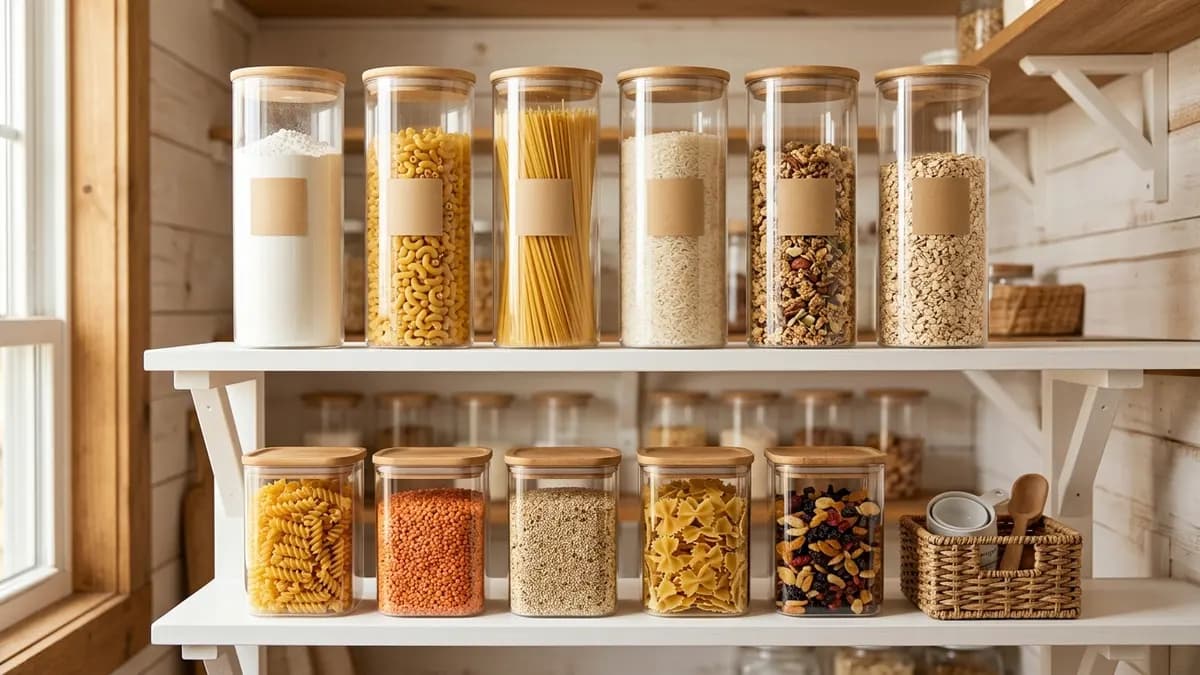
If your pantry feels like a chaotic jumble of half-open bags, mismatched containers, and mystery boxes with no expiration date in sight, you are not alone. The right pantry organization containers can completely transform how your kitchen feels and functions. In 2026, the market is fuller than ever with options spanning every material, size, shape, and price point, and choosing the wrong set can actually make organization harder, not easier. That is why the Sesoris Editorial Team put together this comprehensive review and buying guide to help you cut through the noise. Whether you are building your pantry system from scratch or upgrading a few key pieces, we have covered everything you need to make a smart, well-informed decision.
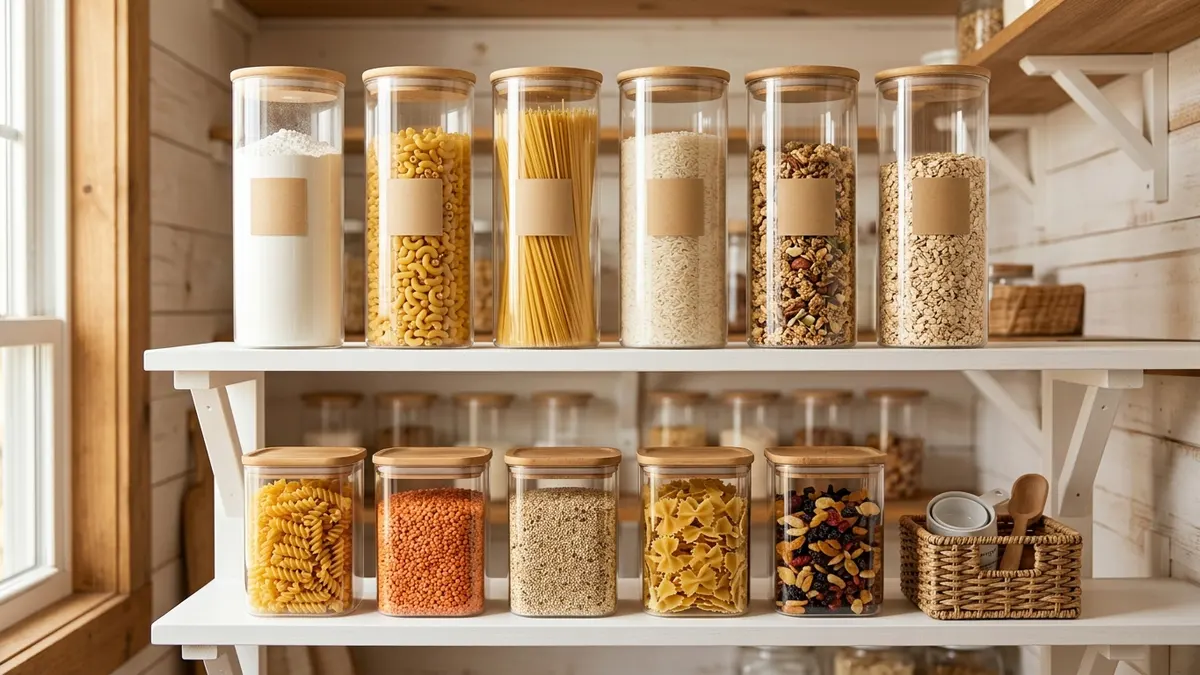
Why Pantry Organization Containers Make Such a Difference
There is a reason the organized pantry aesthetic has become one of the most popular home trends of the decade. Beyond the visual appeal, well-chosen pantry organization containers solve real, everyday problems: ingredients stay fresher for longer, you can see what you have at a glance, and meal prep becomes dramatically faster. Transferring dry goods like flour, rice, oats, and pasta into sealed containers also dramatically reduces the risk of pantry pests. According to the USDA Food Safety and Inspection Service, properly sealed containers protect shelf-stable foods from moisture, air, and contaminants, all of which accelerate spoilage.
The secondary benefit is one that often goes underappreciated: you stop buying duplicates. When your pantry is visible and legible, you always know what you already have. That alone saves money and reduces food waste on a weekly basis.
How We Evaluated Pantry Organization Containers in 2026
Our team assessed containers across several practical criteria rather than focusing on brand prestige or aesthetics alone. Here is the framework we used for this review:
- Seal quality: Does the lid create a genuinely airtight seal, or does it just sit on top?
- Material safety: Is the plastic BPA-free? Does the glass resist thermal shock? Is the steel food-grade?
- Stackability: Can the containers stack stably to make full use of vertical shelf space?
- Size variety: Does the line offer enough sizes to handle everything from tiny spices to a 10-pound bag of flour?
- Label compatibility: Are the flat surfaces easy to label, either with stickers or a chalk marker?
- Ease of cleaning: Are the containers and lids dishwasher-safe or at least straightforward to hand-wash?
- Value: Does the price reflect the durability and function?
With that framework in mind, here is our breakdown by material type, which is the most important decision you will make before buying.
The Best Pantry Organization Containers by Material
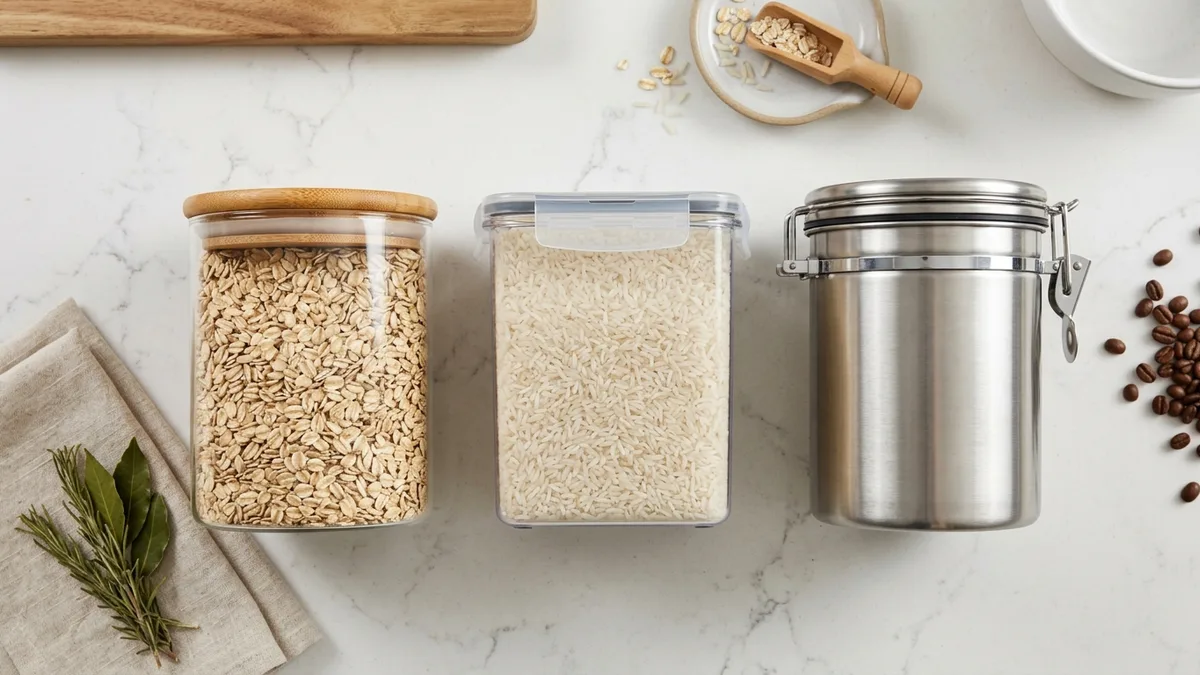
Before the detailed reviews, here is a side-by-side look at the container materials covered below.
| Container material | Best for | Strengths | Trade-offs |
|---|---|---|---|
| Clear plastic (BPA-free) | Everyday dry goods, snacks, cereal | Light, shatter-resistant, easy to see contents | Can scratch and cloud over time |
| Glass with sealed lids | Grains, pasta, baking staples | Does not absorb odors, easy to clean | Heavy and breakable on high shelves |
| Stainless steel | Coffee, tea, light-sensitive items | Blocks light, durable | You cannot see how much is left |
| Open bins and baskets | Packets, bags, grab-and-go snacks | Fast to load and pull out | Not airtight, so pair with sealed containers |
Clear BPA-Free Plastic Canisters
Best for: Everyday households, renters, families with young children, budget-conscious shoppers.
Clear plastic canisters remain the most popular choice for pantry organization, and for good reason. They are lightweight, shatter-resistant, stackable, and let you see exactly how much of an ingredient you have left without opening the lid. The most important quality checkpoint here is the BPA-free designation. Bisphenol A (BPA) is an industrial chemical that has been used in some plastics, and the U.S. Food & Drug Administration has established ongoing review processes around its use in food-contact materials. Choosing containers that are clearly marked BPA-free gives you added peace of mind, especially for dry goods your family eats every day.
What to look for in plastic pantry containers:
- Locking or snap-seal lids rather than push-on lids, which rarely create a true airtight barrier
- Squared or rectangular shapes rather than round, which waste less shelf space
- Uniform sizing within a set so containers stack cleanly and shelves look cohesive
- Wide-mouth openings that fit a standard measuring cup for easy scooping
- Dishwasher-safe ratings on both the body and lid
Typical price range: US$20 to US$60 for a set of 15 to 20 pieces, depending on size variety.
Our verdict: For most households, a high-quality BPA-free plastic canister set offers the best combination of function, durability, and value. Look for sets that include at least three size tiers, small (around 1 quart), medium (around 2 quarts), and large (4 quarts or more).
Glass Canisters with Airtight Lids
Best for: Home cooks who prioritize health and aesthetics, open shelving displays, anyone who microwaves pantry ingredients directly.
Glass pantry containers have surged in popularity as homeowners become more intentional about reducing plastic in their kitchens. Glass does not absorb odors or stains, does not leach any chemicals into food, and looks genuinely beautiful on open shelving. The trade-off is weight and fragility: a large glass canister filled with flour can be heavy, and dropping one on a tile floor is not a pleasant experience.
What to look for in glass pantry containers:
- Borosilicate or tempered glass construction for better resistance to temperature changes
- Silicone-sealed lids (bamboo, acacia, or stainless steel lids with a silicone gasket) to create a proper seal
- Flat bottoms and sides for stable stacking and labeling
- Uniform cylinder or square shape across a full set for a cohesive shelf look
Typical price range: US$30 to US$90 for a set of 6 to 12 pieces. Individual large canisters can run US$15 to US$25 each.
Our verdict: Glass canisters are a worthwhile upgrade for households that prioritize open-shelf aesthetics and minimal plastic use. They are especially practical for ingredients you reach for daily, like coffee, oats, or sugar, because they look great even when sitting on the counter.
You can explore more about glass options in our Best Food Storage Containers Glass: Complete 2026 Review & Buying Guide for an in-depth comparison.
Stainless Steel Canisters
Best for: Minimalist kitchens, UV-sensitive ingredients, long-term storage.
Stainless steel canisters are the most durable option by a significant margin. They are rust-resistant, virtually unbreakable, and protect light-sensitive ingredients like coffee, certain flours, and spices from UV degradation. The main downside is that you cannot see the contents without opening the lid, which is why consistent labeling becomes essential. Food-grade stainless steel is a naturally inert material that does not react with dry foods.
What to look for in stainless steel canisters:
- Food-grade (18/8 or 304) stainless steel designation
- Silicone-sealed lids for a genuine airtight closure
- Wide-mouth openings and smooth interiors that are easy to clean completely
- Label-friendly surfaces, either a chalkboard panel built in or a smooth matte finish that accepts adhesive labels
Typical price range: US$40 to US$120 for a set of 4 to 8 canisters.
Our verdict: Stainless steel works beautifully in minimalist and industrial-style kitchens. We recommend pairing steel canisters with a consistent labeling system since visibility is zero without opening each one.
Choosing the Right Sizes for Your Pantry Organization System
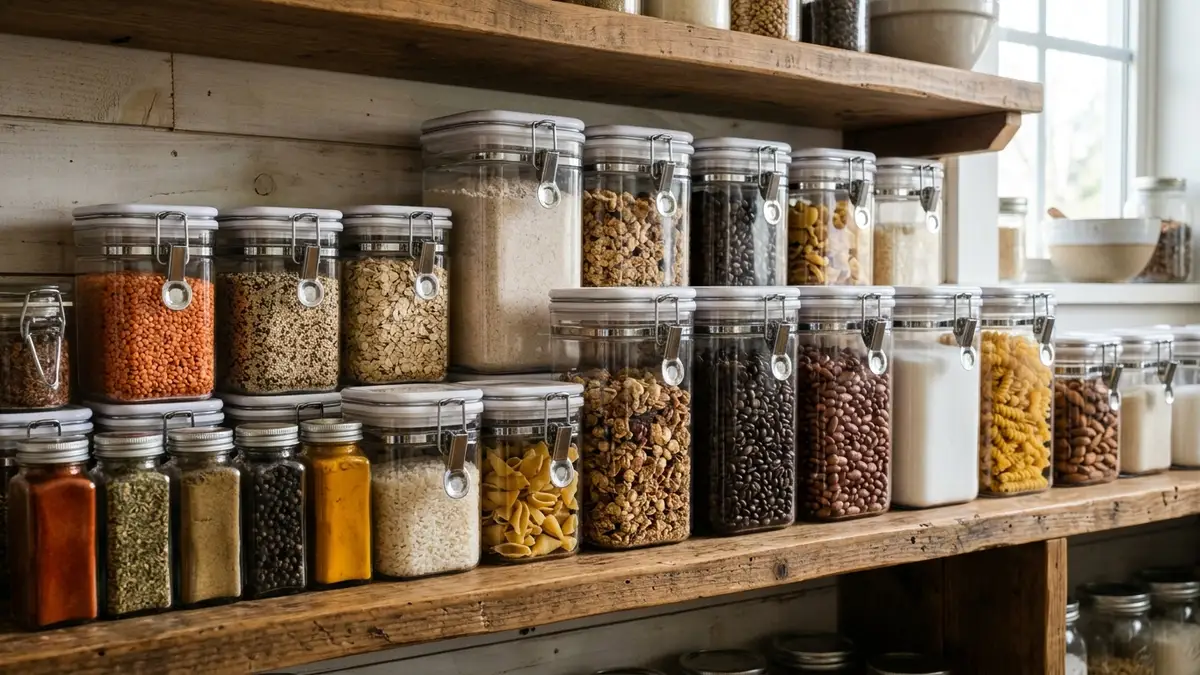
One of the biggest mistakes people make when buying pantry organization containers is purchasing a set with one or two size options and then discovering that nothing quite fits their actual ingredients. Here is a practical size guide based on common pantry staples:
Small (under 1.5 quarts)
- Spices and herbs (though a dedicated spice rack often works better)
- Baking powder, baking soda, yeast
- Nuts, seeds, dried fruit
- Protein powder (single-portion amounts)
Medium (1.5 to 3 quarts)
- Pasta and noodles
- Brown sugar and powdered sugar
- Rolled oats and granola
- Dried beans and lentils
- Breadcrumbs and panko
Large (4 quarts and above)
- All-purpose flour (a 5-pound bag fits comfortably in a 4-quart container)
- White sugar
- Rice (long-grain or jasmine)
- Cereal and popcorn kernels
- Dog kibble (if storing in the pantry)
Pro tip from the Sesoris team: Before you buy, measure your shelf depth, height between shelves, and the height of your tallest intended container. A set that looks perfect online can be a frustrating fit if your shelves are only 12 inches deep and the canister is 13 inches tall.
The Best Container Shapes for Maximum Pantry Space
Shape is not just an aesthetic decision, it is a functional one that determines how much of your shelf space you actually use.
Square and rectangular containers are the gold standard for pantry shelves. They fit together without wasted gaps, maximize every square inch of shelf real estate, and stack cleanly. If you are starting fresh, we strongly recommend going with square or rectangular sets.
Round containers look beautiful, especially in glass, but they leave dead space at every corner where containers meet. On a 12-inch-wide shelf, the cumulative wasted space across a row of round canisters can add up to several inches. They work best in open-concept displays where aesthetics are the priority.
Stackable modular sets with interlocking lids are a newer design trend in 2026. Some sets allow the base of one container to click into the lid of the one below it, creating a stable tower that does not slide around when you pull one out. These are particularly useful for deep pantry shelves where stacking is the only way to create enough storage.
According to The Spruce, the most functional pantry systems combine uniform container shapes with clear fronts and visible labels, reducing the time spent searching for ingredients during meal prep.
Labeling Your Pantry Organization Containers
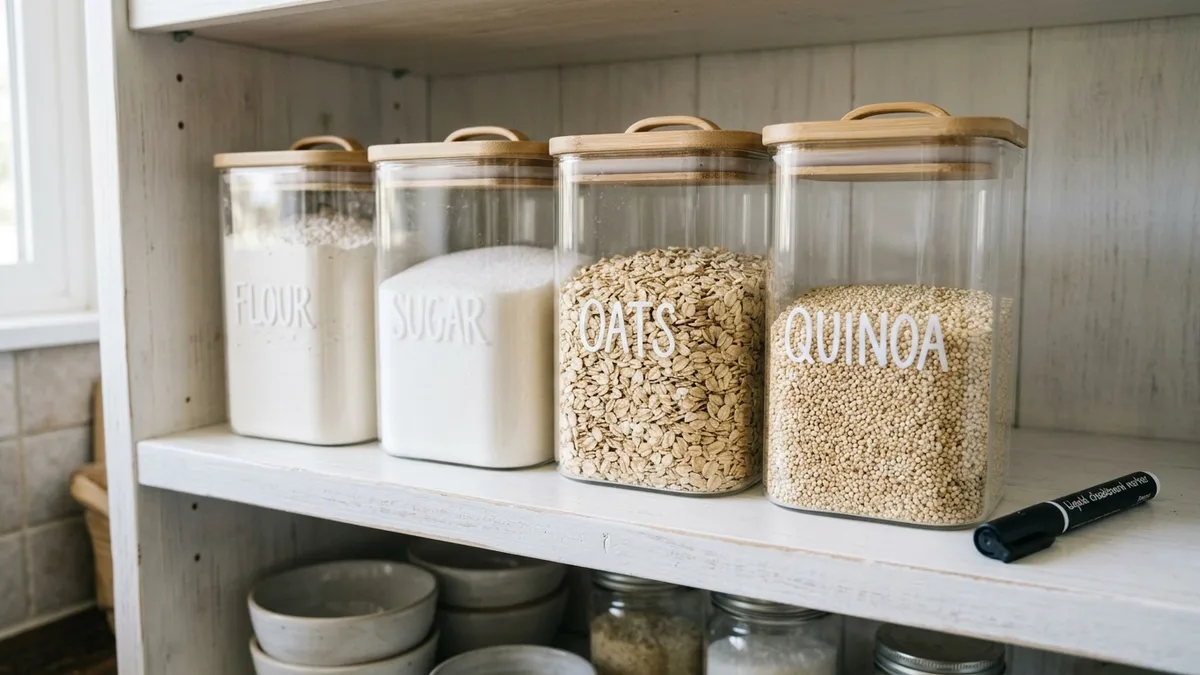
Even the best-looking container set becomes a frustration if you cannot quickly tell what is inside. Labeling is a non-negotiable step in any pantry organization system. Here are the most popular approaches in 2026:
Printed label stickers: Adhesive labels with a clean printed font are the most polished-looking option. You can print them at home using a label maker or print-on-demand service. They work best on smooth plastic and glass surfaces.
Chalkboard labels: Removable chalkboard sticker labels let you write with chalk markers and wipe clean when you change out an ingredient. These are flexible and popular for pantries where the contents rotate seasonally.
Built-in chalkboard panels: Some container sets come with a small chalkboard stripe or panel on the front. These are convenient but can feel small if you want to include the purchase date or expiration information alongside the ingredient name.
Clear window labels: Transparent labels with printed text create an almost invisible label effect that looks extremely clean on glass containers.
For a deeper dive into labeling systems, our Storage Bin Labels: The Complete 2026 Guide to a Perfectly Organized Home walks through the best printable and DIY options in detail.
Building a Complete Pantry Organization System: A Layout Guide
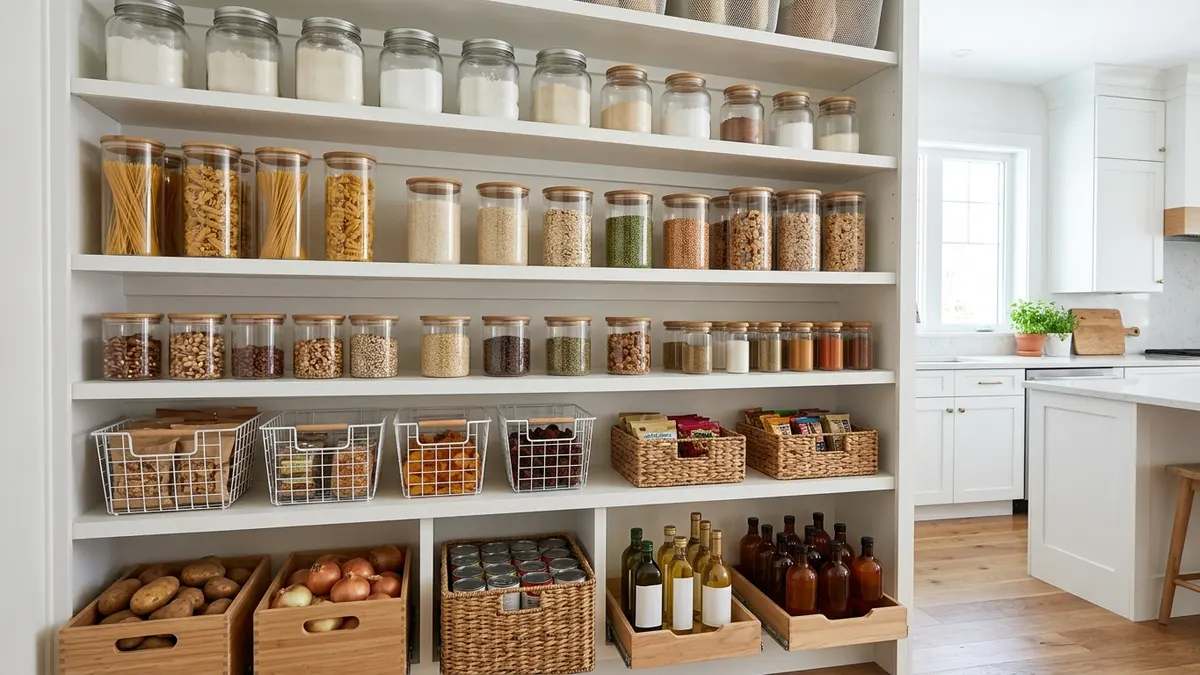
Buying great containers is only half the work. How you arrange them on your shelves determines how functional your pantry actually becomes day to day. Here is the layout system the Sesoris team recommends:
Zone Your Pantry by Category
Group ingredients by how and when you use them, not alphabetically. A functional zone layout might look like this:
- Baking zone (top shelf or eye level): flour, sugars, baking soda, baking powder, vanilla, cocoa powder
- Grains and pasta zone: rice, pasta, quinoa, oats, breadcrumbs
- Canned goods zone: keep these in their original cans, but flank them with containers of dried legumes or broth packets
- Snacks and nuts zone: granola, trail mix, dried fruit, chips in sealed canisters
- Breakfast zone: cereal, pancake mix, instant oatmeal packets
Apply the "First In, First Out" Rule
When you refill a container, always put newer ingredients behind older ones so you use the older stock first. This is the same FIFO principle used in professional food service kitchens and it dramatically reduces waste at home.
Keep Frequently Used Items at Eye Level
Reserve prime real estate for ingredients you reach for daily. Less-used specialty items can go on higher or lower shelves.
Use Pull-Out Bins for Deep Shelves
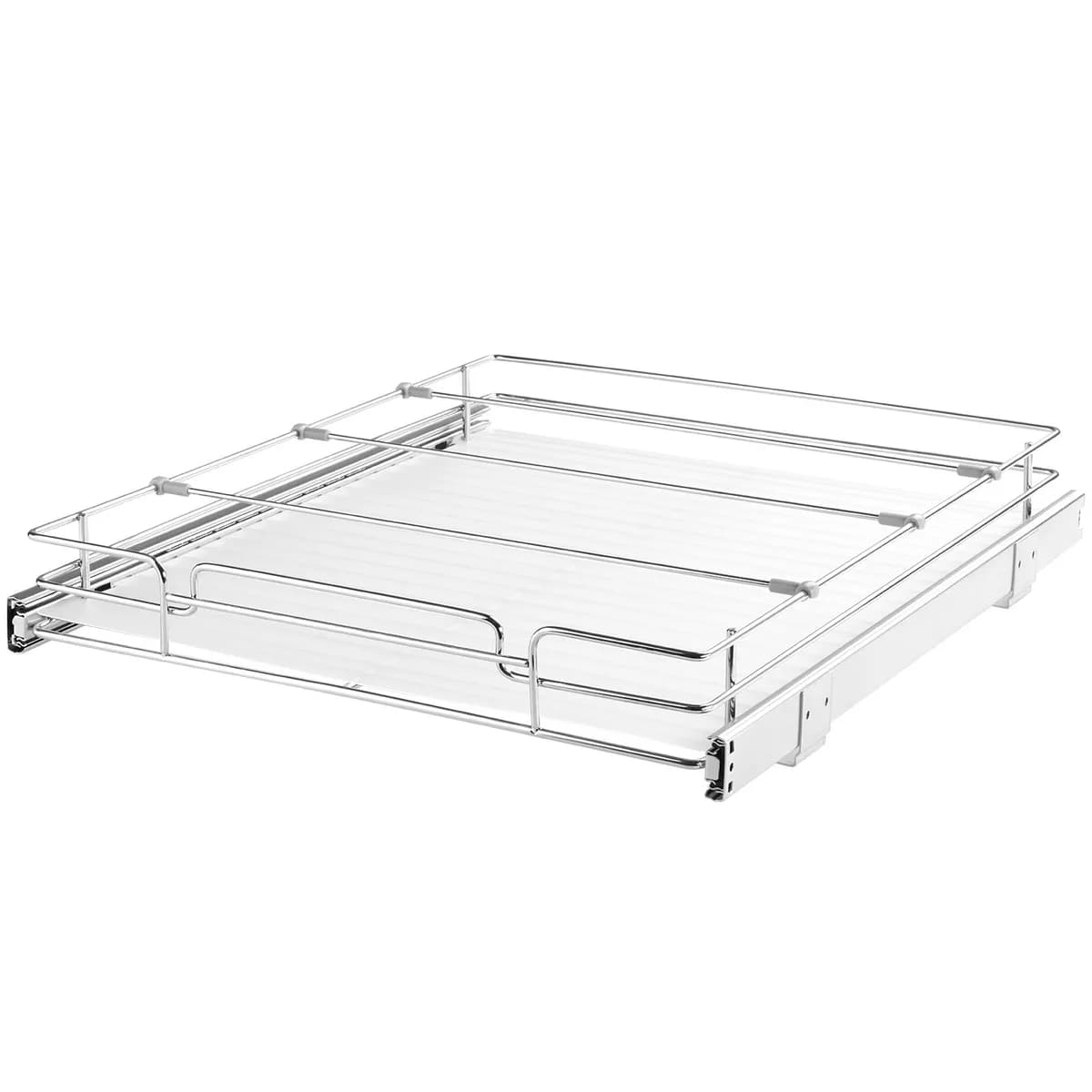
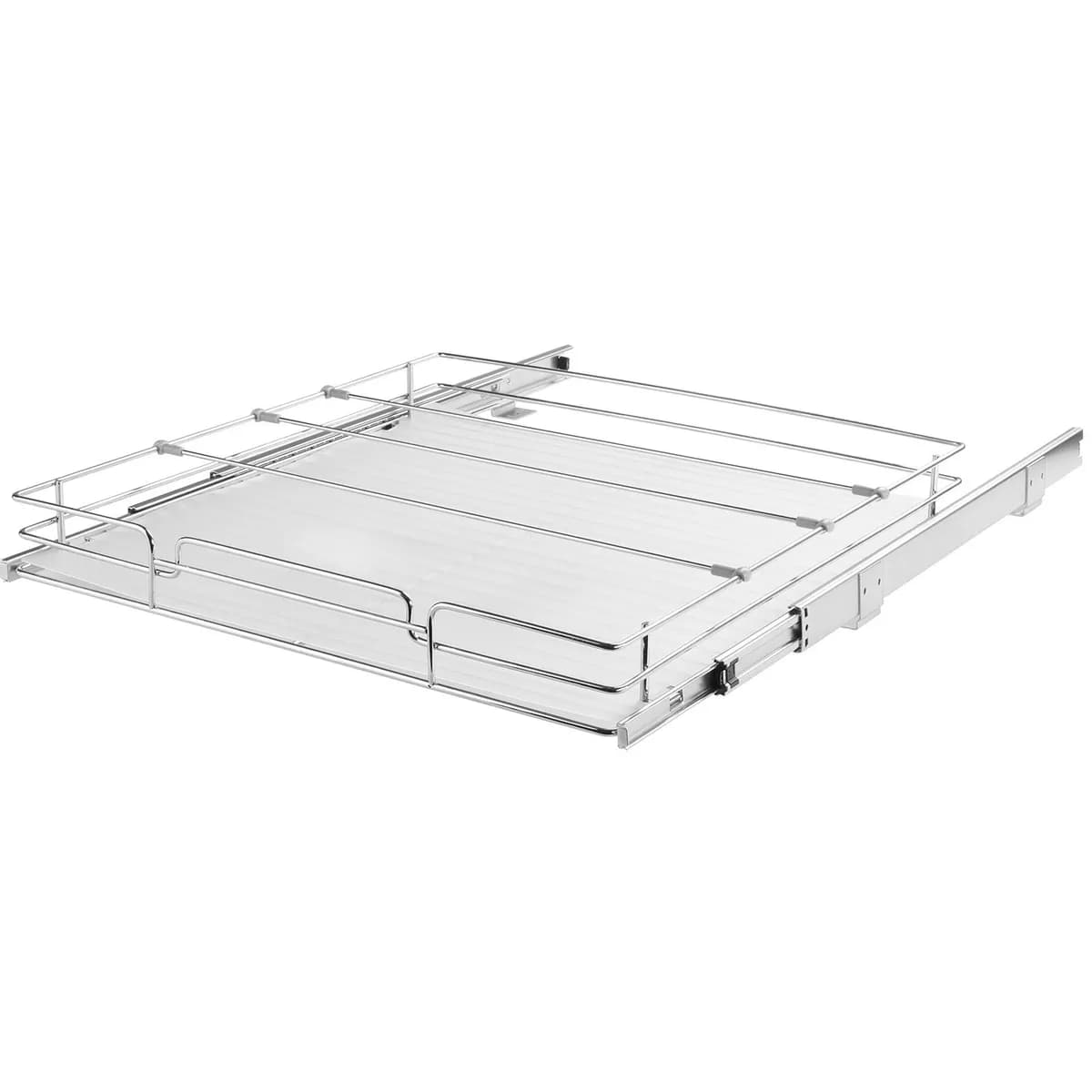
If your pantry is deep and things tend to disappear behind the front row, add one or two open-front pull-out bins or small baskets alongside your containers. These work especially well for packets, pouches, and items that do not transfer well into canisters.
For more pantry-specific layout ideas, our 30+ Best Pantry Storage Ideas to Transform Your Kitchen Organization in 2026 article is packed with visual inspiration.
Common Mistakes to Avoid When Buying Pantry Organization Containers
After years of helping home organizers find the right products, the Sesoris team has seen the same mistakes come up repeatedly. Here are the ones worth avoiding:
Buying a set without checking lid seal quality first: Many budget container sets advertise as "airtight" but use loose push-on lids with no gasket. Read reviews specifically for seal performance before purchasing.
Ignoring capacity labels: Container capacity is listed in volume (quarts or cups), not in weight. A 4-quart canister does not necessarily hold a full 5-pound bag of flour because flour compacts differently than water.
Mixing container styles mid-project: Buying half a set from one brand and topping up with a different brand's containers almost always results in sizing mismatches, lid incompatibility, and a pantry that looks cluttered rather than organized.
Skipping the measuring step: Always measure your shelf height, depth, and width before ordering. This single step prevents the most common buyer frustration.
Forgetting to account for irregular items: Not everything transfers well into canisters. Canned goods, boxed items, and pouches are better handled with open bins or designated shelf zones. Your container budget should not try to contain every single item in your pantry.
How Much Should You Spend on Pantry Organization Containers?
Pantry container costs in 2026 span a wide range, and the right budget depends on your pantry size, how many categories you need to contain, and how long you plan to keep the system.
Entry-level (US$20 to US$50 total): A basic set of 10 to 15 BPA-free plastic canisters in two or three sizes. Great for a small apartment pantry or a first organizational system. Expect solid function but less premium feel.
Mid-range (US$50 to US$150 total): A comprehensive set of 20 or more pieces with better seal quality, more size variety, and often better stackability. This is the sweet spot for most American households.
Premium (US$150 and above): Full glass or stainless steel sets with artisan lids, or large modular systems for walk-in pantries. These are long-term investments meant to last a decade or more.
For a full breakdown of pantry storage options at every price point, our Best Food Storage Solutions: Complete Guide to Organizing Your Kitchen in 2026 is a helpful companion read.
Related Products from Sesoris
If you want to turn this guide into a real setup, start with Pull-Out Cabinet Organizer, 14 in. Wide and Over-the-Door Pantry Organizer, 8 Tier. For broader options, browse the Kitchen & Dining collection so the article journey does not stop at reading only.
Our practical rule: choose one product that solves the main clutter problem first, then add supporting organizers only when the daily workflow is already clear. This keeps the shopping path useful, not pushy.
FAQ: Frequently Asked Questions About Pantry Organization Containers
Q: Are airtight containers really necessary for a pantry, or is it just marketing?
Genuinely airtight containers make a real difference for certain ingredients. Flour, for example, can absorb humidity and develop off flavors when stored in loosely closed bags. Rice and grains are vulnerable to pantry moths and weevils, which cannot penetrate a sealed container. For crackers, cereal, and other snacks, an airtight seal preserves crunch significantly longer than a resealable bag. That said, canned goods and items in sealed original packaging do not need to be transferred.
Q: How do I clean pantry containers before refilling them?
Always wash and fully dry containers before adding a fresh batch of ingredients. Residue from the previous batch can accelerate spoilage in the new one. Most plastic and glass containers are dishwasher-safe on the top rack; check manufacturer guidelines for the lids, which may need hand washing to preserve gaskets.
Q: Can I store pet food in pantry organization containers?
Yes, and many households do. Large-capacity containers (4 quarts and above) work well for kibble. Make sure to use food-grade, BPA-free containers and wash them thoroughly between refills. For dedicated pet food storage guidance, see our Airtight Pet Food Storage Containers: Ultimate Guide to Fresh Pet Food in 2026.
Q: What size pantry container holds a standard 5-pound bag of flour?
A 4-quart (roughly 1-gallon) container holds approximately 5 pounds of all-purpose flour with a little room to spare. If you buy flour in larger quantities, consider a 6-quart container to avoid overfilling, which can prevent the lid from sealing correctly.
Q: Is it safe to transfer hot ingredients directly into plastic containers?
No. Always let cooked or hot items cool to room temperature before transferring into any plastic container, even BPA-free ones. The FDA advises caution around heating food in plastics. For pantry-specific dry goods, this situation rarely arises, but it is worth keeping in mind for any multi-use container.
Q: Should I decant everything into containers or keep some items in their original packaging?
Decant the items you use often and buy in bulk, such as flour, rice, pasta, and cereal. Keep items with important cooking instructions or allergen details in their packaging, or cut out that panel and tape it to the container so the information stays with the food.
Q: How many pantry containers should I buy to start?
Start with the categories you use every week rather than a full matching set. Measure your shelf depth and height, buy containers for five to eight staples, and live with the setup for a few weeks before adding more.
Q: Are square or round containers better for a pantry?
Square and rectangular containers usually use shelf space better because they sit flush against each other and against the wall. Round containers are fine for small items or on a turntable, where their shape makes it easy to spin and reach.
Conclusion: The Right Pantry Organization Containers Make Every Day Easier
The perfect pantry organization containers are not the most expensive ones or the trendiest ones on social media. They are the ones that fit your shelves, match your lifestyle, seal reliably, and make you actually want to use your pantry the way it was designed to be used. Whether you choose BPA-free plastic for budget-friendly flexibility, glass for aesthetics and chemical peace of mind, or stainless steel for long-term durability, the key is building a consistent system where everything has a home and nothing gets lost behind a forgotten bag.
In 2026, there has never been a better time to invest in a pantry system that genuinely works for your household. Start with your most-used ingredients, measure your shelves, pick one material style, and build from there. Once the system is in place, maintaining it takes almost no effort at all.
Ready to start building your dream pantry? Explore our All Products page and browse the Collections at Sesoris for pantry containers, labels, bins, and every other organizational essential you need to live more organized.
Liked this guide?
Get new organizing guides and the occasional new product by email. No spam, unsubscribe anytime.
Related articles
Explore more articles
- Complete Home Organizer Guide: Products and Tips for a Tidy Home (2026)
- Best Indoor Plant Pots and Planters for Home Organization: Complete 2026 Review & Buying Guide
- How to Build a DIY Under-Sink Storage System: Complete Step-by-Step Tutorial for 2026
- Bamboo vs Plastic Storage: Which Material Fits Your Home?
- How to Organize a Linen Closet Step by Step: Complete Tutorial for a Tidy, Functional Space in 2026
- Ideas for Linen Closet Organization: A Practical, Source-Backed Guide for 2026
- Freezable Food Storage Containers: The Complete 2026 Guide to Safe Freezer Organization
- Food Storage Containers for Rice: The Complete 2026 Tutorial Guide to Keeping Rice Fresh