
Pen Holder Organizer Ideas: Types, Setups and How to Keep Pens Sorted
A practical guide to pen holder organizers: which type suits your desk, how to sort pens, markers and highlighters, compartment caddies, drawer trays, storing markers, and setups for home offices, kids and craft tables.
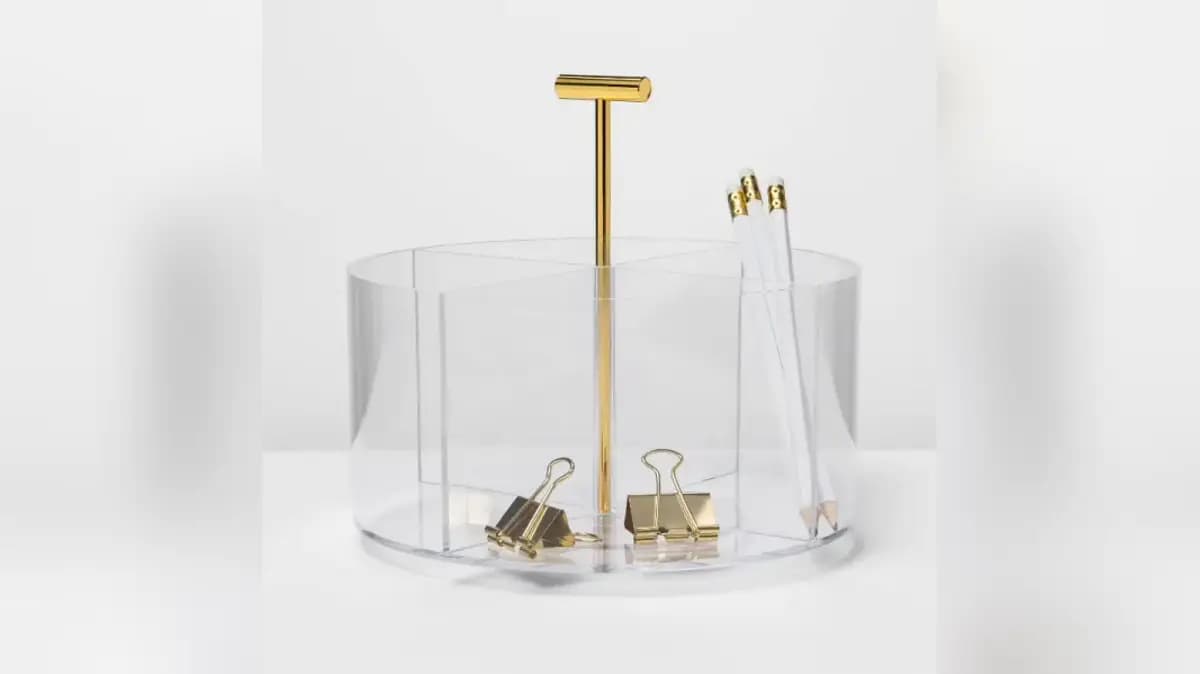
A good pen holder organizer keeps the pens you actually use within one arm's reach and stops the rest from spreading across the desk. Start by testing and culling your pens, then keep only a small daily set in a cup or compartment caddy beside your writing hand. Sort the rest by type (pens, pencils, markers, highlighters) in separate sections, store backups in a drawer tray, and do a quick reset at the end of each week.
Pens multiply quietly. A few come home from the bank, a few more arrive in conference bags, and soon there is a mug of thirty pens of which maybe five still write. A pen holder organizer fixes that by giving every writing tool a defined place and a limit. This guide covers the main types of pen holders, how to choose the right one for your desk, how to sort pens so you can grab the right one without digging, and simple setups for home offices, shared family desks, kids' homework stations and craft tables.
Types of Pen Holder Organizers Compared
There is no single best pen holder. The right one depends on how many pens you keep, how much desk space you have and whether you need to store other supplies alongside them.
| Type | Best for | Strengths | Watch out for |
|---|---|---|---|
| Single pen cup | A small daily set of pens | Takes almost no desk space, quick to grab from | Becomes a jumble past 10 to 15 pens |
| Multi-compartment caddy | Pens plus scissors, clips and sticky notes | Separates supplies by type in one footprint | Shallow sections can tip tall items |
| Round or rotating organizer | Shared desks, craft tables | Every section reachable from one spot | Takes more width than a cup |
| Mesh organizer with drawer | Home offices with many small supplies | Cups for pens, drawer for notes and clips | Mesh can let tiny items fall through gaps |
| Drawer tray | Backup pens, refills, special markers | Keeps the desktop clear | Out of sight means easy to forget |
| Wall or monitor-mounted holder | Very small desks | Frees the work surface entirely | Needs a wall rail, pegboard or monitor edge |
| Pen case or roll | Students, travel, sketching kits | Portable, protects nibs | Not ideal as a permanent desk solution |
Most desks end up with two of these: something on the desktop for daily pens and something in a drawer for everything else. For a broader view of desktop tools, our desk organizer guide compares trays, risers and file sorters.
Start by Culling Your Pens
No organizer can fix a collection that is mostly dead pens. Before you buy or rearrange anything, gather every pen, pencil, marker and highlighter from the desk, drawers, bags and kitchen junk drawer into one pile.
- Test every pen. Scribble on scrap paper. Anything that skips, blots or needs several tries goes in the discard pile. 2. Check markers and highlighters. Dried tips leave faint or streaky lines. Retire them. 3. Remove duplicates you never reach for. If you own eight identical ballpoints, keep two on the desk and move the rest to a backup tray. 4. Separate pencils. Sharpen them and decide how many you really use. 5. Set a number. Decide how many pens your daily holder will hold, then stick to it.
Many communities do not accept writing instruments in curbside recycling, so check your local rules or look for a take-back program before you throw a large batch away. The office declutter guide walks through the same process for the rest of your workspace.
Choose the Right Pen Holder for Your Desk
Once you know how many pens you are keeping, choosing a holder becomes simple. Ask four questions.
How Many Pens Do You Use Every Day?
Most people rotate through a handful of favorites. If your daily set is under ten, a single cup or a small compartment holder is enough. If you work with color-coded pens, fineliners or a full set of highlighters, choose a holder with several sections so each group stays separate.
What Else Needs a Home?
Scissors, a ruler, binder clips, sticky notes and a USB drive often live next to pens. A multi-compartment caddy handles all of them in one footprint, which is usually tidier than a pen cup surrounded by loose items.
How Much Desk Space Is Free?
Measure the area beside your writing hand. A compact organizer that is deeper than it is wide works on narrow desks. On very small desks, move pens off the surface entirely with a wall rail, a pegboard cup or a monitor-mounted holder.
Who Uses the Desk?
A shared family desk or a craft table benefits from a round organizer that everyone can reach. A solo home office can use a caddy tucked into the corner of the writing side.
Compartment Caddies: Pens Plus Everything Else
A compartment caddy is the workhorse of a tidy desk. Tall sections hold pens and scissors upright, shallow sections hold clips and pins, and some models add a small drawer for sticky notes.
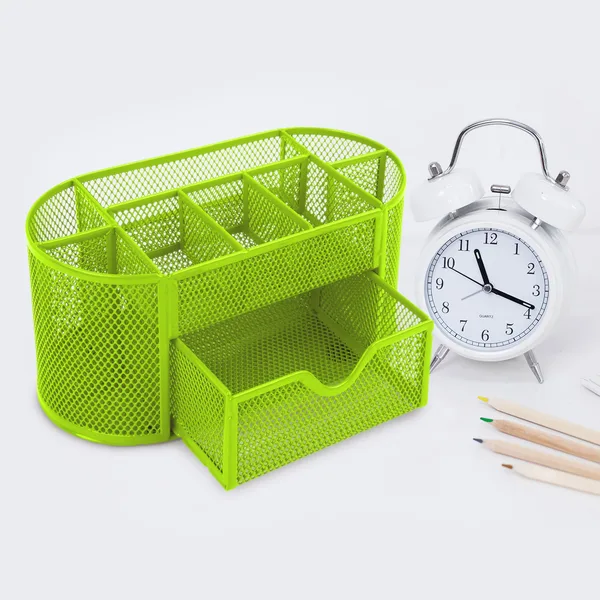
The 9-compartment mesh desk organizer is one example of this layout. It measures 8.66 x 4.33 x 4.13 inches, has four taller rounded cups for pens and scissors, four shallow sections on top for clips and tacks, and a pull-out drawer for sticky notes. Rubber feet on the base keep it from sliding when you pull a pen out.
A few rules make any caddy work better:
- One type per section. Pens in one cup, pencils in another, markers in a third. Mixed cups turn back into a jumble within days. - Tall items at the back. Scissors and rulers go in the rear sections so they do not block the shorter items in front. - Small items in the drawer, not the cups. Paper clips and push pins disappear to the bottom of a deep cup. - Leave a little room. A section packed to the brim makes it hard to pull one pen out without lifting the others.
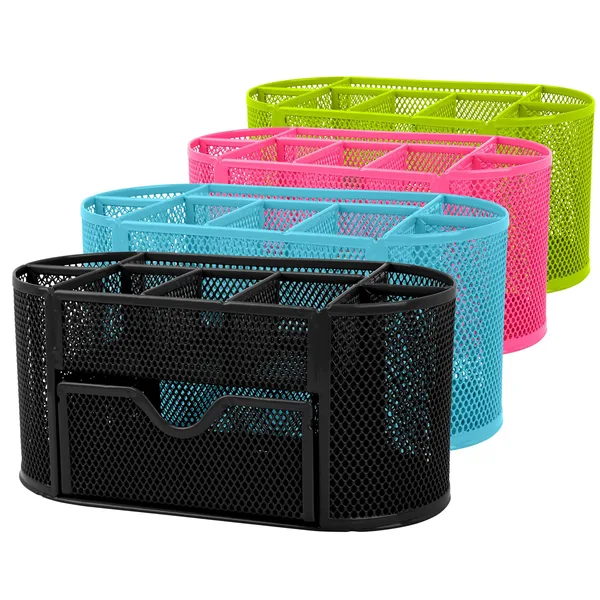
Round and Rotating Pen Organizers for Shared Spaces
When two or more people use the same table, a round organizer works better than a rectangular caddy. Every section faces outward, so a child doing homework on one side and a parent paying bills on the other can both reach the supplies they need.
The round acrylic desk organizer splits into four equal quarter sections around a center handle. Clear acrylic walls show what is in each section, and the handle lets you lift the whole thing from a desk to a craft table and back in one move.
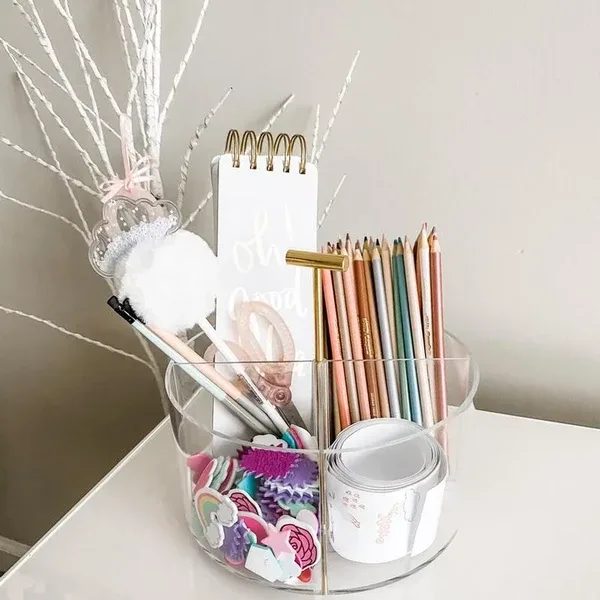
Sort a round organizer by task rather than by item type. For example:
- Section 1: everyday pens and pencils - Section 2: colored pencils or markers - Section 3: scissors, a ruler and a glue stick - Section 4: sticky notes, tape and small extras
This makes the organizer a portable kit. Carry it to the dining table for a school project, then return it to the desk when you are done. Our stationery organizer ideas show more ways to group supplies by task.
How to Sort Pens So You Always Grab the Right One
Even a perfect holder fails if the pens inside are mixed. Sorting takes five minutes and saves you from testing three pens every time you write.
| Sort by | Works best for | How to set it up |
|---|---|---|
| Type | Most home offices | Ballpoints, gel pens, pencils and markers in separate sections |
| Color | Planners, note-takers, teachers | Black and blue in front, colors grouped behind |
| Task | Shared and family desks | Writing kit, coloring kit and craft kit in separate sections |
| Frequency | Small desks | Daily pens on the desk, occasional pens in a drawer tray |
| Owner | Siblings or roommates sharing a desk | One cup or section per person, labeled |
Pick one method and stay consistent. Mixing methods, such as sorting by color in one cup and by type in another, makes the system harder to follow.
Drawer Trays for Backup Pens and Refills
The desktop should only hold the pens you use often. Everything else, from spare ballpoints to refill cartridges and specialty markers, belongs in a drawer where it stays clean and out of the way.
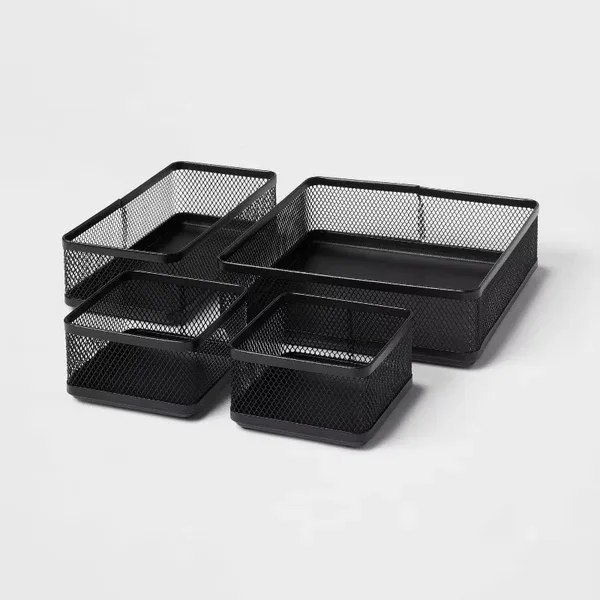
A set of trays in mixed sizes fits most desk drawers. The mesh desk drawer organizer set includes one large tray, one long narrow tray and two small square trays, with a listed set size of 8 x 8 x 4.5 inches. The long tray suits pens laid flat, the small trays suit refills and erasers, and the large tray holds notebooks or sticky note pads.
Lay backup pens flat in a long tray, all facing the same direction. You can see at a glance how many are left, and you will know when to buy more before you run out. If your drawer has turned into a catch-all, our guide to organizing a junk drawer shows how to divide the space.
Storing Markers, Highlighters and Fountain Pens
Not every writing tool should sit point-up in a cup. A few types need a little extra care.
Felt-Tip Markers and Highlighters
Many art supply makers recommend storing double-ended markers horizontally so ink stays evenly spread toward both tips. For single-ended markers, follow the manufacturer's advice on the packaging, as recommendations differ by brand and ink type. Always make sure caps click fully closed, since an open tip dries out quickly. A shallow drawer tray or a flat case is easier for horizontal storage than a cup.
Fountain Pens
Fountain pens are often stored with the nib pointing up when inked, to reduce the chance of ink pooling in the cap. Keep them capped, away from heat and direct sunlight, and in a holder with individual slots so pens do not knock against each other.
Pencils
Pencils are forgiving. Store them point-up in a cup so tips stay sharp and easy to see. Keep a small sharpener in the same section or in the caddy drawer.
Pen Holder Setups for Different Desks
The same principles apply everywhere, but the layout changes with the space.
Home Office Desk
Place a compact caddy on the side of your writing hand, about level with your keyboard. Keep five to ten daily pens, a highlighter, scissors and sticky notes on top. Backups go in a drawer tray directly below. Our home office desk organization tips cover the rest of the work surface.
Small or Shared Desk
When space is tight, go vertical. A pegboard cup, a wall rail with hanging pots or a holder that clips to the side of a monitor stand keeps the work surface free. See office wall shelf ideas for wall layouts that include supply storage.
Kids' Homework Station
Children reach for whatever is easiest, so make the right tools the easiest. Use a round organizer or a caddy with clear sections, keep only working pencils and a small set of colors, and add a label or picture to each section for younger kids. A weekly reset with the child teaches them where things go.
Craft Table
Craft tables need more sections and more color sorting. Group markers, colored pencils and gel pens by color family, keep cutting tools in their own section and use a portable organizer you can move between projects. Our stationery organizer ideas include several craft-friendly setups.
Gaming or Computer Desk
Even keyboard-first desks need a pen and a notepad. A single slim cup beside the monitor is enough. Pair it with a cable management setup so the cup does not compete with cords.
Choosing a Material
Pen holders come in a handful of common materials, and each one behaves a little differently on a desk.
- Acrylic and clear plastic. You can see every pen without lifting anything, which helps when you sort by color. Wipe with a soft damp cloth, since abrasive cleaners can scratch clear surfaces. - Metal mesh. Light, sturdy and easy to dust. Look for rubber or foam feet so the holder does not slide or scratch the desk, and keep tiny items like push pins in solid-bottom sections. - Wood and bamboo. Warm and heavy enough to stay put. Choose a finished surface so ink marks wipe off. - Ceramic. Heavy and stable, a good choice for a single cup. It can chip if knocked off the desk. - Fabric and felt. Quiet and soft, useful inside drawers or bags, but harder to clean when a pen leaks.
Match the material to the rest of the desk so the holder looks like part of the setup rather than an afterthought.
Simple DIY Pen Holder Ideas
You do not need to buy a dedicated organizer to get started. A few household items work well as a first step:
- Clean glass jars. Small jam or spice jars make clear pen cups. Group several on a tray for a multi-section holder. - Cut cardboard tubes. Paper towel tubes cut to different heights and glued to a cardboard base create a quick caddy. Not durable, but useful for testing a layout before you buy. - Mugs you no longer drink from. A heavy mug is hard to tip over. - Small storage boxes. Lidded clear boxes keep refills and erasers together inside a drawer.
DIY holders are great for testing how many sections you really need. Once you know, a purpose-made organizer usually looks tidier and lasts longer.
Keeping Your Pen Holder Organized
A pen holder stays useful only if it stays curated. Build three small habits:
- Return pens at the end of the day. Pens left on the desk end up in bags and coat pockets. 2. Weekly test. Once a week, scribble with each daily pen. Replace any that skip from your backup tray. 3. One in, one out. When a new pen comes home, an older or less-loved one moves to backup or goes away.
Keep a scrap notepad near the holder for testing, and the habit takes seconds. For more routines that keep a workspace calm, read our office organization ideas.
Frequently Asked Questions
What is the best pen holder organizer for a small desk?
A compact multi-compartment caddy or a wall-mounted holder works best. A caddy keeps pens, scissors and clips in one small footprint, while a wall or monitor-mounted holder frees the desktop entirely.
How many pens should I keep on my desk?
Keep only the pens you use regularly, typically a small daily set of about five to ten. Store backups in a drawer tray and replace daily pens when they run dry.
Should pens be stored point up or point down?
Ballpoint and gel pens with caps or retractable tips are usually fine point-up in a cup, which also makes them easier to grab. For markers and fountain pens, follow the manufacturer's storage advice, since some are best stored horizontally or nib-up.
How do I store markers so they do not dry out?
Make sure every cap clicks fully closed and store markers away from heat and sunlight. Many double-ended markers are best stored flat so ink stays balanced between both tips.
What is the difference between a pen cup and a desk caddy?
A pen cup is a single open container for writing tools. A desk caddy has several sections, often with a drawer, so it can hold pens alongside scissors, clips and sticky notes without mixing them.
How do I organize pens for a shared family desk?
Use a round organizer that everyone can reach, sort sections by task or by person and label each section. Keep backups in a drawer so the desktop stays clear.
Where should a pen holder go on a desk?
Place it on the side of your writing hand, within easy reach and roughly level with your keyboard or notebook, so you can grab a pen without stretching or turning.
What can I use as a DIY pen holder?
Clean glass jars, sturdy mugs, cut cardboard tubes on a base or small clear boxes all work. They are useful for testing how many sections you need before buying a dedicated organizer.
Final Thoughts
The best pen holder organizer starts with fewer pens. Test and cull your collection, choose a holder that matches how many pens you use and what else needs a home, sort by one simple method and keep backups in a drawer tray. A compartment caddy suits most home offices, a round organizer suits shared and craft tables, and wall or monitor holders rescue tiny desks. Add a weekly test-and-reset habit and your pens will stay sorted. For the rest of your workspace, see our guide on how to organize your desk.
Liked this guide?
Get new organizing guides and the occasional new product by email. No spam, unsubscribe anytime.
Related articles


Explore more articles
- How to Build a Custom Under-Stair Storage System: Complete Step-by-Step Tutorial for 2026
- Bamboo vs Plastic Storage: Which Material Fits Your Home?
- Morning Routine Organization: How a Structured Start Transforms Your Entire Day in 2026
- How to Choose and Install Shelf on Wall Ideas That Actually Work in 2026
- Bathroom Storage Solutions: The Complete 2026 Tutorial Guide to a Tidy, Organized Bathroom
- 30+ Best Under Staircase Storage Ideas to Transform Dead Space in 2026
- Organization Laundry Room: 30+ Smart Tips to Transform Your Space in 2026
- Food Storage Containers with Lids: The Complete 2026 Guide to Fresh, Organized Kitchens