
Under Bed Shoe Storage Ideas: How to Measure, Choose Containers and Keep Shoes Dry
Under bed shoe storage ideas: how to measure clearance, which containers suit low and raised beds, layout and labeling, keeping stored shoes clean and dry, and what to do when the bed is too low.
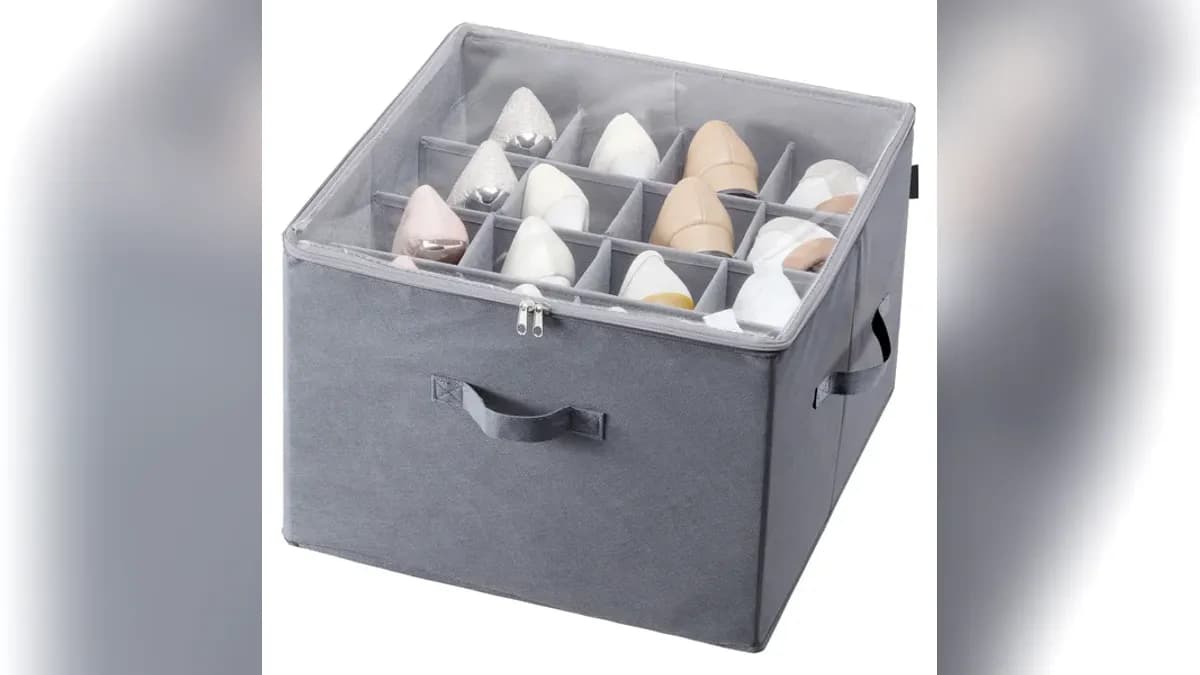
The best under bed shoe storage ideas start with one number: the clearance between the floor and the bed frame. Measure it, then choose a container that is at least half an inch lower. Low flat bins with lids or zippered fabric boxes suit standard frames, rolling drawers make heavy loads easy to pull out, and taller compartment boxes fit raised or storage-friendly beds. Keep everyday pairs near the edge of the bed, seasonal pairs toward the middle, and only store shoes that are clean and completely dry.
The space under a bed is one of the largest unused storage areas in most bedrooms. It is also one of the easiest places to lose track of things. A pile of loose sneakers pushed under the frame collects dust, gets tangled with cables and is hard to reach. A planned system, on the other hand, can hold a whole season of shoes and still let you pick out the pair you want in a few seconds. This guide explains how to measure, which containers work best for which shoes, how to lay out the space and how to keep shoes in good condition while they are out of sight.
Measure the Space First
Every under-bed system depends on three measurements. Take them before you buy anything.
- Clearance height. Measure from the floor to the lowest part of the frame or the side rail, not to the mattress. Slats, center supports and bed skirts can make the usable height lower than it looks. 2. Usable depth. Measure from the edge of the bed to the center support or the wall. Most people can reach comfortably about halfway under a bed, so anything stored deeper than that needs a handle or wheels. 3. Usable width. Check where the legs and any center legs sit. A container that blocks a leg will not slide in straight.
Write the numbers down and subtract at least half an inch from the height for clearance. That small gap is what lets a box slide out without scraping the frame. If your flooring is carpet, subtract a little more, since boxes sit lower into the pile and drag harder.
Also check what is already under the bed. Power strips, phone chargers and cords should stay reachable and should not be crushed by boxes. Our guide to under bed storage covers the whole space, not only shoes.
Choose the Right Container
The container is the whole system. Picking the wrong one is the most common reason under-bed storage ends up as a tangle.
| Container type | Best for | Typical strengths | Watch out for |
|---|---|---|---|
| Low plastic bin with lid | Flats, sandals, sneakers on standard frames | Rigid, stackable, easy to wipe | Lids can be hard to lift if the bin sits deep under the frame |
| Zippered fabric box with clear lid | Mixed pairs you want to see at a glance | Light, folds flat when empty, keeps dust out | Needs more height; soft sides sag if overloaded |
| Rolling drawer on casters | Heavy loads, boots, frequent access | Pulls out smoothly, no lifting | Wheels add height; check clearance carefully |
| Compartment organizer with dividers | Many pairs of similar size | Every pair has a slot, nothing touches | Fixed slots may not fit large sneakers or boots |
| Flat shoe bag with handles | Very low frames, occasional shoes | Fits tight gaps, inexpensive | Little protection from crushing |
| Vacuum or compression bag | Not recommended for shoes | Saves space for soft textiles | Crushes shoe shapes and traps moisture |
A clear lid or window is worth paying attention to. When you can see the shoes without opening the box, you are much more likely to actually wear what you stored. For a broader comparison of bins, rolling drawers and bags, see our under-bed storage containers buying guide.
Compartment Boxes for Raised Beds
If your bed sits high off the floor, a deeper box with movable dividers can hold far more than a low tray.
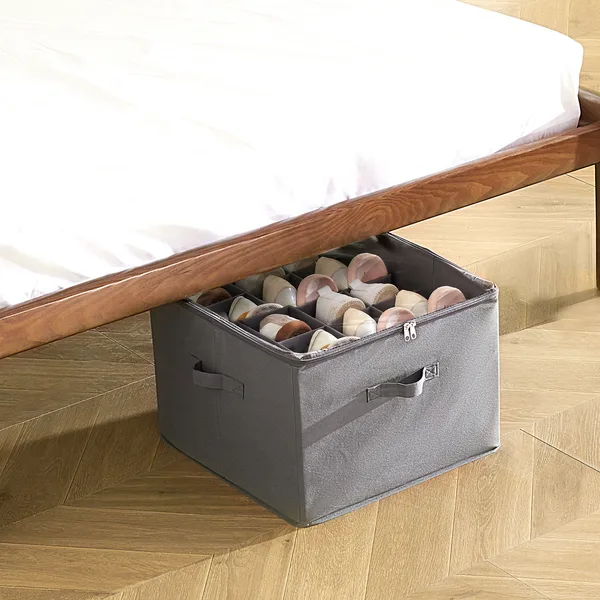
The under-bed shoe storage box has 16 compartments with movable dividers inside a gray non-woven fabric box. It measures 17 x 17 x 12.4 inches, so it needs a bed with at least that much clearance plus a small gap. That makes it a good match for raised frames, platform beds with open legs and loft beds, and a poor match for low frames.
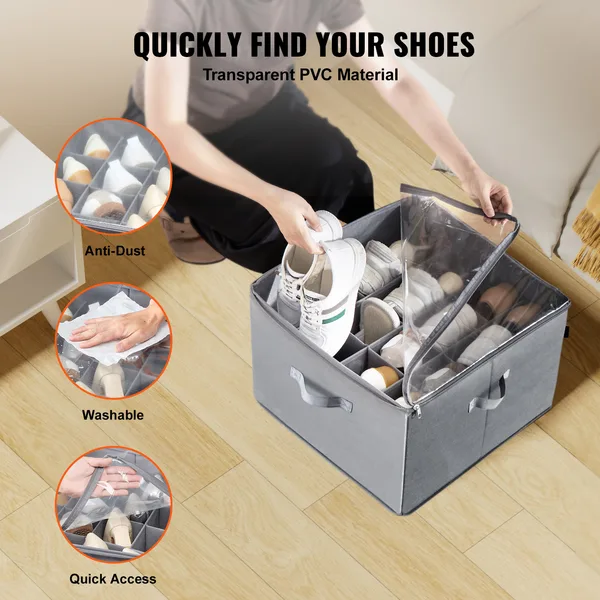
The clear PVC lid zips closed to keep dust out and lets you see every pair without opening it. Fabric handles on the sides help you pull the box out from under the frame. Because the dividers move, you can make some compartments wider for sneakers and keep narrow slots for flats and sandals.
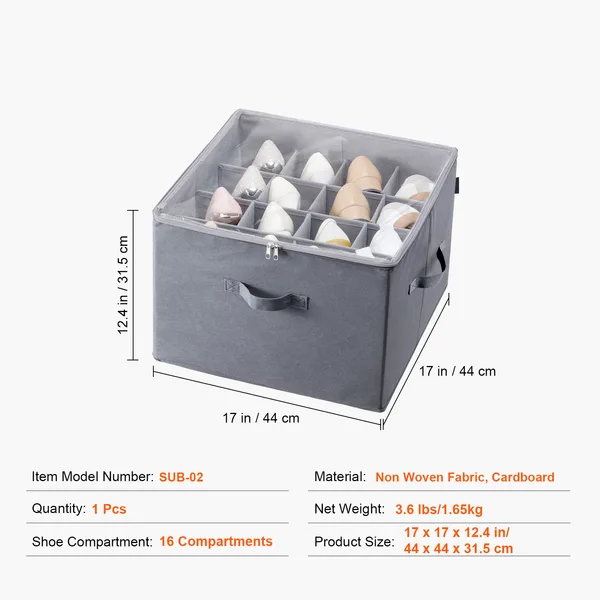
Use the dimensions as your check against the clearance you measured. If the box is a few inches too tall for your bed, it still works well on a closet shelf, the floor of a wardrobe or the bottom of a linen closet.
Low Bins and Flat Bags for Standard Frames
Many bed frames sit lower than a deep compartment box. In that case, go flat.
- Low lidded bins hold four to eight pairs laid side by side, depending on size. Store pairs heel to toe so they nest and use less width. - Flat zippered bags with a clear top and handles slide into very tight gaps. They protect against dust but not against weight, so do not store anything on top of them. - Shallow drawers on low casters combine the easy pull of a rolling drawer with a low profile. Measure the height including the wheels.
For low frames, store flats, ballet shoes, sandals and slippers under the bed, and keep chunky sneakers and boots elsewhere. Thick soles alone can rule out a low container.
Raise the Bed for More Room
If you love the idea of under-bed shoe storage but your frame is too low, you can gain height.
- Bed risers lift the legs of the frame by several inches. Choose sturdy risers sized for the leg shape, and place them on a level floor so the bed does not wobble. - A new frame with taller legs or an open platform frame often gives more usable height than an older low frame. - A storage bed with built-in drawers replaces separate containers entirely, which is useful in very small rooms.
Raising a bed changes how high you sit and climb in, so test the new height before committing. Our bedroom storage ideas look at other ways to add storage when the bed is not the answer.
Plan the Layout Under the Bed
Once you have containers, think about where each one goes.
- Front edge for everyday shoes. The pairs you wear every week go in the box closest to the side of the bed you get up from. 2. Middle for seasonal shoes. Sandals in winter and boots in summer can sit deeper under the frame. 3. Foot of the bed for rarely used pairs. Formal shoes and shoes for special events can go in the hardest-to-reach spot. 4. Leave a pull path. Do not put one box in front of another unless both have wheels or handles you can reach.
Label each container on the side that faces out, so you can find the right box without pulling every one. A label with the season or the type of shoe is enough.
Sort Shoes Before You Store Them
Under-bed storage works best for shoes you have already sorted. Go through the pile once and make three groups:
- Wear often: these may not belong under the bed at all. A rack by the door or in the closet is faster for daily shoes. - Wear seasonally or occasionally: the ideal group for under-bed storage. - Do not wear: donate, recycle or discard shoes that no longer fit, hurt or are worn out.
This step often reduces the number of pairs enough that a single container fits everything. Our home decluttering tips walk through the same sorting method for the rest of the house.
Keep Shoes Clean and Dry Before Storing
Storing shoes in a closed box for months can trap dirt and moisture. A few minutes of preparation prevents odors and damage.
- Clean the soles. Wipe or brush off dirt and grit so it does not spread to other shoes or the box. - Let shoes dry fully. Shoes that were worn in rain or snow, or after exercise, should dry at room temperature before going into a closed container. - Keep the room's humidity in check. The US Environmental Protection Agency recommends keeping indoor humidity below 60 percent, ideally between 30 and 50 percent, to limit mold growth, according to its guide to mold and moisture. - Do not seal damp shoes in plastic. Plastic and vacuum bags trap moisture. Breathable fabric boxes are a better choice for long storage. - Stuff delicate shoes. Soft paper inside the toe helps shoes keep their shape while stored.
If a room tends to be damp, check stored shoes every month or two, and open the box to air it out.
Protect Different Types of Shoes
Not every pair needs the same treatment under the bed.
| Shoe type | Under-bed approach |
|---|---|
| Sneakers | Wider compartments or a low bin laid side by side; keep laces tucked in |
| Flats and sandals | Narrow slots or heel-to-toe in a flat bin; ideal for low frames |
| Dress shoes and heels | Separate slots so heels do not scratch other pairs |
| Boots | Usually too tall; store short boots on their sides in a rolling drawer, keep tall boots elsewhere |
| Kids' shoes | Small compartments; one box per child makes it easy to see what fits |
| Slippers | A soft flat bag near the edge of the bed for quick access |
Leather shoes in particular benefit from airflow, so a fabric box with a mesh or clear breathable top is better than a sealed plastic tub for long periods.
When Under the Bed Is Not Enough
Sometimes the bed simply cannot hold everything, or the room has no clearance at all. Other spaces nearby can take the overflow.
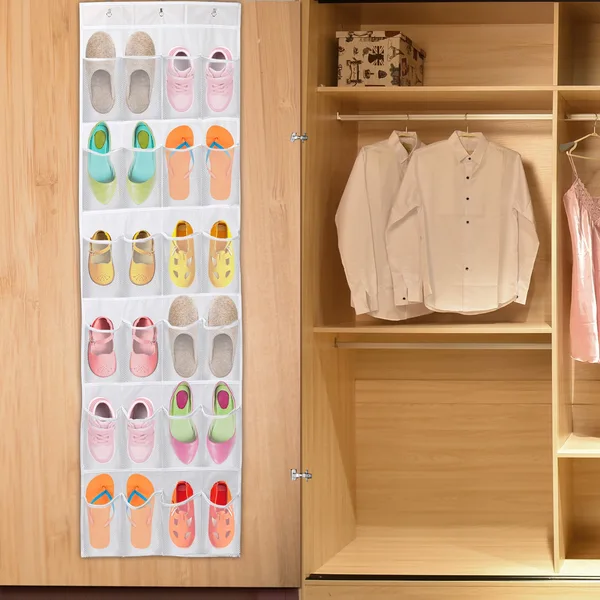
The back of a bedroom or wardrobe door is a good partner to under-bed storage. The 24-pocket over-the-door shoe organizer has clear pockets about 7.87 x 4.25 inches, sized for women's and kids' shoes rather than large sneakers or boots. Put small daily shoes on the door and seasonal pairs under the bed, and both stay easy to reach.
Other good partners include a slim rack in the closet, a shelf at the top of a wardrobe and a bench with a shoe shelf. Our shoe storage ideas for the bedroom and hidden shoe storage ideas cover these options in detail, and ideas for shoe storage in a small closet help if the closet is tight.
Ideas for Kids' Rooms and Dorms
Under-bed shoe storage is especially useful in shared and small rooms.
- Kids' rooms: a low, light container with handles lets children put their own shoes away. Use picture labels for young children. Our children's shoe storage ideas and kids bedroom storage ideas have more options. - Dorm rooms: many dorm beds can be raised, which creates a lot of space underneath. A tall compartment box fits well there, alongside other bins. See our under-bed storage ideas for dorm rooms for planning the whole space. - Guest rooms: store your own off-season shoes under the guest bed, then pull the boxes out when visitors need the space.
Budget-Friendly Under-Bed Shoe Ideas
You do not need to buy a full set of containers on day one. Start with what you have and add pieces as the system proves itself.
- Reuse shallow boxes. Sturdy shoe boxes or low gift boxes with the lids cut into a flap work for a few pairs of flats. Label the outward end. - Make a slide-out tray. A large, low tray or the lid of an old storage tub becomes a simple sled. Add a strap or ribbon to the front so you can pull it out. - Add felt pads. Stick furniture felt pads under hard bins so they glide over wood or tile without scratching the floor. - Use one good container for the most-used pairs. Spend on a single quality box for the shoes you reach for most, and use free boxes for the rest. - Group by color or use. Putting all the running shoes together, or all the neutral flats together, makes finding the right pair faster even in simple boxes.
Test the setup for a few weeks. If you keep pulling out the same box, it may deserve wheels or a better spot near the edge of the bed.
Mistakes to Avoid
A few habits undo even the best container.
- Buying before measuring. A box that is half an inch too tall will not fit at all. - Storing loose shoes. Loose pairs get separated, collect dust and slide out of reach. - Overfilling soft boxes. Too many pairs squash the sides and make zippers hard to close. - Stacking on top of shoe boxes. Under the bed, there is no room to stack, so keep one layer. - Forgetting what is stored. Without labels or clear lids, under-bed shoes are easy to forget, and you end up buying pairs you already own.
Keep the System Working
Under-bed storage only stays useful if you maintain it.
- Swap seasonally. Twice a year, move the next season's shoes to the front and push the off-season pairs back. 2. Vacuum under the bed when you swap. It keeps dust off the containers and the floor. 3. Do a quick edit each season. Remove pairs you did not wear and decide whether to keep them. 4. Keep a one-in, one-out rule. When a new pair arrives, an old pair leaves.
For more ways to organize the rest of the room, see our bedroom organization ideas, the broader ideas for shoe storage and our collection of shoe rack ideas.
Frequently Asked Questions
How do you store shoes under a bed?
Measure the clearance under the frame, choose a lidded container at least half an inch lower, sort shoes so only seasonal or occasional pairs go under the bed, and make sure each pair is clean and dry. Keep everyday shoes near the edge and label each container.
How much space do I need under the bed for shoe storage?
It depends on the container and the shoes. Flats and sandals fit in low flat bins, while a deep compartment box such as one measuring 12.4 inches tall needs a raised frame. Always measure to the lowest part of the frame, not the mattress.
Is it bad to store shoes under the bed?
No, as long as the shoes are clean and dry and stored in a container that keeps dust out. Avoid sealing damp shoes in plastic, and check stored pairs every month or two in humid rooms.
What is the best under bed shoe storage for low beds?
Flat zippered bags with handles, shallow lidded bins and low-profile rolling drawers. Store flats, sandals and slippers there, and keep thick sneakers and boots elsewhere.
Can I store boots under the bed?
Short boots can lie on their side in a rolling drawer or deep box if the clearance allows. Tall boots usually need a closet shelf, a boot rack or a tall organizer instead.
Should under-bed shoe storage be plastic or fabric?
Plastic bins are rigid and easy to wipe, while breathable fabric boxes let air move and are better for long storage of leather shoes. In damp rooms, fabric with a clear lid is usually the safer choice.
How do I stop shoes under the bed from getting dusty?
Use containers with lids or zippered tops, vacuum under the bed when you rotate seasonal shoes, and wipe the containers occasionally.
How can I get more room under my bed for shoes?
Use sturdy bed risers to lift the frame, switch to a frame with taller legs or an open platform design, or choose a storage bed with built-in drawers.
Final Thoughts
Under-bed shoe storage is simple once the measuring is done. Pick containers that fit the clearance, keep everyday pairs near the edge and seasonal pairs deeper, and store only clean, dry shoes. With clear lids and labels, the space under your bed becomes a reliable shoe closet that keeps the floor clear and every pair easy to find.
Liked this guide?
Get new organizing guides and the occasional new product by email. No spam, unsubscribe anytime.
Related articles

Explore more articles
- Stainless Steel Food Storage Containers: The Complete 2026 Tutorial Guide to Durable, Healthy Kitchen Organization
- Food Storage Containers with Lid: The Complete 2026 Buyer's Guide to Fresh, Organized Kitchens
- Pyrex Food Storage Containers: The Complete 2026 Guide to Safe, Durable Kitchen Organization
- 30+ Best Open Shelving Kitchen Ideas to Transform Your Cooking Space in 2026
- 30+ Best Corner Shelf Ideas to Transform Every Room in Your Home in 2026
- Pegboard Garage Organization: The Complete 2026 Guide to a Clutter-Free, Functional Garage
- Office Organization Ideas: Complete 2026 Guide to a Productive, Clutter-Free Workplace
- How to Build DIY Closet Shelves: Step-by-Step Tutorial for a More Organized Home in 2026