
Wire Shelf Pantry Organization Ideas: 12 Fixes That Make Wire Shelves Work
Wire shelf pantry organization ideas that stop tipping jars and lost cans: liners, bins, risers, door racks, zones and a simple plan for heavy items.
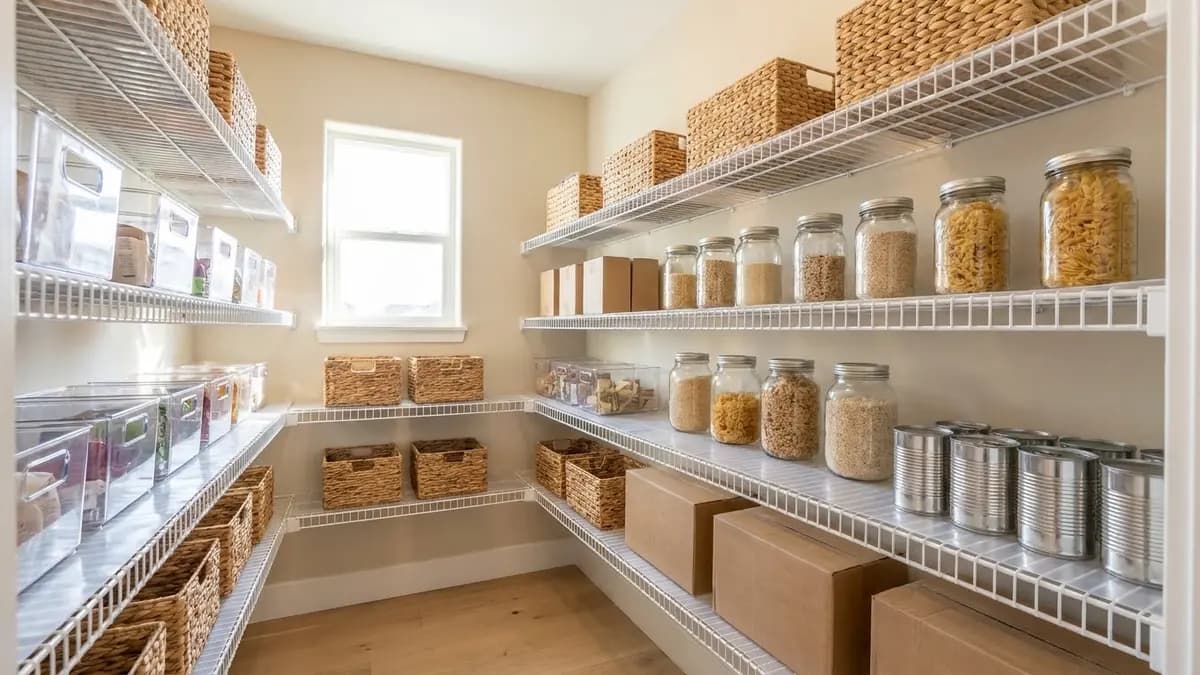
The best wire shelf pantry organization ideas cover the gaps first, then group food into bins you can pull out like drawers. A clear shelf liner stops jars and spice bottles from tipping, handled bins bring the back of each shelf within reach, and heavy cans and bottles go on the lowest levels. With those three moves in place, a wire pantry can be just as tidy and easy to use as one with solid wood shelves.
This guide walks through 12 practical fixes, a zone plan for every shelf height, the best containers for wire, and the mistakes that make wire shelving feel messy. If you are starting the whole pantry from scratch, our pantry organization ideas give you the big picture, and this article stays focused on making wire shelves work.
Why Wire Pantry Shelves Feel So Messy
Ventilated wire shelving is common in American closets and pantries because it is quick to install, it lets air move around food, and it does not hold dust the way a solid shelf can. Light passes through it too, so you can often see what is on the shelf above. Those are real advantages, and there is no need to tear the shelving out to get an organized pantry.
The problems come from the gaps between the wires. Narrow jars, spice bottles and small packets wobble or tip over, and anything with a small base can slip partway through. Lids catch on the wires when you slide items out. Many wire shelves also have a curved front lip that makes the front edge awkward to use. On top of that, wire pantries are often deep, so food at the back disappears from view.
Every fix in this guide targets one of those issues. Cover the gaps, give small items a flat base, bring the back of the shelf forward, and put weight where the shelf is strongest. You do not need special tools, and most of the changes can be undone if you move.
Start With an Empty Shelf and a Plan
Organizing works best when you can see everything at once. Empty one section of the pantry at a time onto a table, wipe the wires, and check dates while you are there. Toss anything expired, and set aside duplicates you can use up first. This step also tells you what kinds of containers you actually need, so you do not buy a stack of bins that do not fit.
Then measure. Note the depth of each shelf, the height between shelves, and the width of each bay between the uprights. Write these down, because bins are sold in many sizes and the most common mistake is a bin that is a little too tall or a little too deep. Measure the door opening too if you plan to hang an over-the-door rack.
Finally, sort the food into groups that match how you cook: breakfast, baking, snacks, pasta and grains, canned goods, sauces and oils, drinks and backstock. Each group will get its own spot, and ideally its own bin. If labels help your household stick to the system, our guide to storage bin labels shows simple ways to make them.
12 Wire Shelf Pantry Organization Ideas
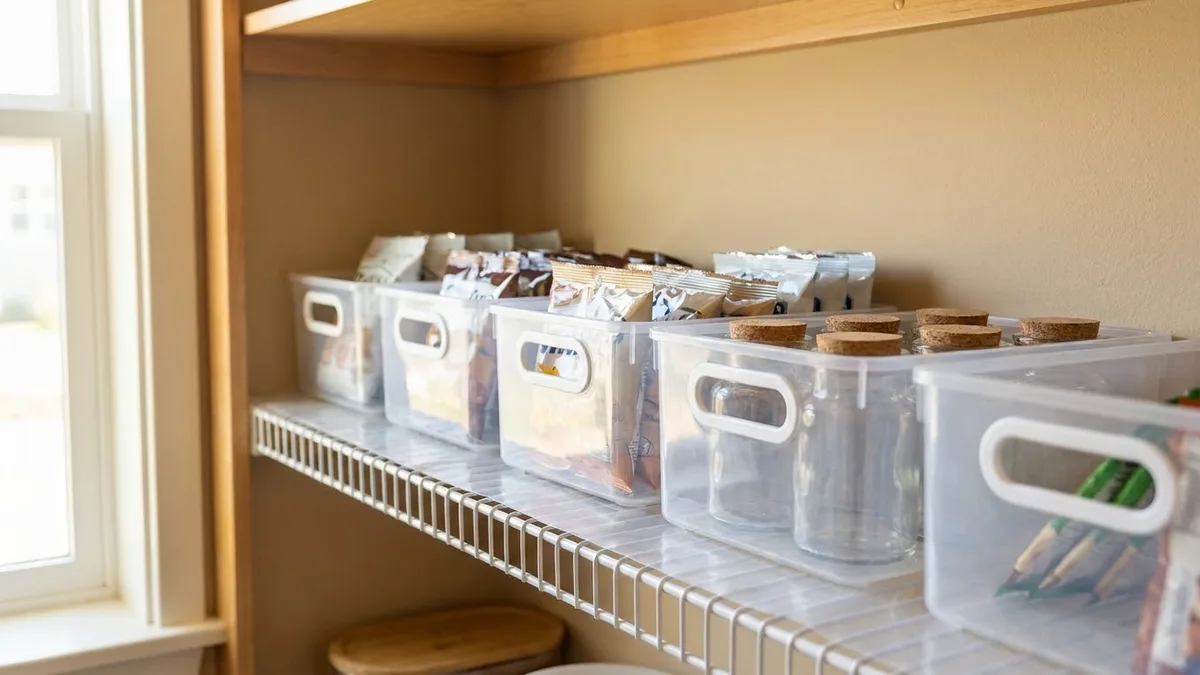
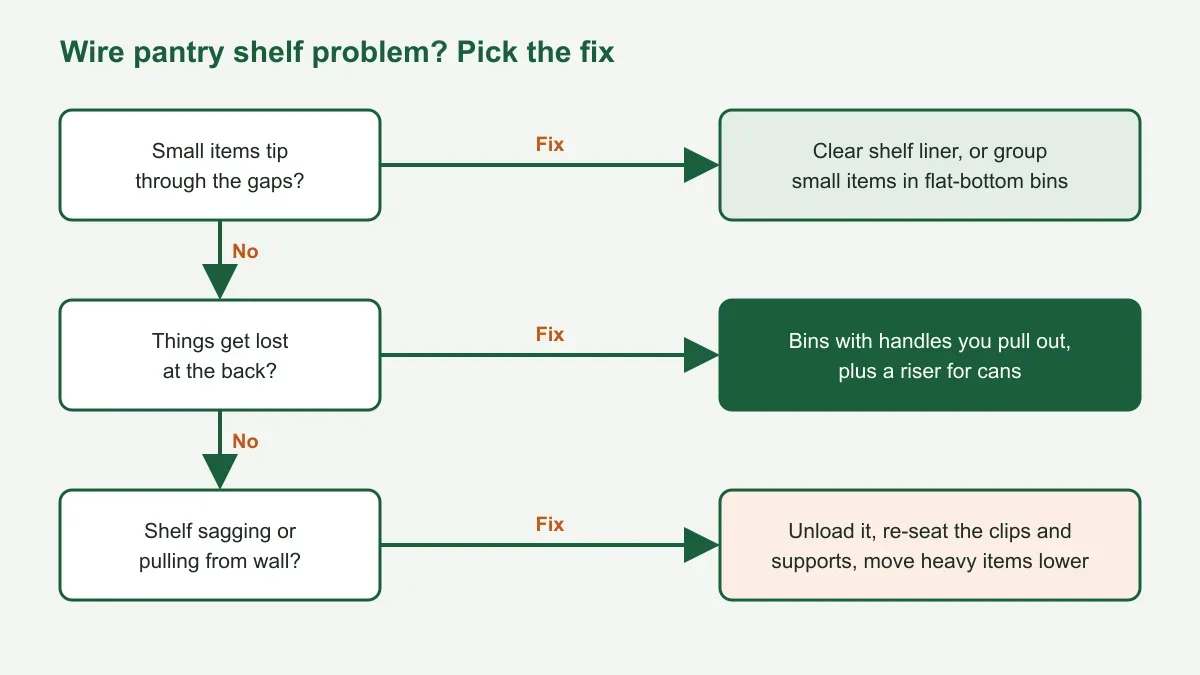
- Add a clear shelf liner. A liner laid over the wires gives every shelf a flat surface, so jars and bottles stand steady. Clear liners keep the light-through benefit of wire, and they are easy to lift out and wipe.
- Use flat-bottomed bins for small items. Spice jars, seasoning packets and sauce pouches belong in a bin, not loose on the wires. A bin becomes the flat base, and you lift the whole group out at once.
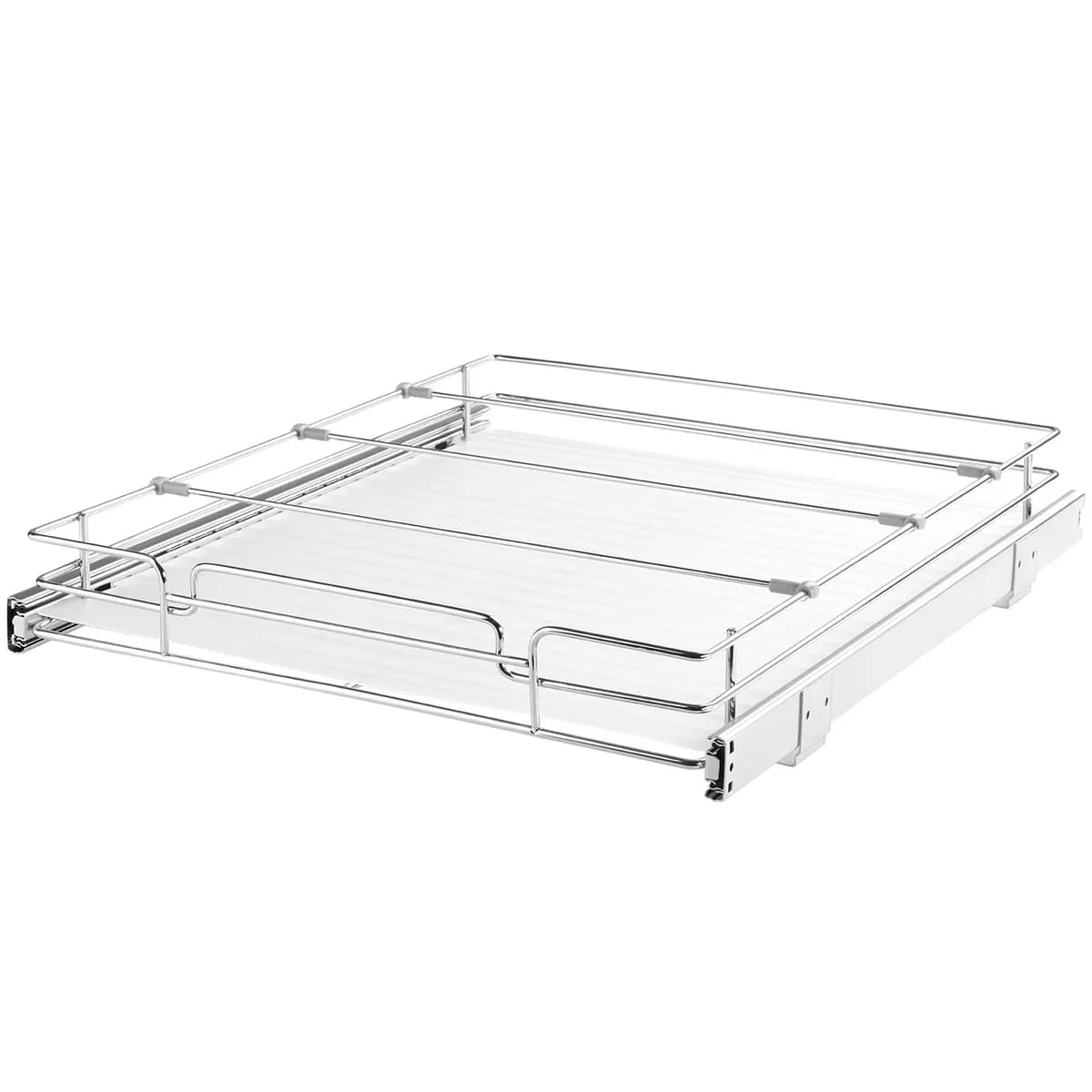
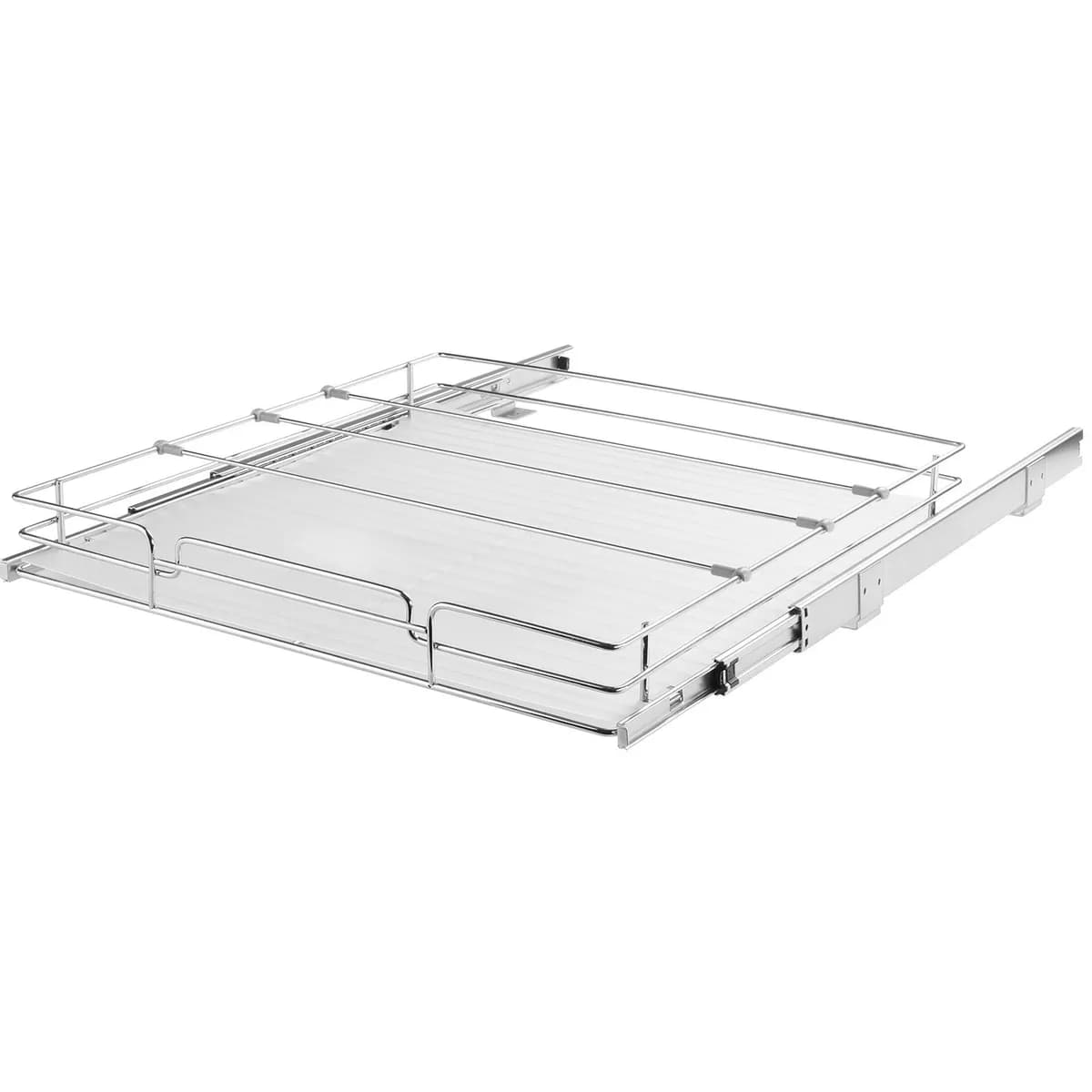
- Choose bins with handles. On a deep shelf, a bin with a front handle works like a drawer. You pull it forward, grab what you need and push it back, and nothing is lost behind it. Our pantry organization bins guide compares the main bin types.
- Put a riser on the can shelf. A tiered riser lifts the back row of cans so you can read every label. It also sits flat across the wires, so cans do not roll.
- Group drinks and heavy jars on the lowest shelf. Bottles, large jars and bulk bags are the heaviest things in a pantry. Keep them low, where the shelf is easiest to reach and the load is safest.
- Turn the curved front lip into a label rail. Clip-on labels along the front edge tell everyone where things belong, which helps the system last longer than a weekend.
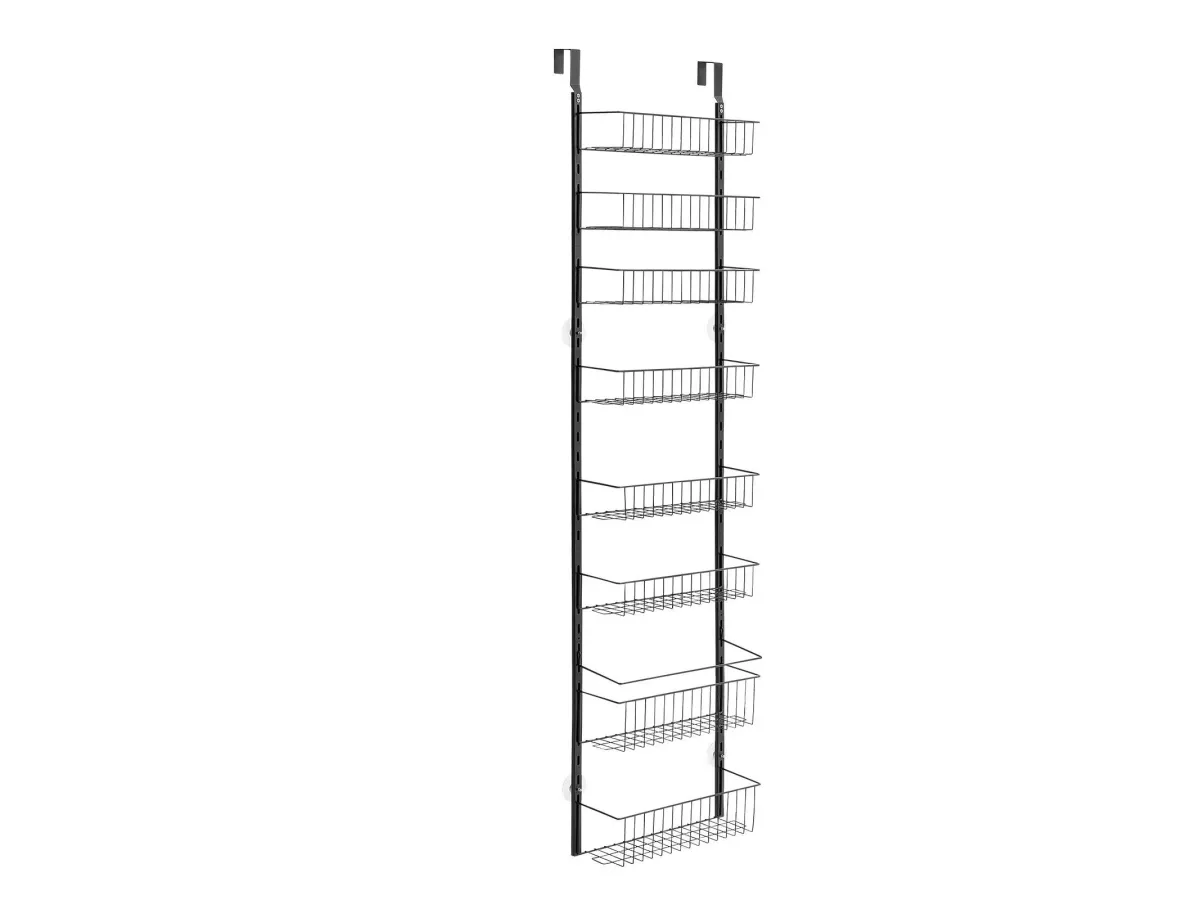
- Hang an over-the-door rack. The back of the pantry door is free storage for spices, snacks and small jars. A rack with wire baskets on adjustable tiers, like our over-the-door pantry organizer, keeps small items off the main shelves.
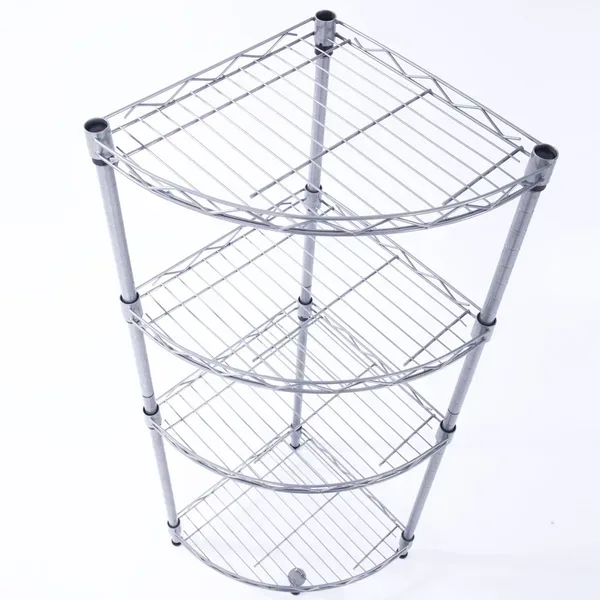
- Fill a corner with a corner shelf. The inside corners of an L-shaped or U-shaped pantry are often wasted. A freestanding corner unit such as our 4-tier corner wire shelf turns that dead space into four extra levels.
- Decant dry goods into clear containers. Flour, rice, pasta and cereal in clear, flat-based containers stand steady on a liner and show you when you are running low. Our guide to glass containers for food storage explains the trade-offs between glass and plastic.
- Use baskets for bags and odd shapes. Chips, bread and bags of snacks do not stack well. A basket keeps them together and stops them from sliding through the front gap.
- Add under-shelf baskets. Baskets that hook onto the shelf above use the empty air between shelves for foil, wraps and small packets. Check that they fit the wire spacing before you buy.
- Keep backstock up high and out of the way. Extra paper towels, spare packs and seasonal baking supplies can go on the top shelf, where they are out of the way but still visible through the wires.
Containers That Work Best on Wire
Not every container suits a wire shelf. The table below compares the common choices on how well they sit on wires and what they are best at holding.
| Container | Sits well on bare wire? | Best for | Watch-out |
|---|---|---|---|
| Clear bin with handle | Yes, flat base | Snacks, packets, baking supplies | Measure depth so it does not overhang |
| Woven or wire basket | Yes | Bags of chips, bread, produce that keeps at room temperature | Small items can still fall through a wire basket |
| Tiered can riser | Yes | Canned goods | Check the width fits between uprights |
| Clear canister | Best on a liner | Flour, rice, pasta, cereal | Narrow bases wobble on bare wire |
| Spice jars | Only in a bin or on a liner | Spices and seasonings | Tip easily through gaps |
| Glass jars | Best on a liner | Home-canned food, bulk dry goods | Heavy, so keep low |
If you only buy one thing, make it a liner. It solves the tipping problem for every container at once, and it costs far less than a full set of new bins.
A Zone Plan for Every Shelf Height
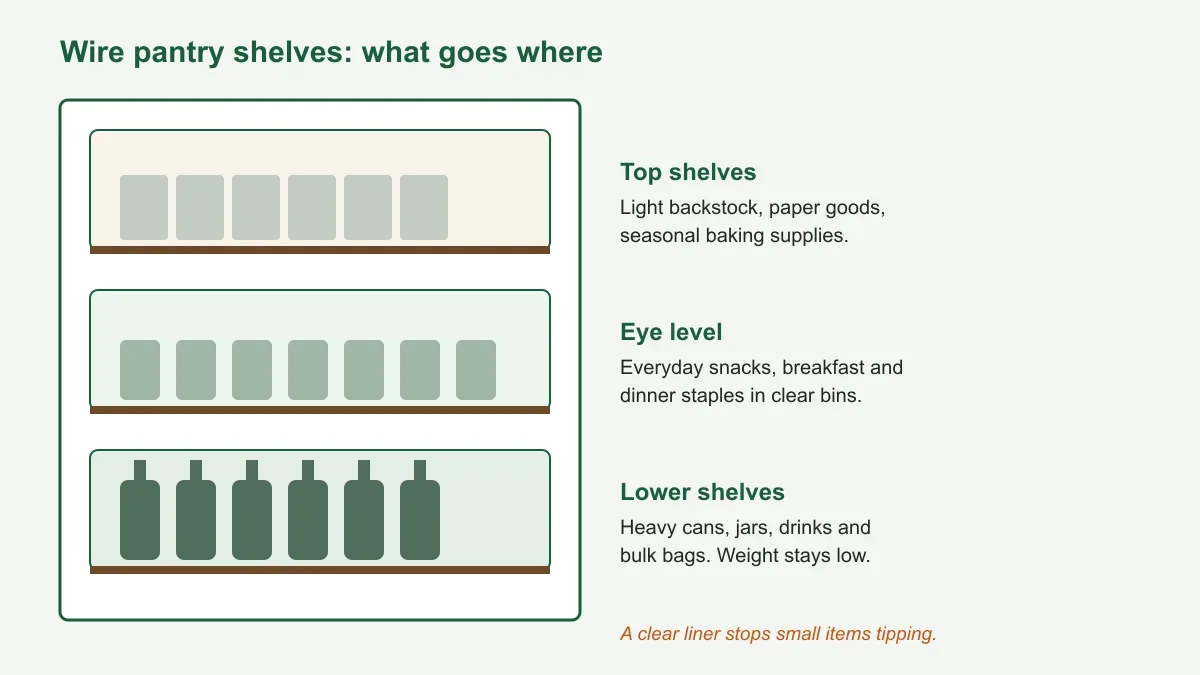
A pantry stays tidy when every shelf has a clear job. Use height to decide what goes where. The things you reach for every day belong between your waist and your eyes. Heavy items belong low. Light backstock goes up high.
| Shelf height | What to keep there | Why |
|---|---|---|
| Top shelves | Paper goods, backstock, seasonal baking supplies | Light and rarely used |
| Eye level | Breakfast, snacks, pasta and dinner staples | Easy to see and reach every day |
| Waist level | Baking bins, oils and sauces | Easy to lift out to the counter |
| Lower shelves | Cans, jars, drinks, bulk bags | Heavy items are safer low |
| Floor | Bulk water, pet food, a step stool | Too heavy or bulky for shelves |
Children's snacks can go on a low shelf they can reach on their own, which takes pressure off the rest of the pantry. If space is tight, see our small pantry ideas for ways to fit these zones into a reach-in closet.
Storing Jars and Home-Canned Food on Wire
Glass jars are heavy and fragile, so they need a flat, steady surface and a low shelf. A liner is the minimum. For home-canned food, the National Center for Home Food Preservation advises that you label and date the jars and store them in a clean, cool, dark, dry place, and it gives 50 to 70 °F as the range for best quality.
The same source warns against stacking jars too high on top of each other, noting that one manufacturer recommends no more than two layers, with support between layers. On a wire shelf, that means a single row on a liner is usually the better choice. Keep the jar shelf away from a water heater, an oven wall or a sunny window, since heat and light shorten quality.
When the Shelf Itself Is the Problem
Sometimes the shelf, not the food, is the issue. A wire shelf that sags, tilts forward or pulls away from the wall needs attention before you add bins. Unload it completely. Check that every wall clip and support bracket is still seated and that the shelf sits fully in its supports. Then reload it with the heaviest items on the lower shelves.
If the shelf keeps pulling loose, the fixings may not be holding in the wall. That is a repair job, not an organizing one. Follow the manufacturer's instructions for the shelving system, or ask a handyman to re-fix the supports into studs. Do not hang extra baskets from a shelf that is already struggling.
Make the Most of Corners and Doors
Corners and doors are where wire pantries usually waste the most space. In a walk-in or L-shaped pantry, the shelves often meet in a corner that is hard to reach. A freestanding corner unit or a lazy Susan fills that corner with something you can actually use. Our walk-in pantry organization ideas show how to plan a larger space around those corners.
The door is the other big opportunity. An over-the-door rack holds dozens of small items that would otherwise wobble on the main shelves. Before you buy one, check that the door closes with the rack in place and that the shelves inside do not block it. Put the lightest items on the rack, such as spices, tea and snack packets, and keep jars on the shelves.
Keep It Organized Week to Week
The best system is the one that survives a busy week. Put new groceries behind the older ones, so the oldest food gets used first. Keep one empty spot on each shelf, because a shelf packed edge to edge is the first to fall apart. A quick five-minute reset once a week, pushing bins back and wiping the liner, keeps the pantry looking the way it did on day one.
Write a simple shopping list on the inside of the door or on your phone, and note things as they run low. If spices are your weak spot, our guide on how to organize a spice drawer covers an alternative to keeping them in the pantry at all. For a deeper reset, follow our step-by-step pantry organizing tutorial.
Common Mistakes to Avoid
- Putting narrow jars straight on bare wire. They wobble and tip. Use a liner or a bin.
- Buying bins before measuring. Depth and height between shelves vary, so measure first.
- Storing heavy items up high. Cans and jars belong on the lowest shelves.
- Filling every inch. A full shelf leaves no room to put things back.
- Ignoring the door and corners. They are often the biggest source of extra storage.
- Overloading a sagging shelf. Fix the supports before you add more weight.
For more ideas on shelving layouts, our pantry shelving ideas compare wire, wood and adjustable systems, and our pantry storage ideas cover containers and racks for every type of pantry.
Frequently Asked Questions
How do you organize a pantry with wire shelves?
Cover the wires with a clear shelf liner, group small items in flat-bottomed bins with handles, put cans on a tiered riser, and keep heavy jars and drinks on the lowest shelves. Use the door and corners for extra storage.
How do you keep things from falling through wire shelves?
Lay a clear shelf liner over the wires to create a flat surface, or store small items such as spice jars and packets inside a bin. The bin becomes the base, so nothing can tip through the gaps.
What can I put on wire shelves to make them flat?
A shelf liner made for wire shelving is the simplest option. Clear liners keep light passing through and lift out for cleaning. Some people use cut-to-size boards, but a liner is lighter and easier to remove.
What containers work best on wire pantry shelves?
Flat-bottomed bins with handles, baskets for bags of snacks, tiered risers for cans, and clear canisters for dry goods. Narrow jars and canisters work best on a liner, since they can wobble on bare wire.
Should heavy items go on the top or bottom pantry shelf?
The bottom. Cans, jars, drinks and bulk bags are the heaviest things in a pantry, and they are safer and easier to lift from a low shelf. Keep the top shelves for light backstock and paper goods.
How should I store home-canned jars on a wire shelf?
On a liner, in a single row, on a low shelf away from heat and sun. The National Center for Home Food Preservation advises a clean, cool, dark, dry place and gives 50 to 70 °F as the range for best quality.
How do you use the corners of a wire pantry?
Add a freestanding corner shelf or a lazy Susan so you can reach items without moving everything in front. Corner units with quarter-round shelves fit neatly into the space where two runs of shelving meet.
Why does my wire pantry shelf sag?
The shelf may be overloaded or a wall clip or support may have come loose. Unload it, check that every clip and bracket is seated, then reload with heavy items lower. If it keeps pulling loose, have the supports re-fixed.
Final Thoughts
Wire pantry shelves are not the enemy of an organized kitchen. Cover the gaps with a liner, give small items a bin, put weight low and use the door and corners. Those simple changes turn a wobbly, cluttered wire pantry into one where you can see what you have and reach it in seconds.
Liked this guide?
Get new organizing guides and the occasional new product by email. No spam, unsubscribe anytime.
Related articles

Explore more articles
- Stainless Steel Food Storage Containers: Ultimate Guide to Durable Food Storage in 2026
- 20 Essential Travel Accessories That Make Your Journey More Comfortable (2026)
- Pyrex Glass Food Storage Containers: The Complete Guide to Premium Kitchen Storage in 2026
- Recessed Wall Shelf Ideas: 15 Built-In Niches for Every Room
- Home Office Wall Organization Systems: Pegboards, Rails, Grids and Shelves
- How to Organize Your Pantry Step by Step: Complete Tutorial for a Functional, Clutter-Free Kitchen in 2026
- How to Build a DIY Under-Sink Storage System: Complete Step-by-Step Tutorial for 2026
- Lidded Box vs Open Basket Storage: Which Keeps Items Easier to Use?